Artwork
Untitled
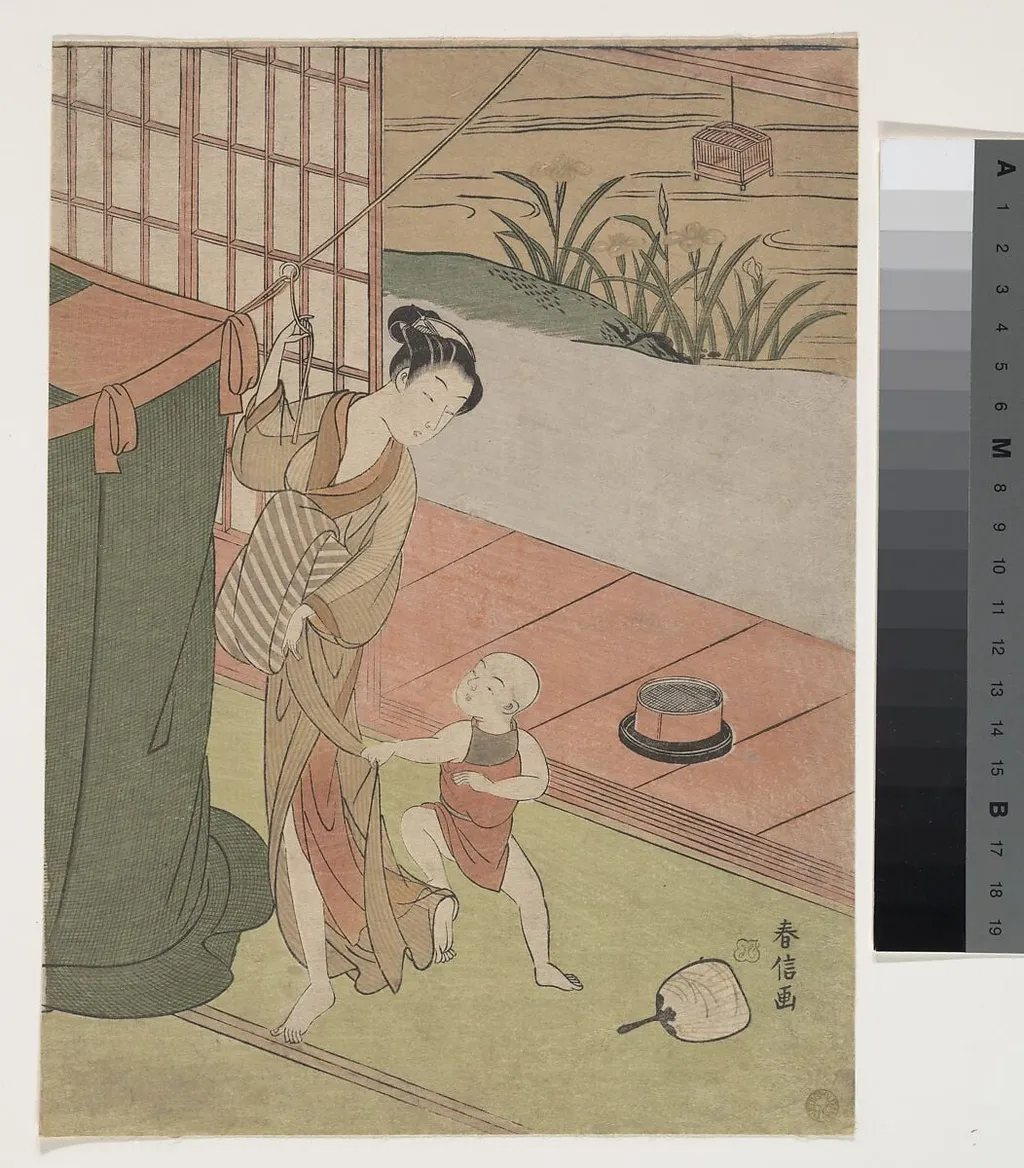
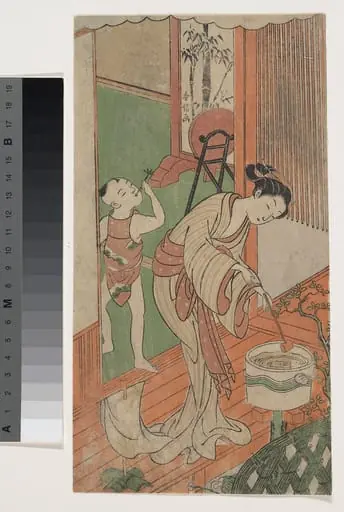
Untitled is an ink print by the Romanticist artist Suzuki Harunobu. It dates from 1769 and is held in the collection of the Metropolitan Museum of Art.
- Accession no.
- JP565
- Credit line
- Purchase, Joseph Pulitzer Bequest, 1918
About this work
Subject & Meaning
Together these elements transform a simple mother-and-child vignette into a quietly charged image, characteristic of Harunobu's 1769 nishiki-e production.
The print depicts a domestic scene centered on a mother and child enclosed together beneath a mosquito net, a motif closely associated with the ukiyo-e sub-genre of abuna-e, or "dangerous pictures," which used suggestive, intimate imagery to appeal to ukiyo-e's largely male audience. The child holds an insect cage, while a sieve and a uchiwa (flat fan) appear nearby, reinforcing the everyday, indoor setting of a summer night. Classified as a kodomo-e, or "picture of children," the work uses the tender pairing of parent and offspring as its primary subject, blending the sensual undertones of abuna-e with the charming appeal of child imagery that Harunobu helped popularize.
The mosquito net functions both as a literal domestic fixture and as an iconographic device, signaling privacy, intimacy, and the warm-weather season, while the insect cage and sieve evoke the small amusements and routines of childhood. Together these elements transform a simple mother-and-child vignette into a quietly charged image, characteristic of Harunobu's 1769 nishiki-e production.
Technique & Style
The work is an ōban-format nishiki-e woodblock print produced in 1769, employing polychrome pigments applied through the keyblock-and-bokashi technique characteristic of Harunobu’s mature style.
Handling shows delicate gradations of color achieved by bokashi, especially around the mosquito netting and the child’s garment, while the outlines remain sharp, indicating a well-registered print from multiple blocks. The composition balances flat areas of color with subtly modulated shading to render volume without European-style chiaroscuro.
Condition is not specified in the cited records, but the print is catalogued among the Metropolitan Museum of Art’s holdings as a color woodblock print on paper.
History & Provenance
The woodblock print Untitled was created by the Japanese artist Suzuki Harunobu in 1769. Classified within the ukiyo-e tradition as a nishiki-e, kodomo-e, and abuna-e, the work depicts a domestic scene featuring a mother, a child, a mosquito net, an insect cage, a sieve, and a uchiwa fan. Executed in ink and color on paper, the piece is held in the collection of the Metropolitan Museum of Art.
The specific commissioning details and the precise chain of ownership prior to its current museum holding are not detailed in the provided records.
The print Untitled by Suzuki Harunobu, created in 1769, is part of the Metropolitan Museum of Art's collection, accessioned under the inventory number 2016.145. It has been featured in exhibitions at the Metropolitan Museum of Art, including the 2016 exhibition 'The Art of Ukiyo-e: The Japanese Print 1680–1930'.
Overview
Created in 1769, this untitled woodblock print by Suzuki Harunobu exemplifies the nishiki-e (brocade print) technique, marking a pivotal moment in ukiyo-e history as one of the first works to utilize full-color printing. The composition depicts a quiet domestic scene featuring a woman kneeling on a wooden porch, holding a small cage containing a glowing firefly, while a child reaches toward it. Harunobu's mastery is evident in the delicate rendering of the figures and the subtle interplay of light and shadow, which conveys a sense of intimacy and transience.
The work reflects the artist's innovative approach to color registration and his ability to capture fleeting moments of everyday life, distinguishing his style from the monochromatic or limited-color prints that preceded it. This piece underscores Harunobu's role in transforming ukiyo-e into a vibrant medium capable of expressing nuanced emotional and atmospheric qualities, influencing subsequent generations of printmakers.
Context
The print belongs to the late‑eighteenth‑century Edo period, a time when ukiyo‑e artists increasingly depicted scenes of daily life. Harunobu’s focus on intimate family moments reflects broader cultural interest in the pleasures and routines of ordinary citizens.
Legacy
Harunobu’s innovations in color printing helped establish the vibrant aesthetic that later ukiyo‑e masters would expand. Works such as this one provide valuable visual insight into the domestic environments and social customs of Edo‑era Japan.
Artist & collection

- Untitled
 百人一首 天智天皇|Sympathy
 Untitled
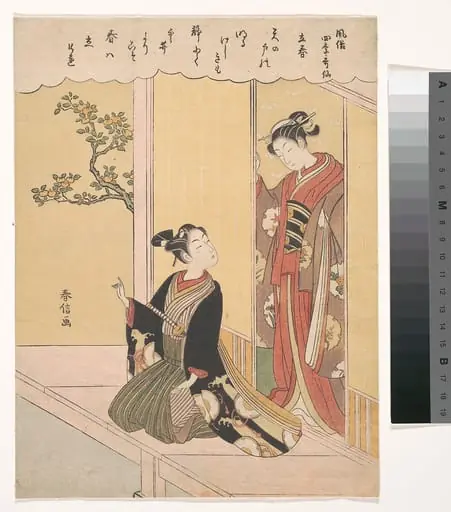 鈴木春信画「風俗四季歌仙 立春」|The First Day of Spring (Risshun), from the series Fashionable Poetic Immortals of the Four Seasons (Fūzoku shiki Kasen)
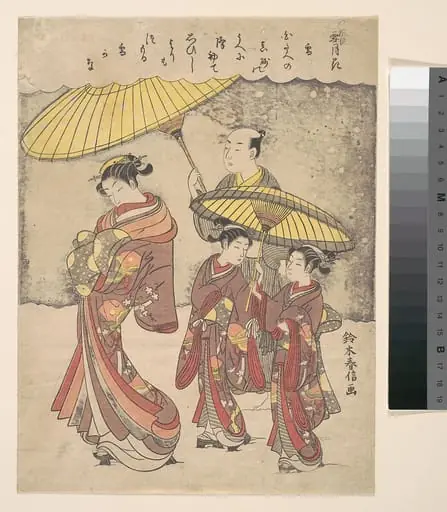 Yuki|雪月花 雪|Snow
 Untitled
 Untitled
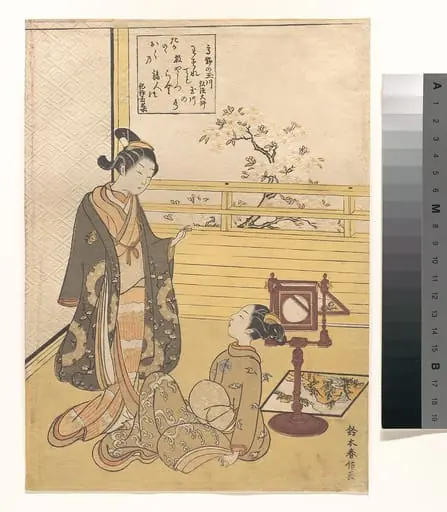 鈴木春信画 覗き絡繰り・「高野の玉川 弘法大師」|A Teenage Boy and Girl with a Viewer for an Optique Picture (Nozoki-karakuri); Kōbō Daishi’s Poem on the Jewel River of Kōya (Kōya no Tamagawa: Kōbō Daishi)
 Untitled
 Untitled
 Untitled
 Untitled