Artwork
Pharaoh's Army Drowns in the Red Sea
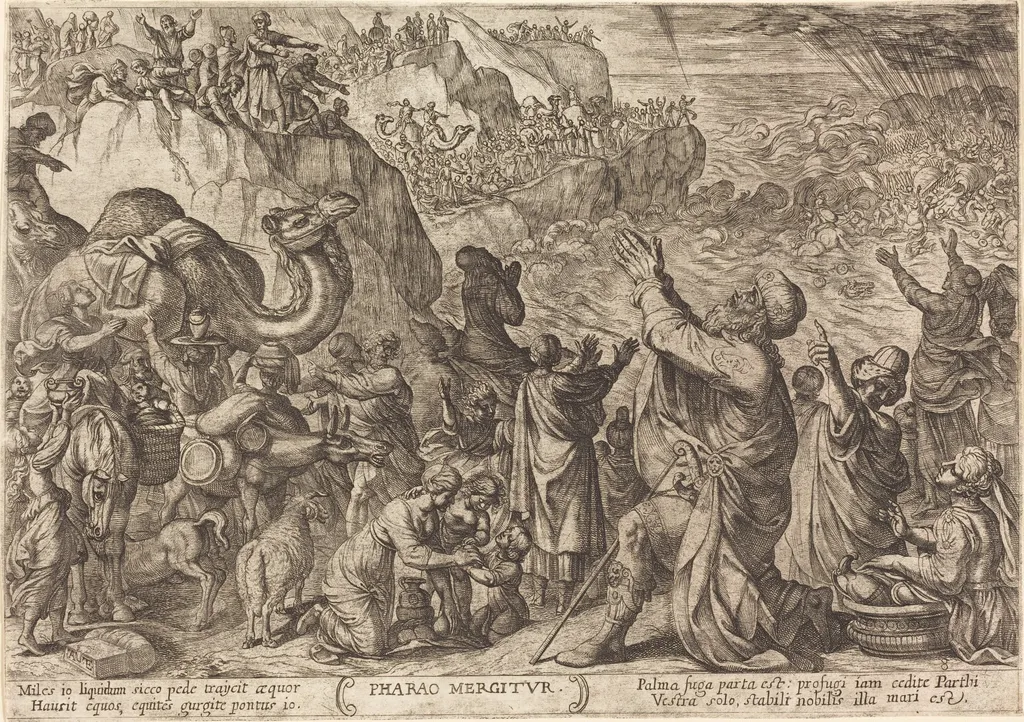
Pharaoh's Army Drowns in the Red Sea is an ink print by the Baroque artist Antonio Tempesta. It dates from 1613 and is held in the collection of the National Gallery of Art.
About this work
Overview
Created in Rome during the early Baroque era, the work is part of a series of prints by Tempesta that explore historical and mythological conflicts.
Antonio Tempesta’s 1613 etching captures the biblical moment when Pharaoh’s forces are engulfed by the Red Sea. Created in Rome during the early Baroque era, the work is part of a series of prints by Tempesta that explore historical and mythological conflicts. The medium of etching allowed for intricate detail and dynamic composition, reflecting his skill as both a painter and printmaker active in the Roman artistic milieu.
Subject & Meaning
The scene illustrates the divine punishment of Pharaoh’s army as described in Exodus, showing soldiers drowning amid turbulent waters while celestial figures observe from above. A robed figure on a raised platform, likely Moses, gestures toward the disaster, reinforcing the narrative of divine intervention. The composition emphasizes human vulnerability against overwhelming natural and supernatural forces, aligning with Counter-Reformation themes of divine justice.
Technique & Style
Tempesta employed fine, incised lines to render swirling waves, crumpled armor, and contorted bodies with precise texture. Deep shadows and high contrast heighten the drama, characteristic of Baroque sensibilities. The etching’s dense composition fills the frame with motion, using layered lines to suggest depth and chaos.
The Latin inscription at the base anchors the image in its scriptural source, guiding interpretation without overt narration.
History & Provenance
Created in Rome around 1613, the print was part of Tempesta’s broader output of battle scenes and biblical subjects circulated widely across Europe. His work bridged Italian and Northern European traditions, particularly influencing print collectors in Antwerp. Though specific early ownership records are sparse, the print’s survival in multiple institutional collections suggests its resonance among early 17th-century audiences.
Context
Tempesta worked during a period when the Catholic Church encouraged visual narratives reinforcing doctrinal authority. His prints, including this one, responded to the Counter-Reformation’s demand for emotionally charged religious imagery. The emphasis on divine retribution and the dramatic rendering of chaos aligned with contemporary tastes in Rome, where artists like Caravaggio were similarly exploring intensity and realism in sacred subjects.
Legacy
Tempesta’s etching contributed to the dissemination of biblical narratives through print culture, making complex theological stories accessible beyond elite audiences. His technical precision and compositional energy influenced later printmakers specializing in historical and military scenes. Though less celebrated today than his contemporaries, his work remains a significant example of early Baroque printmaking’s narrative power and technical refinement.
Own this work as a print
Artist & collection
Artist
Antonio Tempesta, also called il Tempestino (1555 – 5 August 1630), was an Italian painter and engraver, whose art acted as a point of connection between Baroque Rome and the culture of Antwerp.