Artwork
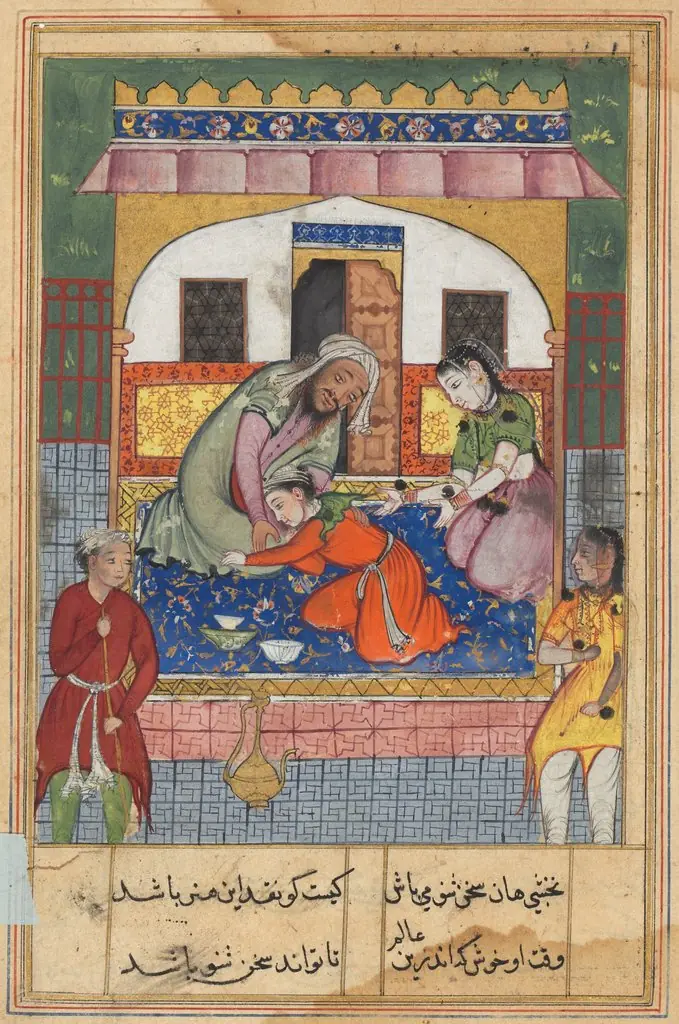
The daughter of the king of the jinns bows before the King of Kings who has just undergone the ordeal of passing through the boiling oil to emerge as a youth, from a Tuti-nama (Tales of a Parrot): Seventh Night
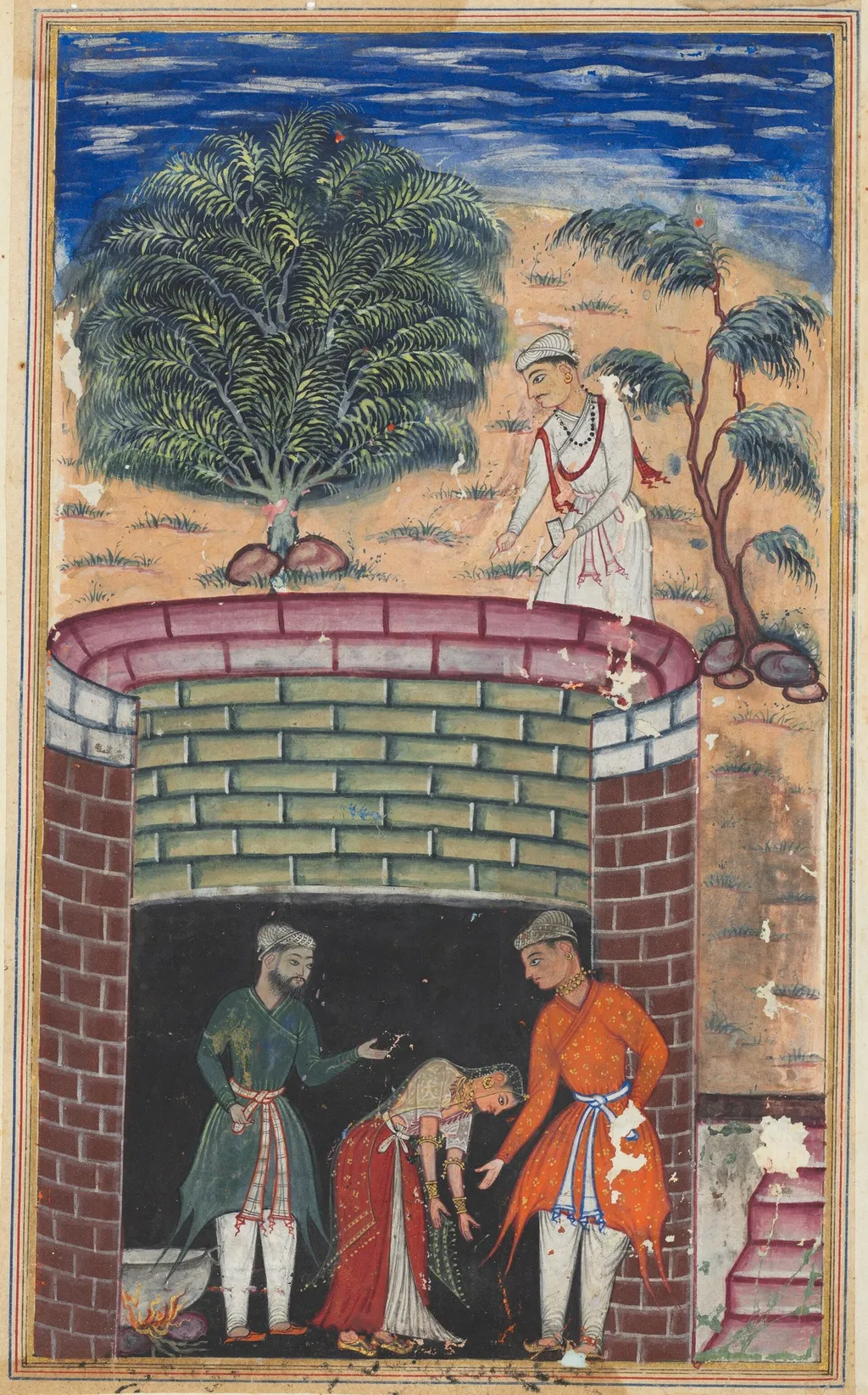
The daughter of the king of the jinns bows before the King of Kings who has just undergone the ordeal of passing through the boiling oil to emerge as a youth, from a Tuti-nama (Tales of a Parrot): Seventh Night is an unspecified painting. It dates from 1560 and is held in the collection of the Cleveland Museum of Art.
About this work
Subject & Meaning
The painting illustrates a scene from the Seventh Night of the Tuti-nama (Tales of a Parrot), in which the daughter of the king of the jinns bows before the King of Kings after he has passed through the ordeal of boiling oil and emerged renewed as a youth. The narrative centers on themes of miraculous transformation, divine kingship, and submission to a sovereign whose power transcends ordinary human limits, with the jinn princess's prostration underscoring the recognition of his restored, youthful authority.
The iconography combines Persianate literary tradition with Mughal visual conventions, depicting the trial by boiling oil as a moment of supernatural triumph rather than suffering. The juxtaposition of the humbled jinn daughter and the rejuvenated ruler conveys the moral that even beings of the supernatural realm acknowledge the supremacy of a divinely favored king.
History & Provenance
It is currently held in the collection of the Cleveland Museum of Art, where it is cataloged under the accession number 1962.
The painting, titled "The daughter of the king of the jinns bows before the King of Kings who has just undergone the ordeal of passing through the boiling oil to emerge as a youth, from a Tuti-nama (Tales of a Parrot): Seventh Night," was created in 1560 within the Mughal Empire. The work is attributed to an unknown artist and forms part of the illustrated manuscript known as the Tuti-nama. It is currently held in the collection of the Cleveland Museum of Art, where it is cataloged under the accession number 1962.279.49.b. The creation date is established as 1560, marking its origin during the early Mughal period.
Legacy
The miniature depicting the daughter of the jinn king paying homage to the King of Kings after his fiery trial influenced later Mughal book arts through its dramatic narrative treatment and stylized figure modeling. The composition informed subsequent folio paintings that emphasized ritual submission and supernatural encounters within courtly settings. Its visual language persisted in regional workshops producing illustrated manuscripts through the 17th century. The work remains on view in the Indian miniature gallery at the Cleveland Museum of Art.
The miniature is part of the Cleveland Museum of Art's collection of Mughal paintings from the 1560s. It is catalogued under accession number 1962.279.49.b and has been exhibited in thematic shows on Persianate manuscript traditions.
Overview
The work, titled The daughter of the king of the jinns bows before the King of Kings who has just undergone the ordeal of passing through the boiling oil to emerge as a youth, from a Tuti‑nama (Tales of a Parrot): Seventh Night, depicts a small narrative scene rendered in a flat, decorative style. Four figures are arranged before a brick structure: two men within a dark doorway, a kneeling woman in red, and a standing figure in white outside the entrance.
Technique & Style
Executed with a limited palette, the painting emphasizes bold colors, green, orange, red, and white, against a muted architectural background. The figures are outlined with fine lines, and details such as the orange‑clad figure’s belt and jewelry are highlighted to draw attention. The flat perspective and stylized rendering align with Persian miniature conventions of the period.
Context
Illustrations like this served both decorative and didactic purposes, accompanying literary texts that conveyed ethical lessons through fantastical episodes. The scene reflects the interplay of human and supernatural characters, a hallmark of Persian narrative art, and illustrates the cultural exchange between courtly literature and visual representation.
Artist & collection

- The daughter of the king of the jinns bows before the King of Kings who has just undergone the ordeal of passing through the boiling oil to emerge as a youth, from a Tuti-nama (Tales of a Parrot): Seventh Night
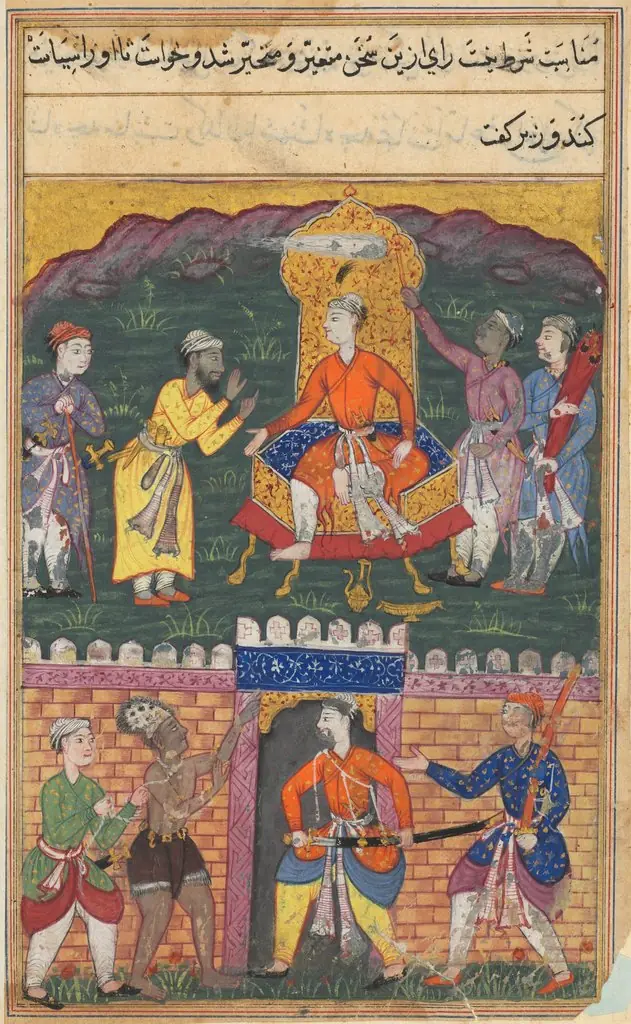 The vizier dissuades the king of Bahilistan from executing the dervish who asks for his daughter’s hand in marriage, from a Tuti-nama (Tales of a Parrot): Seventh Night
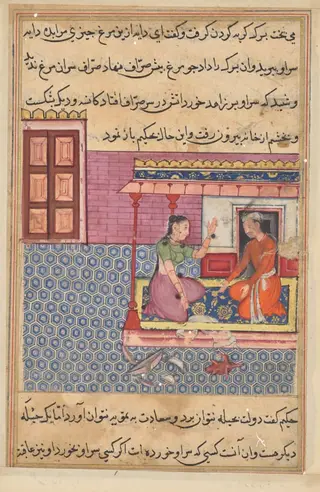 The pious man’s wife offers the seven-colored bird as food to her lover, but not finding its head, he breaks the pot and bowl in anger, from a Tuti-nama (Tales of a Parrot): Fifty-second Night
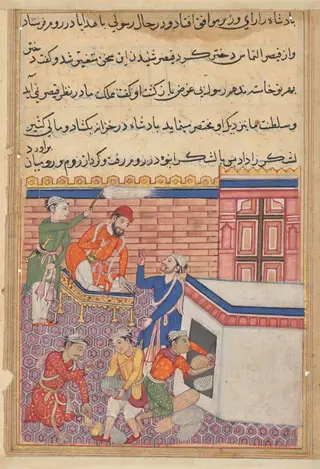 The king’s emissary being provided with gifts for his mission to Rum in order to seek the hand of the emperor’s daughter in marriage, from a Tuti-nama (Tales of a Parrot): Fiftieth Night
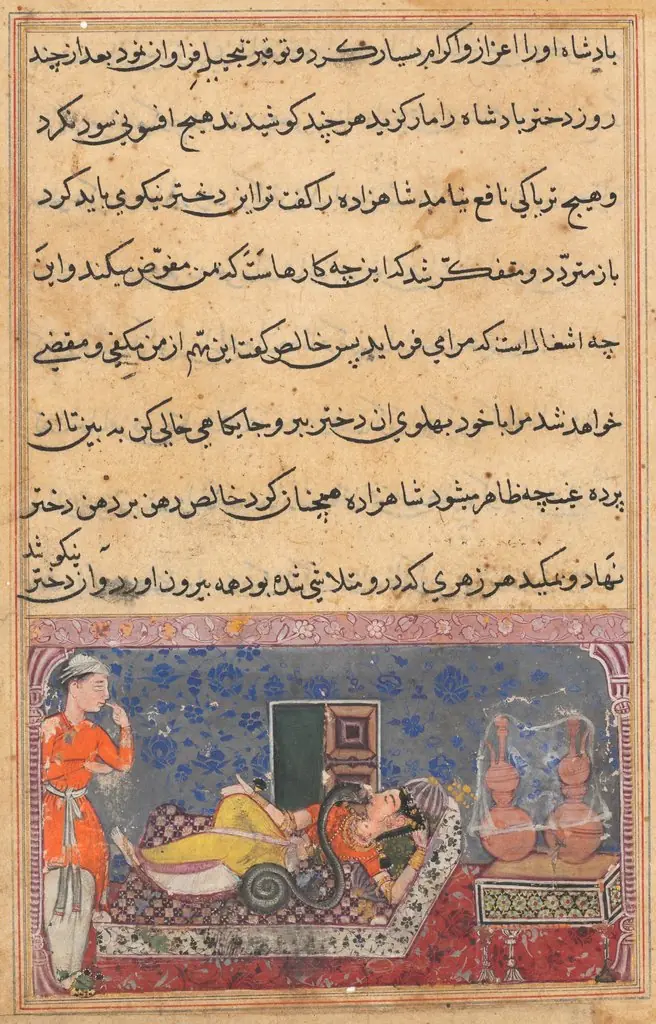 Khalis repays the prince for his kindness by changing into a snake and sucking the poison from the king’s daughter, from a Tuti-nama (Tales of a Parrot): Eighteenth Night
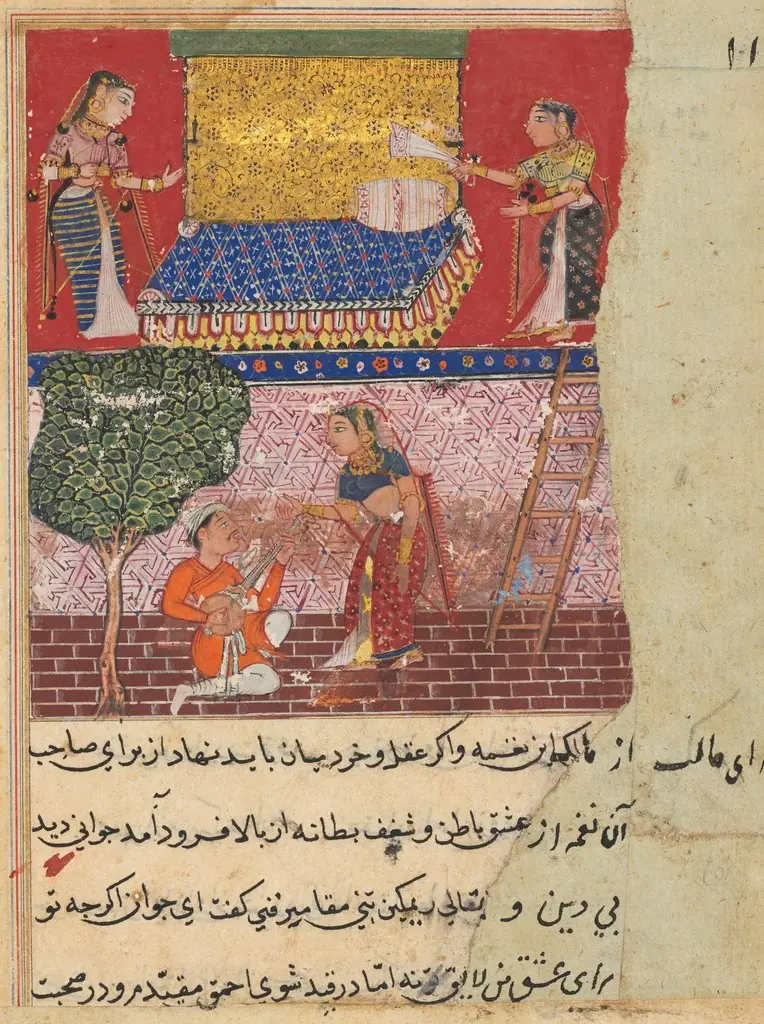 The daughter-in-law of the king of Banaras, charmed by the music of a vagabond, comes down to meet him, from a Tuti-nama (Tales of a Parrot): Sixteenth Night
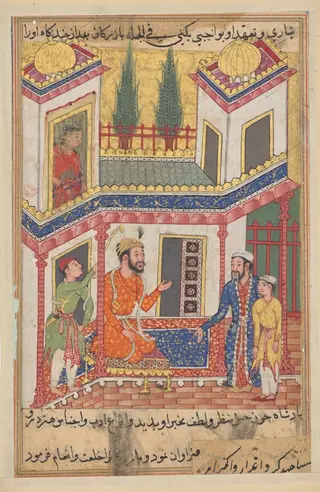 The merchant returns bringing a young slave who is really the son of the princess of Rum, now married to the king, from a Tuti-nama (Tales of a Parrot): Fiftieth Night
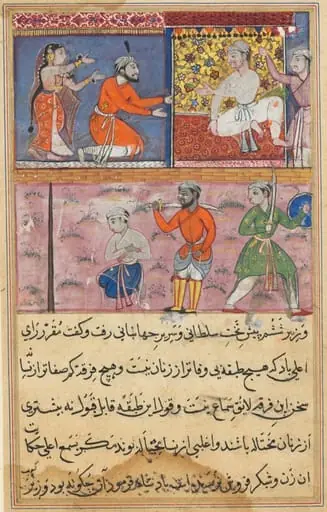 The prince sent back to the place of execution for the sixth time, from a Tuti-nama (Tales of a Parrot): Eighth Night
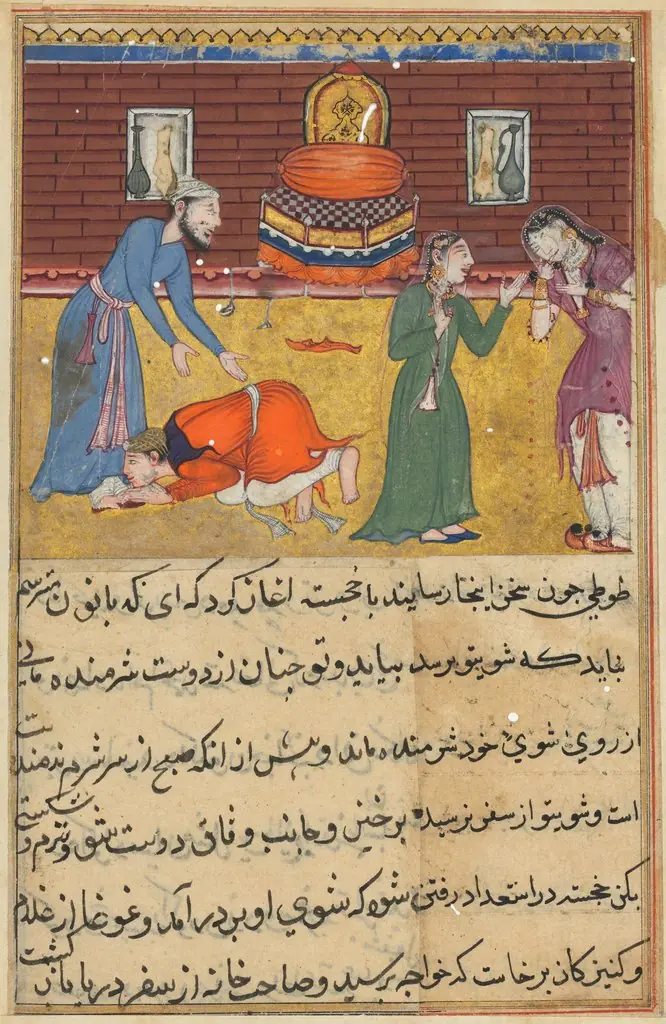 The pious man’s son, now a king, reveals himself to his father; his nurse upbraids his unfaithful mother, from a Tuti-nama (Tales of a Parrot): Fifty-second Night
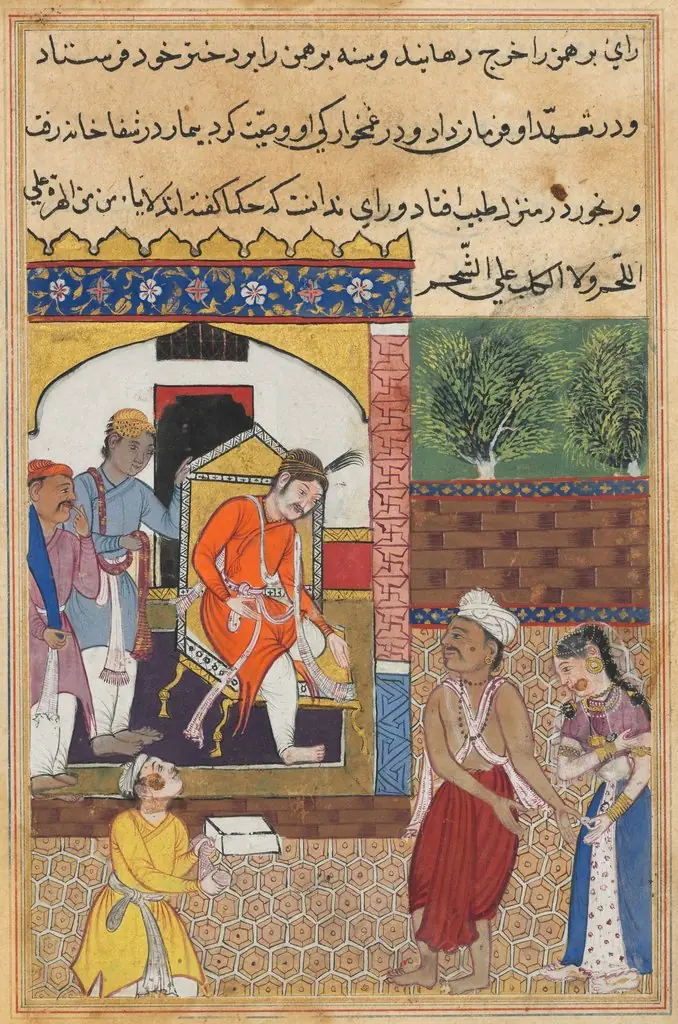 The magician, disguised as a Brahman, visits the king of Babylon, from a Tuti-nama (Tales of a Parrot): Thirty-fifth Night
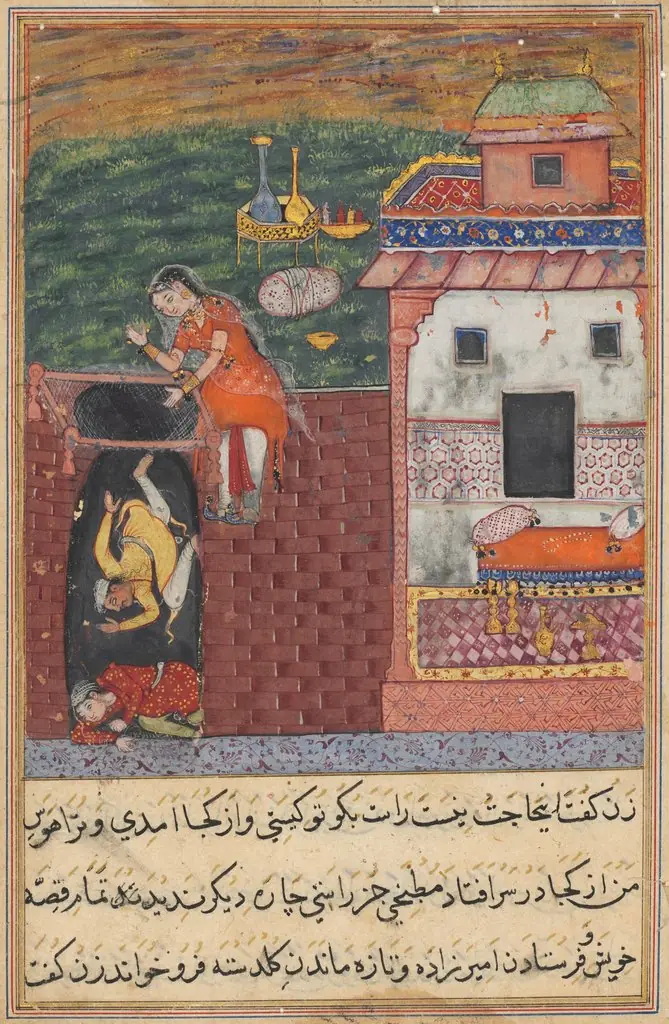 The two cooks, who attempt to seduce the warrior’s loyal wife, are trapped by her in a cellar, from a Tuti-nama (Tales of a Parrot): Fourth Night
 Repenting his conduct, ‘Ubaid falls at the feet of his parents, from a Tuti-nama (Tales of a Parrot): Forty-second Night