Artwork
Doge Andrea Gritti
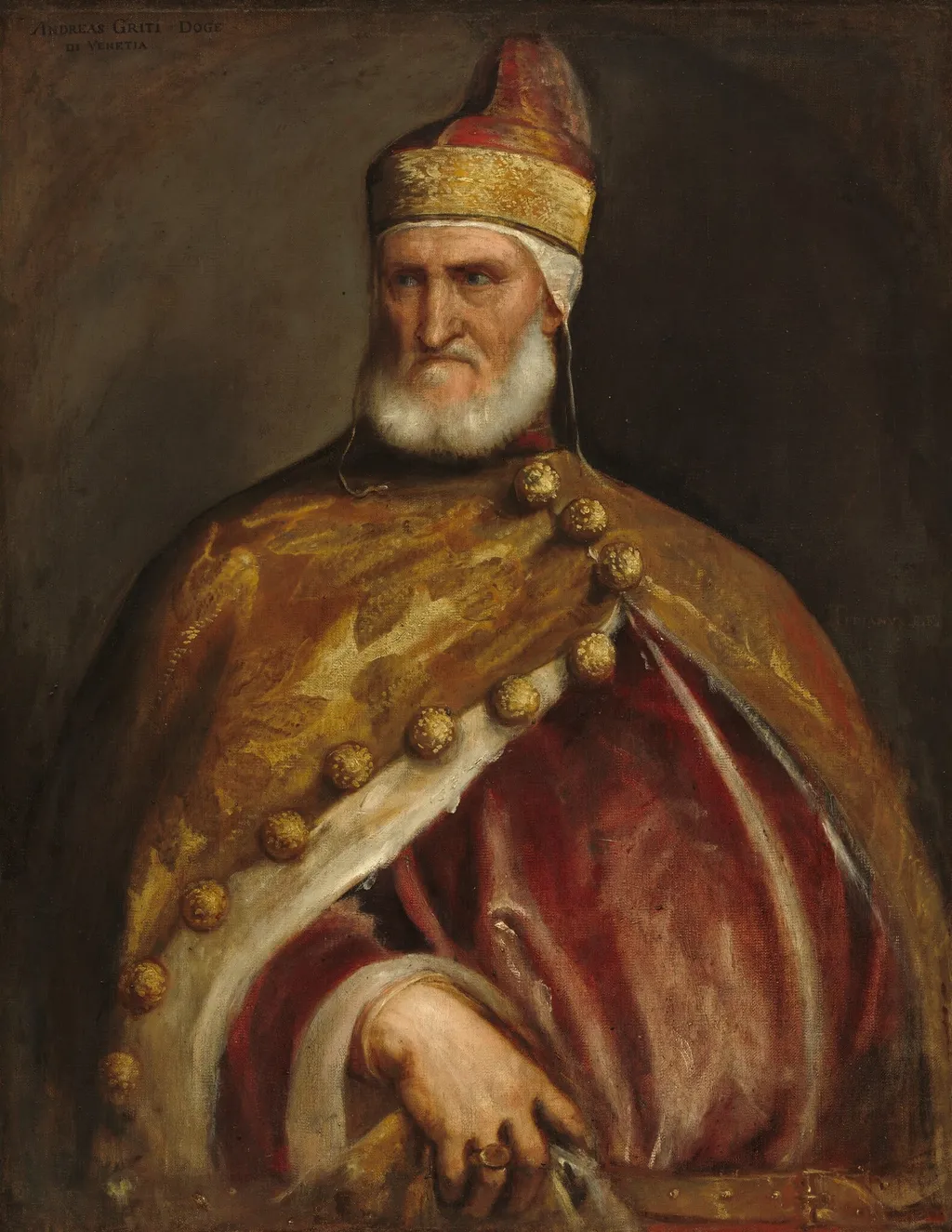
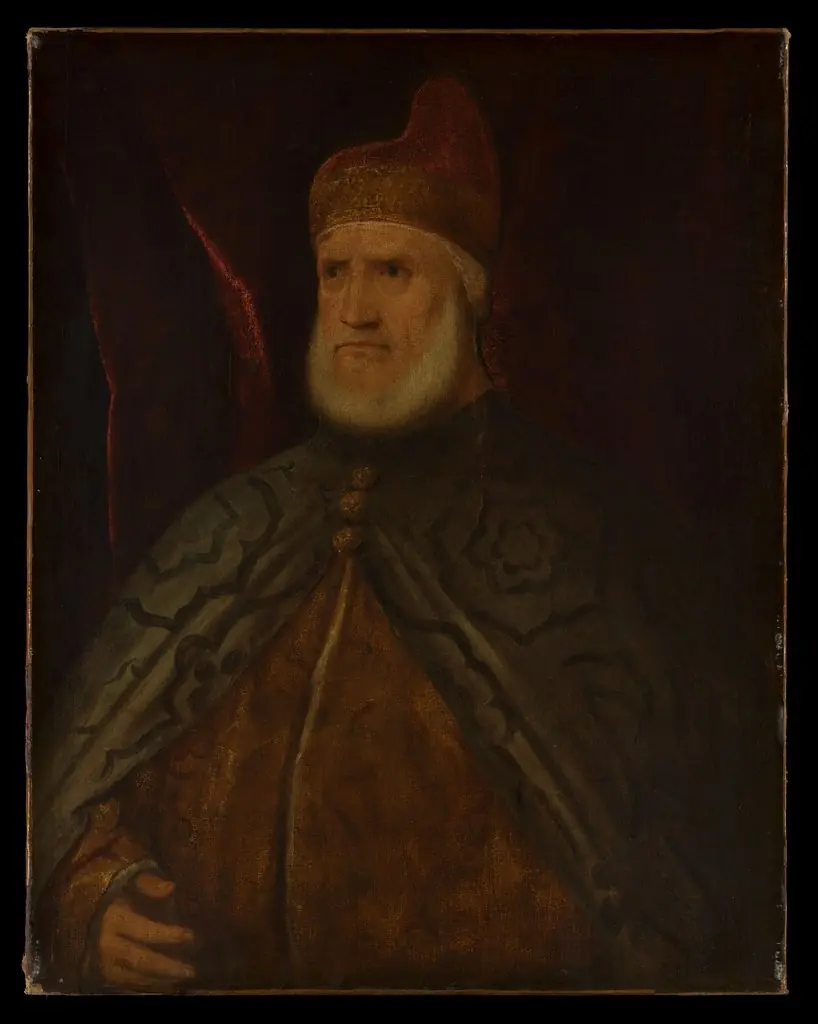
Doge Andrea Gritti is an oil painting by the Renaissance artist Titian. It dates from 1548 and is held in the collection of the National Gallery of Art.
- Inscription
- Inscribed:upper left, in black paint: ANDREAS GRITI DOGE / DI VENETIA; center right, in gold leaf: TITIANVS E. F. (Titian, Knight, made it); reverse, on paper: Bought for His Majesty in Italy, 1626.[1]
About this work
Subject & Meaning
The painting is a posthumous portrait of Andrea Gritti, Doge of Venice from 1523 until his death in 1538, executed by Titian in the late 1540s.
The painting is a posthumous portrait of Andrea Gritti, Doge of Venice from 1523 until his death in 1538, executed by Titian in the late 1540s. Gritti is shown half-length, turned to the right while his gaze directs leftward, wearing the ducal cap, rendered larger than life-size as a traditional emblem of office, and a gold-brocaded robe of state trimmed with white fur. The inscription ANDREAS GRITI DOGE DI VENETIA identifies the sitter, while the signature TITIANUS E.F. authenticates Titian's authorship.
Critics have linked the clenched hand gathering the golden mantle to Michelangelo's statue of Moses in San Pietro in Vincoli, suggesting Titian absorbed its terribilità during his 1545 visit to Rome. The shadowed eyes beneath projecting brows, the firmly closed mouth, and the luminous accents on brocade, fur, beard, and gold lace concentrate the viewer's attention on an imposing, psychologically penetrating presence, conveying the gravitas of the Venetian Republic and its ruler.
Technique & Style
Executed in oil on canvas between 1546 and 1550, the portrait depicts Doge Andrea Gritti from the hips up against a brown background. Titian employs a loose, spontaneous handling of paint, broadly sketching the composition and finishing it with a few sittings to achieve a sense of freshness. The artist utilizes the interplay of light on the gold brocade of the State robe, the white fur lining, the gold lace of the ducal cap, and the subject's white beard as distinct color accents.
Gritti's eyes, partially shadowed by projecting brows, serve as the focal point of his severe, attentive expression. The work is signed "Titianus E. F." and features an inscription identifying the sitter. Stylistically, the painting exhibits the quality of terribilità, drawing comparisons to Michelangelo's Moses, particularly in the depiction of the Doge's clenched hand gathering his golden mantle.
History & Provenance
Painted by Titian between 1546 and 1550, this posthumous portrait depicts Doge Andrea Gritti, who died in 1538. The work likely relies on earlier depictions, including a lost state portrait by Titian destroyed in 1577. Its documented ownership begins in 1626 when it was purchased in Italy for Charles I of England, a fact confirmed by a label on the reverse.
Following the king's execution, the painting was sold at the Commonwealth sale in London on October 23, 1651. It subsequently entered the collection of Prince Wenzel Anton von Kaunitz-Rietburg, passing to his heir Wenzel Alois before being sold in Vienna in 1820. Johann Rudolf Count Czernin von Chudenitz acquired it, and it remained in the Czernin family until 1954.
That year, it was sold to the Samuel H. Kress Foundation in New York, which gifted the work to the National Gallery of Art in Washington, D.C., in 1961.
Currently held in the National Gallery of Art in Washington, D.C., as part of the Samuel H. Kress Collection, the painting was gifted to the institution in 1961. Its documented history begins with its 1626 purchase in Italy for King Charles I of England, where it hung at Whitehall Palace until the Commonwealth sale at Somerset House on October 23, 1651. Following ownership by the Syndicate of the Twelfth Dividend, the work entered the collection of Prince von Kaunitz-Rietburg in Vienna.
It remained with the Kaunitz family until their 1820 sale, after which Count Czernin von Chudenitz acquired it; the piece stayed within the Czernin family until 1954. That year, it was sold via M. Knoedler & Co. to the Samuel H. Kress Foundation. The work was notably exhibited in 'The Age of Titian: Venetian Renaissance Art from Scottish Collections.'
Legacy
Titian's posthumous portrait of Andrea Gritti is the only surviving example among the doges' portraits he is believed to have produced in his capacity as official painter to the Venetian Republic. The painting's commanding psychological intensity has invited comparison with Michelangelo's Moses in San Pietro in Vincoli, both works sharing what scholars describe as a quality of terribilità. Its provenance through the collection of Charles I, the Kaunitz-Rietburg and Czernin von Chudenitz families, and ultimately the Samuel H. Kress Foundation has secured its place in the canon of Venetian Renaissance portraiture.
The work entered the National Gallery of Art in Washington, D.C., in 1961 and remains a touchstone in studies of Titian's late style and Venetian state portraiture.
Overview
This oil on canvas painting, titled Doge Andrea Gritti, was created by the Venetian artist Titian in the late 1540s. It depicts Andrea Gritti, who served as Doge of Venice from 1523 until his death in 1538. The work is held in the collection of the National Gallery of Art in Washington, D.C., and represents a significant example of Titian's portraiture from the mid-16th century.

Own this work as a print
Artist & collection
Artist
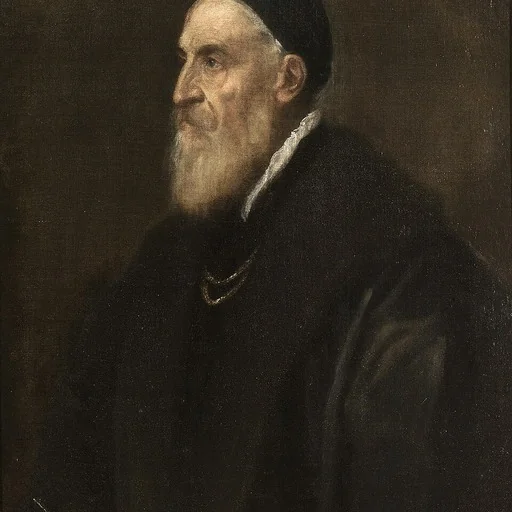
Tiziano Vecellio (Italian:; c. 1488/1490 – 27 August 1576), Latinized as Titianus, hence known in English as Titian ( TISH-ən), was an Italian Renaissance painter. The most important artist of Renaissance Venetian…