Artwork
Venus and Adonis
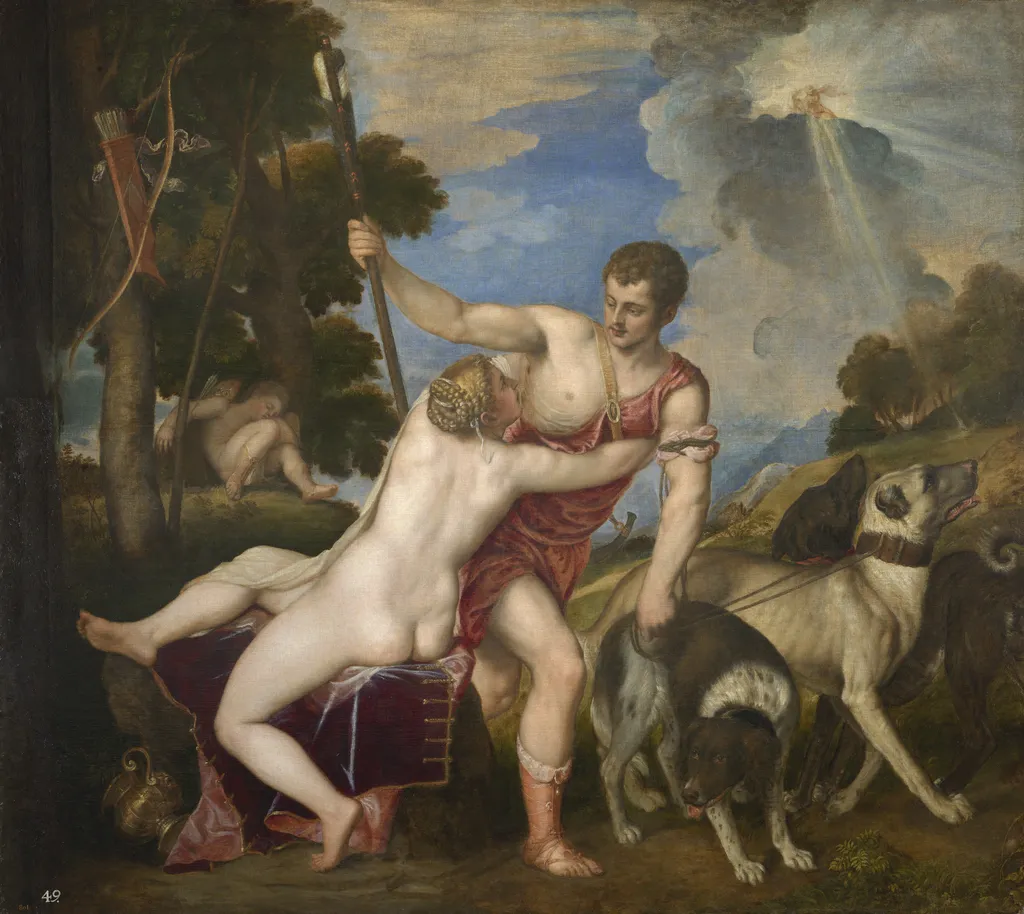
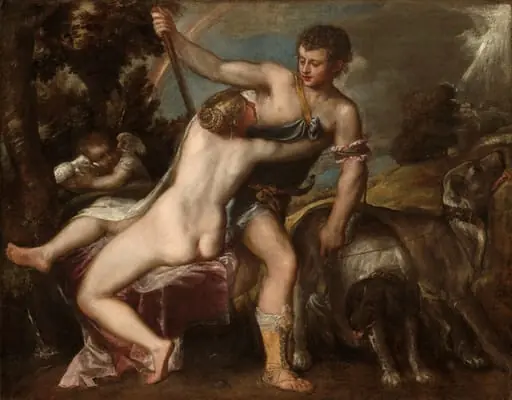
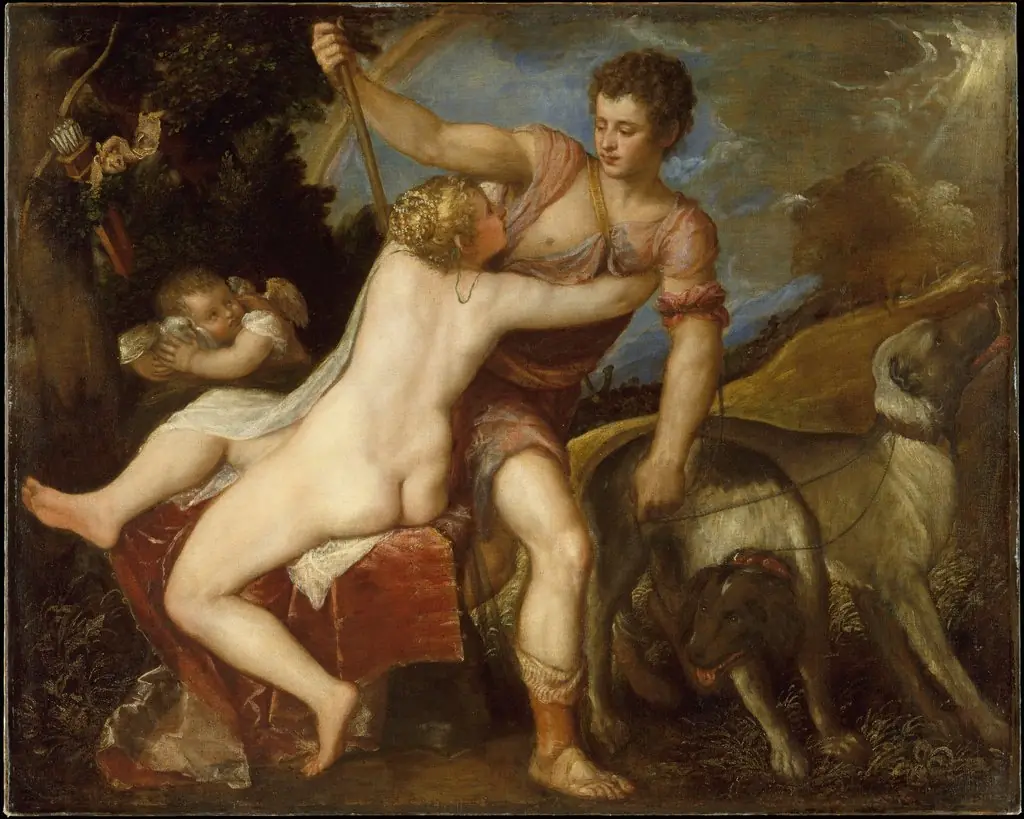
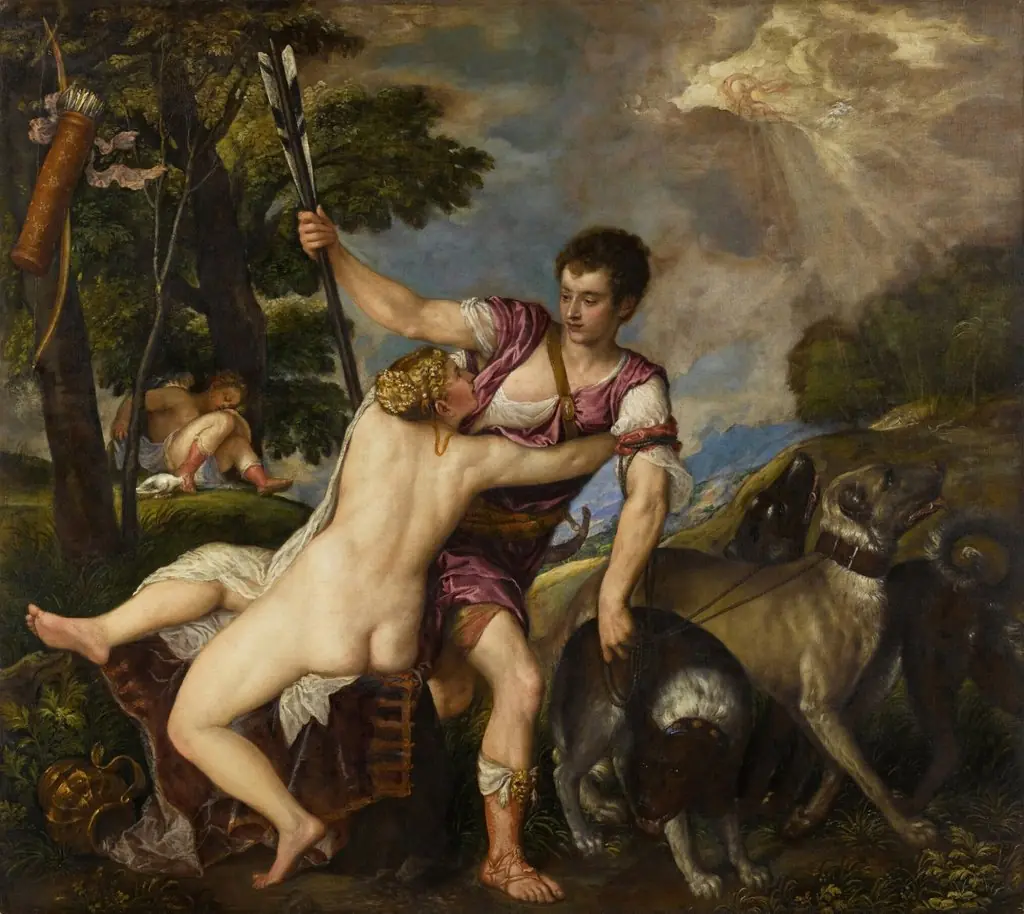
Venus and Adonis is an oil painting by the Mannerist artist Titian. It dates from 1554 and is held in the collection of the Museo del Prado.
About this work
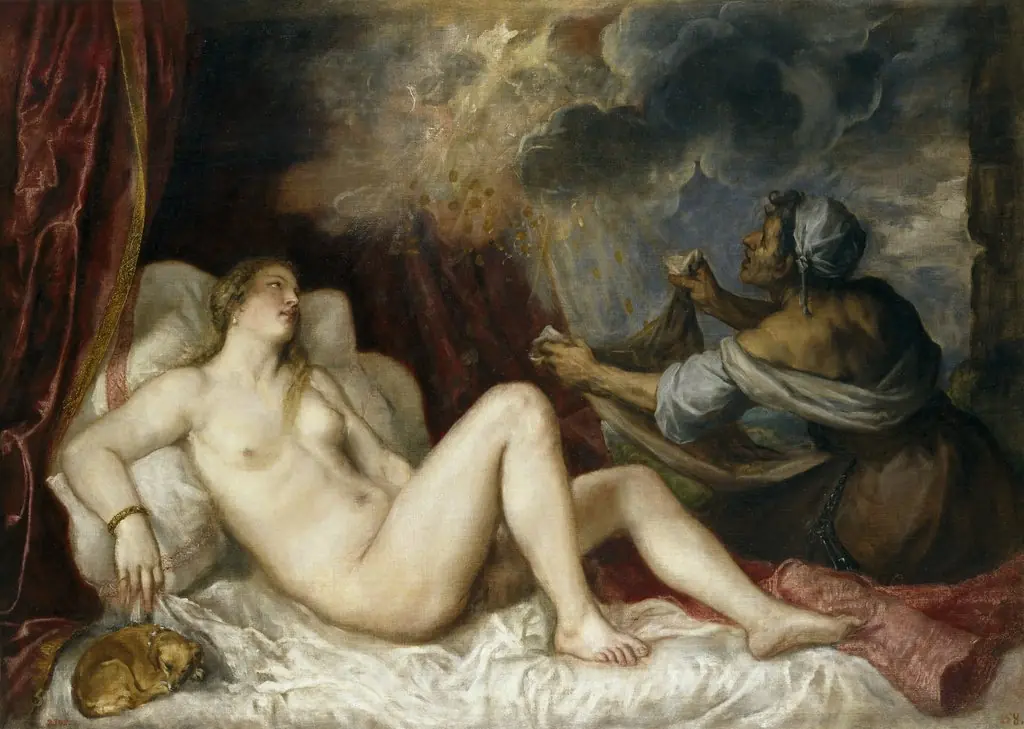
At dawn Apollo's chariot glints above the trees as Venus clings to Adonis, her bare back to the viewer, while he pulls away with three hounds straining at his arm. Titian sent this canvas to Philip II in London in 1554, two months after the prince married Mary Tudor, meaning it to hang beside Danaë and show the nude from front and back. The Museo del Prado now holds it.
Subject & Meaning
Iconographically, Titian invents an episode absent from Ovid, Adonis’s flight rather than Venus’s departure, to heighten the tragedy.
The painting depicts a pivotal, Ovid-inspired moment from the Metamorphoses: at dawn, the hunter Adonis, ignoring Venus's desperate embrace, prepares to leave with his dogs for the hunt that will kill him. Iconographically, Titian invents an episode absent from Ovid, Adonis’s flight rather than Venus’s departure, to heighten the tragedy. Symbolic details reinforce the meaning: an overturned amphora (symbol of voluptas) and a sleeping Cupid who still clutches a passion-arrow suggest interrupted, unfulfilled eroticism.
This narrative choice, along with Venus shown partly from behind taking the initiative, emphasizes the negative consequences of hunting as a metaphor for life’s subjection to fortune and divine injustice, a melancholy meditation on the violence inherent in classical myths. The work was conceived as a pendant to the frontal Danae, offering a contrasting view of Venus.
Technique & Style
Executed in oil on canvas (186 × 207 cm), the painting employs Titian’s late, free handling: backgrounds are sketchily rendered, with the preparation layer occasionally visible. The condition suffered from oxidised varnishes and repaints that obscured this technique until a 2014 restoration cleaned the surface and removed overpaint. The original canvas is extended on the left by a 15 cm vertical band, not by the artist, now hidden beneath the frame.
Stylistically, Venus’s posture combines a naturalistic upper body with hips and legs rendered disproportionately heavy, a departure from classical proportion that enhances the erotic tension. The composition deliberately contrasts with Titian’s earlier, frontal Danaë, showing Venus partially from behind.
History & Provenance
Titian painted Venus and Adonis in 1553 for Philip II of Spain, dispatching the canvas in 1554 as part of a series of mythological works the artist called 'poesie'. The painting was conceived as a pendant to the Danaë (also for Philip), showing Venus from the back to contrast with the frontal view of Danaë. It is the prime autograph version, with several workshop replicas.
The work entered the Spanish royal collection and is now held at the Museo del Prado in Madrid.
This painting is held at the Museo del Prado in Madrid. No specific inventory or accession number is provided in the sources. In 2020–2021, it was included in a touring exhibition that brought together Titian's six mythological 'poesie' paintings, shown at the National Gallery, London; the Museo del Prado, Madrid; and the Isabella Stewart Gardner Museum, Boston.
Context
Titian’s Venus and Adonis has long been noted for its eroticism, especially Venus’s backward posture that displays her buttocks and her active role in trying to detain Adonis. The composition was conceived as a pendant to the frontal Danae, forming part of Titian’s series of mythologies, or 'poesie,' commissioned by Philip II. Art historically, the painting marks Titian’s later shift toward Habsburg patronage and away from the Venetian public sphere.
Contemporary criticism includes Raffaello Borghini’s objection to Titian’s invention of Adonis’s departure, a moment not found in Ovid. Scholarship by Panofsky and others has explored its iconographic sources and psychological tension, while a 2020–21 exhibition reunited the six original poesie at the National Gallery, Prado, and Isabella Stewart Gardner Museum. The work remains a key example of the Venetian School’s mythological painting.
Legacy
Titian's Venus and Adonis (1554) has secured a lasting legacy as one of the most celebrated mythological paintings of the Venetian school. Its fame has been sustained by its eroticism and innovative composition. The work is part of the 'Poesías' series painted for Philip II of Spain.
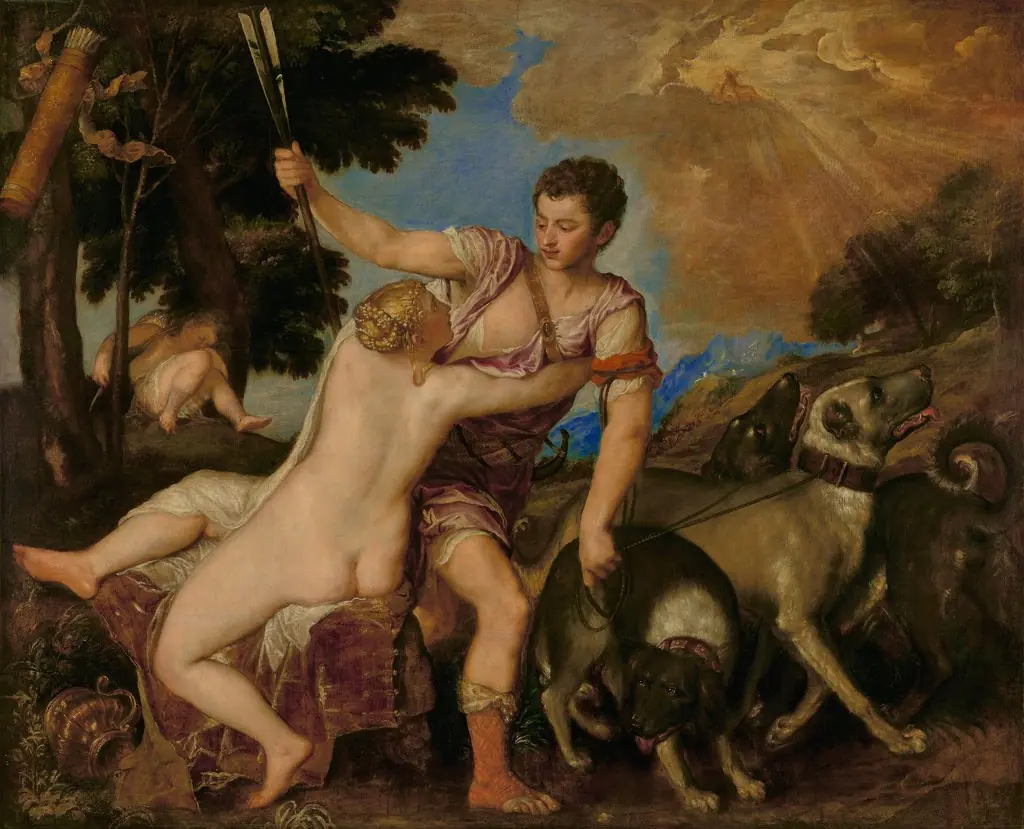
In 2020–2021, six of these paintings were reunited in an exhibition at the National Gallery, London; the Museo del Prado, Madrid; and the Isabella Stewart Gardner Museum, Boston. The composition was widely replicated, with autograph and studio versions in the J. Paul Getty Museum, the National Gallery of Art, the Metropolitan Museum of Art, the Dulwich Picture Gallery, and private collections. A version sold for £11 million in 2022. The Prado version underwent a major restoration in 2014, which removed old varnishes and repaints.
Overview
Titian's "Venus and Adonis," completed in 1554, is a central work within his "Poesie" series, commissioned for Philip II of Spain. Drawing inspiration from Ovid's Metamorphoses, the painting captures a moment of emotional intensity as Venus desperately tries to prevent Adonis from leaving for the hunt. Titian's unique depiction of this farewell, particularly Venus's pose with her back to the viewer, was an innovative artistic choice. This canvas is now a significant piece in the collection of the Museo del Prado.
Own this work as a print
Artist & collection

Artist
Tiziano Vecellio (Italian:; c. 1488/1490 – 27 August 1576), Latinized as Titianus, hence known in English as Titian ( TISH-ən), was an Italian Renaissance painter. The most important artist of Renaissance Venetian…