Artwork
Danaë
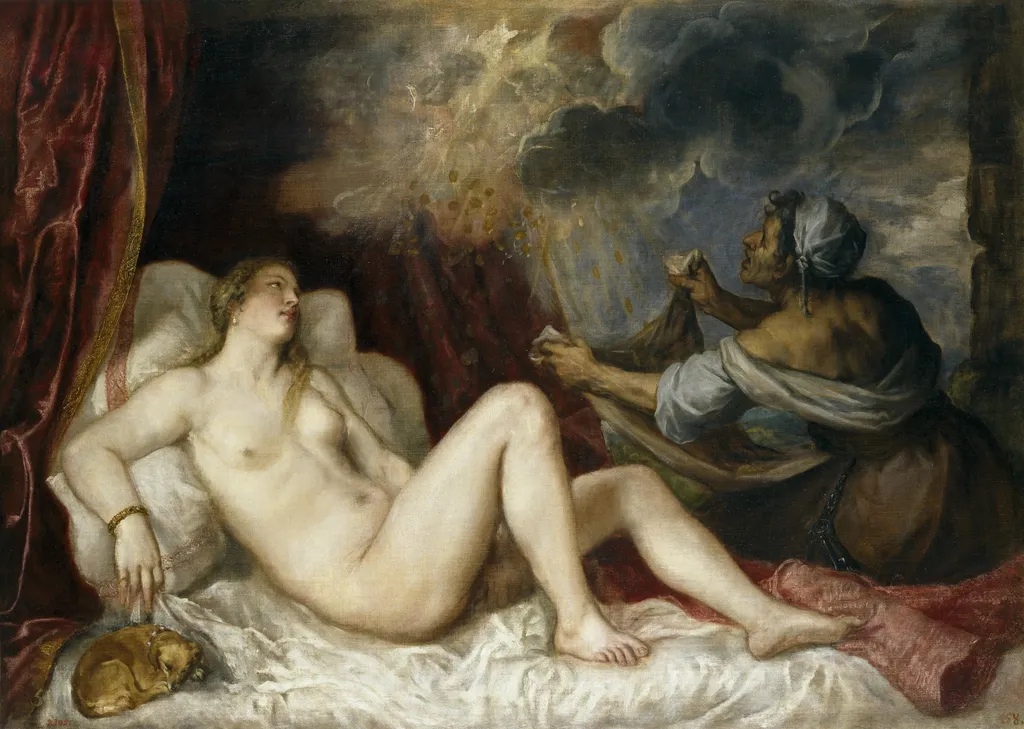
Danaë is an oil painting by the High Baroque Italian artist Titian. It dates from 1560 and is held in the collection of the Museo del Prado.
About this work
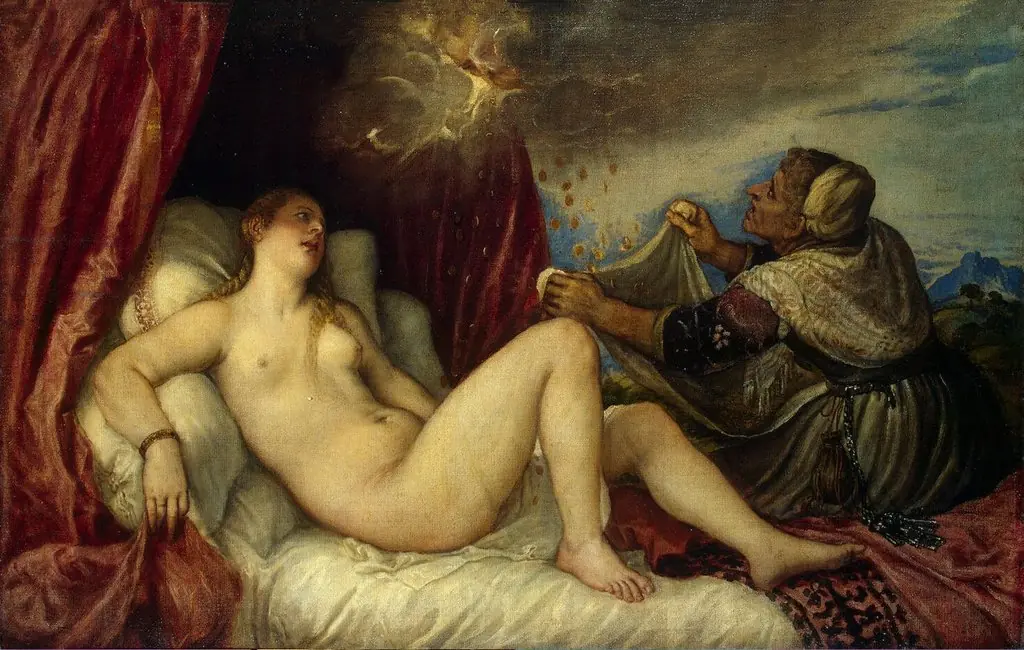
Titian painted this Danae in oil around 1560, one of several versions he and his workshop made of the scene. It shows the myth of Princess Danae, locked in a bronze tower because of a prophecy, whom Zeus visited as a shower of gold. The story comes from Ovid and Boccaccio.
Subject & Meaning
Zeus seduced her by descending as a shower of gold, a metamorphosis Titian renders as an explosion of color or golden coins falling from stormy clouds.
The painting depicts the mythological princess Danaë, who was imprisoned by her father Acrisius to prevent a prophecy that her son would kill him. Zeus seduced her by descending as a shower of gold, a metamorphosis Titian renders as an explosion of color or golden coins falling from stormy clouds. The central nude figure lies on a bed with legs half-parted, a pose derived from Michelangelo's 'Night' and Giorgione's Venetian nudes.
Symbolically, the work contrasts Danaë's youth and beauty with an elderly maid who eagerly collects the gold, representing avarice and folly. A small dog at her side serves as a traditional attribute of the courtesan. While earlier interpretations viewed the scene as a benevolent divine act, Titian's later versions, particularly the Prado painting, adopt a more pessimistic tone, suggesting the corrupting influence of wealth and the tragic nature of encounters between gods and mortals.
Technique & Style
The Prado Danaë is executed in oil on canvas, measuring approximately 129.8 × 181.2 cm. Titian and his workshop produced several versions of this composition between about 1544 and the 1560s, with the Madrid canvas identified as a late autograph version, dated to about 1560. Stylistically, the work belongs to the Venetian school and develops Titian's tradition of the reclining female nude inherited from Giorgione's Dresden Venus and his own Venus of Urbino. The pose, nude, recumbent on a couch with knees raised and legs half-parted, is consistent across the series and has been traced to Michelangelo's Night, reversed and opened out.
The Prado canvas shows notably loose, almost impressionistic brushwork while retaining a Giorgionesque placement of the nude. The composition sets the luminous nude against a dark-clad elderly maid, with a small dog at Danaë's side, and bathes the figure and golden shower in a reddish atmosphere.
History & Provenance
Titian painted the Prado Danaë for Philip II of Spain as one of the mythological 'poesie' he produced for the king; it follows the first autograph version, the Naples canvas made about 1544–46 for Cardinal Alessandro Farnese. The painting entered the Spanish royal collection and passed through the royal palaces of Madrid, and it has been held by the Museo del Prado since the museum's early years following its 1819 opening. It is catalogued there as an oil on canvas measuring 129.8 by 181.2 cm.
In 2020–2021 the Prado Danaë was shown in the exhibition reuniting Titian's mythological poesie for Philip II, which traveled to the National Gallery in London, the Museo del Prado in Madrid, and the Isabella Stewart Gardner Museum in Boston.
Context
Titian's Danaë has attracted sustained critical attention since its creation. Vasari recorded Michelangelo's admiration for Titian's color while privately faulting Venetian draftsmanship, a judgment passed on the Danaë. Later scholarship, exemplified by Kenneth Clark, positioned the figure within broader Italian nude conventions rather than a purely Venetian ideal, and George Bull traced its pose to Michelangelo's Night and to works by Primaticcio and Correggio.
The composition's popularity prompted Titian to produce several autograph versions. Its influence extended to Baroque and modern artists, with Rembrandt, Van Dyck, and Klimt all treating the Danaë theme. As part of Titian's mythological poesie for Philip II, the Prado canvas exemplifies the Venetian school's contribution to Renaissance mythological painting.
Legacy
Titian's multiple versions of Danaë, produced between the 1540s and 1560s, established a compositional archetype that influenced subsequent European art. The arrangement of the reclining nude served as a model for later interpretations by Rembrandt, Anthony van Dyck, and Gustav Klimt. Art-historical analysis traces Titian's pose to Michelangelo's sculptural figure Night.
The series was highly successful during the artist's lifetime, the initial Naples version prompting several further variants. In the modern era, the legacy of these works was highlighted during the 2020–2021 reunion of Titian's six mythological poesie for Philip II, exhibited across London, Madrid, and Boston, reaffirming the cycle's status as a high point of Renaissance mythological painting.
Overview
Titian, a leading Venetian painter, created "Danaë" around 1560 using oil paint. This work is one of several distinct versions of the same mythological scene produced by the artist and his workshop. These interpretations were developed over an extended period, beginning in the mid-1540s and continuing into the 1560s, reflecting a sustained interest in the subject matter.
Own this work as a print
Artist & collection
Artist
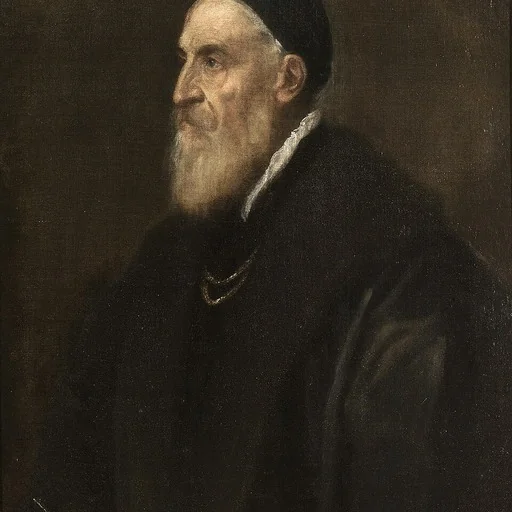
Tiziano Vecellio (Italian:; c. 1488/1490 – 27 August 1576), Latinized as Titianus, hence known in English as Titian ( TISH-ən), was an Italian Renaissance painter. The most important artist of Renaissance Venetian…