Artwork
Girl in a Fur
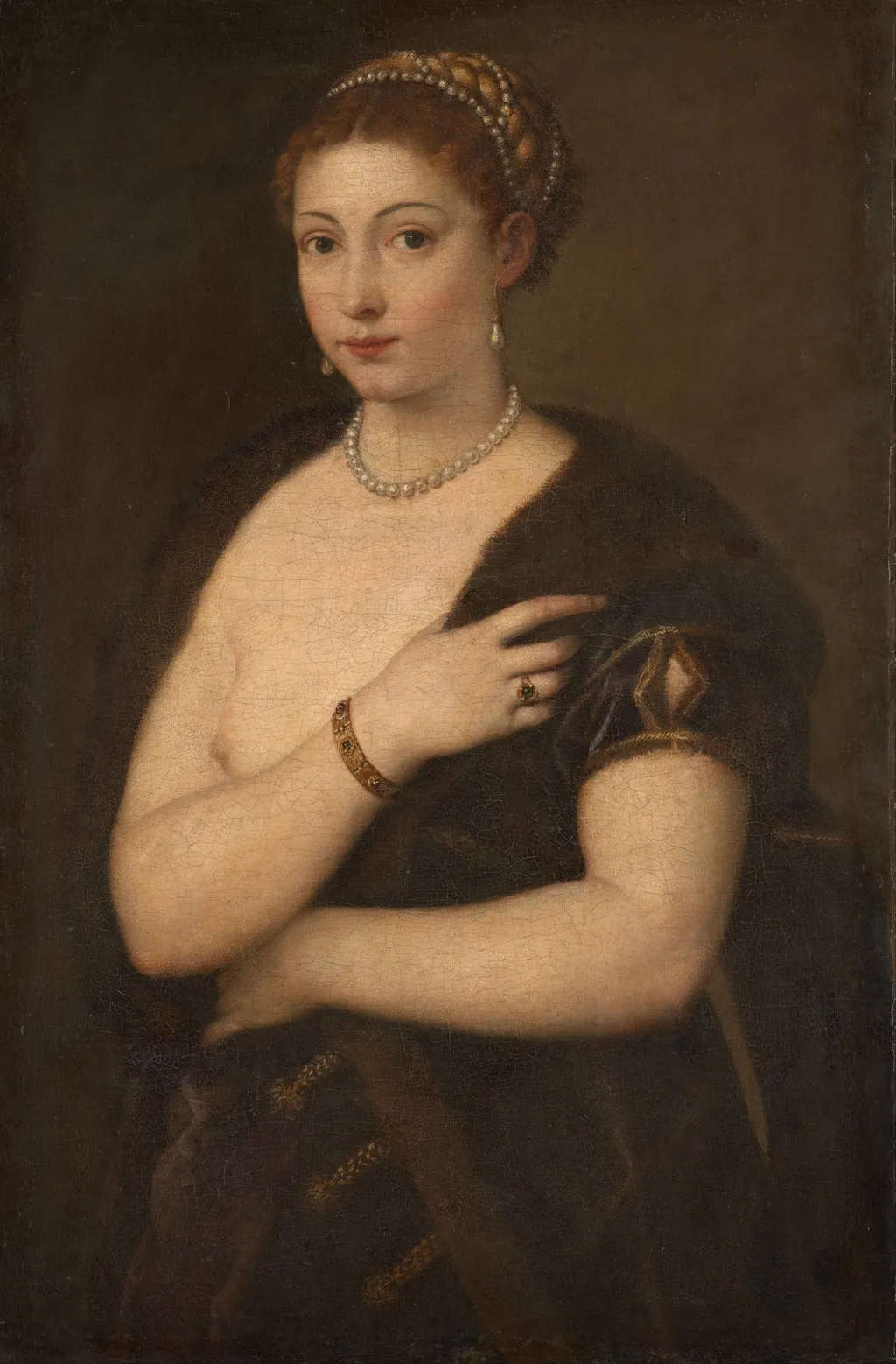
Girl in a Fur is an oil painting by the Mannerist artist Titian. It dates from 1535 and is held in the collection of the Kunsthistorisches Museum.
About this work
Subject & Meaning
The painting shows a young adult woman draped in a black fur coat that slips from her right shoulder, revealing pale, plump skin and a slight blush.
The painting shows a young adult woman draped in a black fur coat that slips from her right shoulder, revealing pale, plump skin and a slight blush. She wears a pearl necklace, teardrop earrings, gold bracelets and rings, and her braided hair is adorned with a pearl ornament. Her pose echoes the classical Venus Pudica, and the work is described not as a seductive portrait but as a celebration of an ideal of female beauty inspired by Petrarchan lyricism.
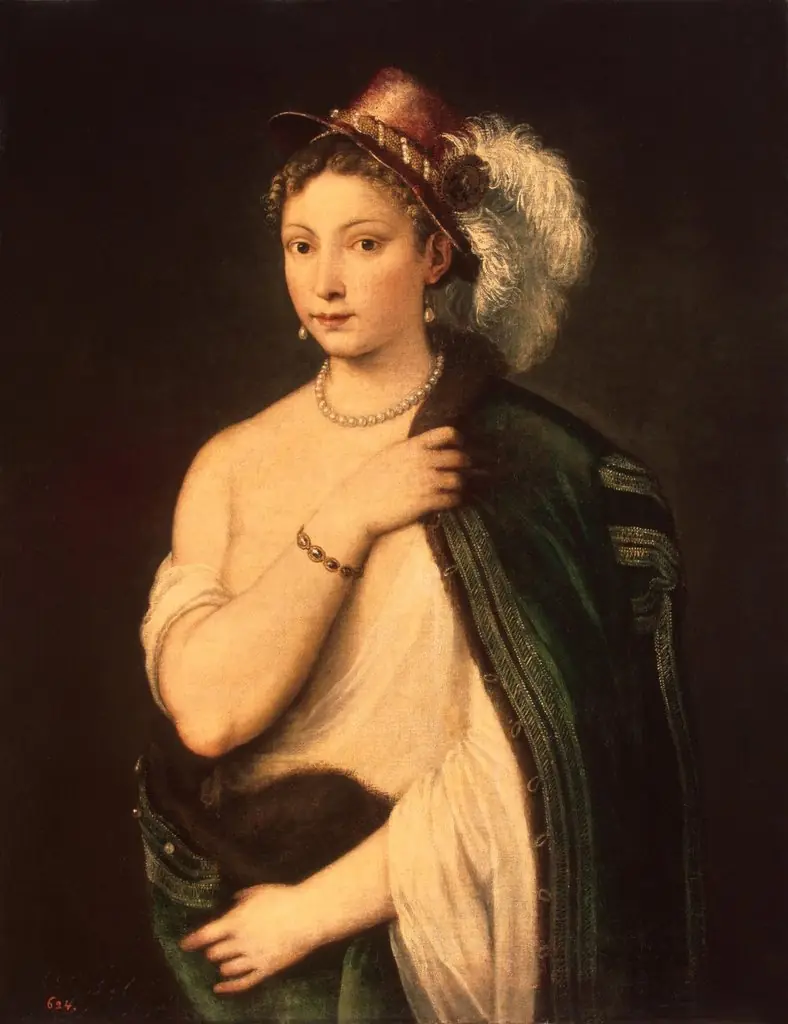
The sitter is believed to be the same model Titian used for La Bella, the Venus of Urbino, and a Portrait of a young woman with a feather hat, and X‑ray analysis indicates the canvas was originally conceived as a copy of La Bella before being altered into its present nude form.
Technique & Style
Girl in a Fur is an oil painting on canvas created by Titian between 1536 and 1538. The work measures 95.5 cm in height and 63.7 cm in width. Stylistically, it belongs to the Venetian school and functions as a portrait that celebrates an ideal of female beauty inspired by Petrarchan lyricism rather than mere sensuality.
The composition depicts a half-naked woman with pale, blushed skin, wearing a black fur draped over her body, a pearl necklace, teardrop earrings, and gold jewelry. Her pose, holding the fur in her right hand, references the classical Venus Pudica sculpture. Scientific X-ray analysis indicates the painting was initially conceived as a copy of La Bella in both pose and costume before being altered to its current nude form.
The brushwork highlights the texture of the fur against the smoothness of the skin, with light reflecting in the eyes to create a lively expression.
History & Provenance
Titian painted Girl in a Fur between 1536 and 1538. The work was likely commissioned by Francesco Maria I della Rovere, the Duke of Urbino and nephew of Pope Julius II, or alternatively by his son, Guidobaldo. Scientific examination using X-rays has revealed that the canvas was originally intended as a copy of Titian's La Bella, matching it in both pose and costume, before being altered into its present composition.
The painting shares the same female model used in La Bella, the Venus of Urbino, and Portrait of a young woman with a feather hat. The artwork is currently held by the Kunsthistorisches Museum in Vienna.
Girl in a Fur has been held by the Kunsthistorisches Museum in Vienna since its acquisition. The painting is part of the museum’s permanent collection, though its specific accession or inventory number is not detailed in available sources.
The work has been exhibited as part of the Kunsthistorisches Museum’s core displays, reflecting its status as a key example of Titian’s portraiture. While individual exhibition histories beyond its home institution are not extensively documented in the provided sources, its inclusion in scholarly discussions and museum contexts underscores its prominence in Venetian Renaissance art.
Context
Scholarship has emphasized the painting’s transformation from an intended copy of Titian’s La Bella into its present form, a shift revealed by X-ray analysis. The adjustment aligns the work with Petrarchan ideals of female beauty rather than a specific sitter, linking it to contemporaneous Venetian lyricism. Its classical pose, derived from the Venus Pudica, situates the figure within a long tradition of idealized female nudes.
The work’s reception frames it as a celebration of beauty ideals rather than a straightforward portrait, connecting it to Titian’s broader oeuvre including La Bella and Venus of Urbino, all featuring the same model. This continuity underscores the artist’s serial engagement with beauty types across the 1530s.
Overview
Titian’s oil painting dated between 1536 and 1538 portrays a young woman draped in a fur mantle. Executed on canvas, the work now belongs to the collection of Vienna’s Kunsthistorisches Museum. The figure, rendered with a calm expression, gazes directly at the viewer, her posture and attire emphasizing a quiet, intimate presence.
Own this work as a print
Artist & collection

Artist
Tiziano Vecellio (Italian:; c. 1488/1490 – 27 August 1576), Latinized as Titianus, hence known in English as Titian ( TISH-ən), was an Italian Renaissance painter. The most important artist of Renaissance Venetian…