Artwork
The Virgin and Child with St John the Baptist and an Unidentified Saint
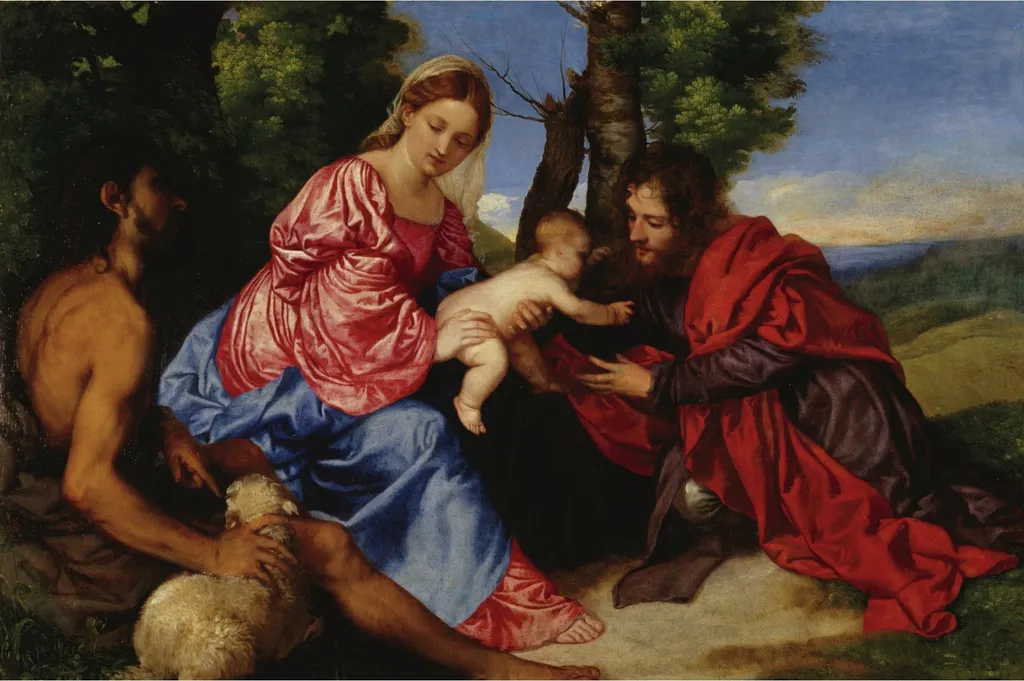
The Virgin and Child with St John the Baptist and an Unidentified Saint is an oil painting by the High Renaissance artist Titian. It dates from 1517 and is held in the collection of the National Galleries Scotland.
About this work
The painting is titled The Virgin and Child with St John the Baptist and an Unidentified Saint.
The painting is titled The Virgin and Child with St John the Baptist and an Unidentified Saint. It was made by Titian in 1517, using oil paint. The work is a religious piece that shows a traditional holy grouping.
It is also known as The Virgin with Saint John the Baptist, Adored by a Donor. Scholars date it to around 1515‑1520. Today the canvas is on loan and can be seen in Edinburgh.
If you’re curious to see it in person, check out the Scottish National Gallery.
Subject & Meaning
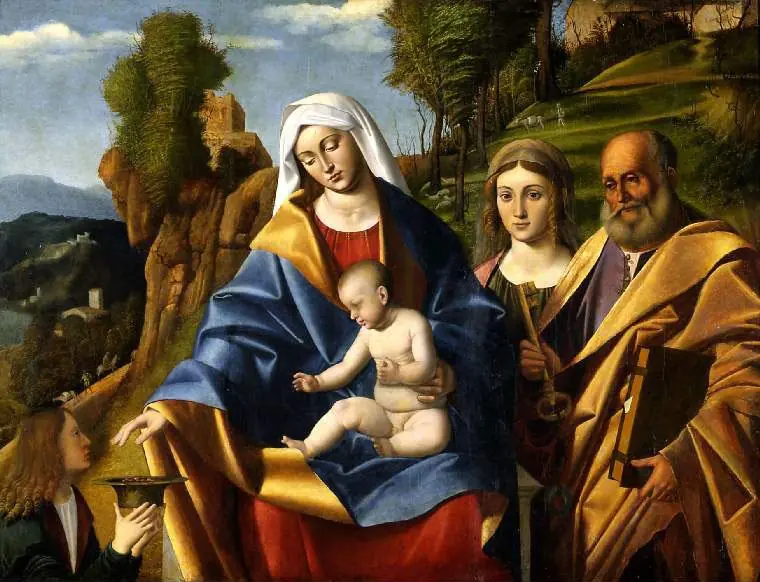
The painting belongs to the genre of the sacra conversazione, a devotional format in which the Virgin and Child are shown in informal communion with saints within a shared space rather than separated into distinct panels. The composition is arranged in two asymmetrical halves, one shaded and the other opening onto a landscape, with the luminous figures of the Virgin and Child placed between two saints posed with relaxed attitudes.
On the left, St John the Baptist is shown in serene contemplation while caressing the Agnus Dei, the Lamb of God, a standard attribute identifying him and prefiguring Christ's sacrifice. On the right stands an unidentified saint, possibly a donor, dressed in brilliant red and purple whose garment catches the light as vividly as the Virgin's robes. The intense reds and blues, including that of the sky, magnetize the viewer's gaze and signal the chromatic orchestration that would define Titian's later masterpieces. The work was likely created for private devotion.
Technique & Style
The painting is executed in oil on canvas, having originally been painted on panel before being transferred to canvas. Titian’s technique here reflects the Venetian High Renaissance emphasis on luminous color and atmospheric effects. The composition employs a rich, layered application of oil paint, allowing for subtle transitions between light and shadow, particularly evident in the drapery of the figures’ garments, such as the Virgin’s blue mantle and the unidentified saint’s vivid red and purple robes.
The handling is characterized by a fluid, almost sculptural modeling of forms, with soft contours and a harmonious integration of figures into the landscape. The sky and distant scenery exhibit a delicate sfumato, enhancing the spatial depth. Stylistically, the work aligns with Titian’s early sacre conversazioni, blending Giorgionesque influences with his emerging mastery of chromatic orchestration.
The condition, while not detailed in sources, appears stable enough for display, though the transfer from panel to canvas may have introduced minor alterations to the surface texture.
History & Provenance
The work was originally owned by the Earl of Ellesmere at Bridgewater House in Westminster before entering the Scottish National Gallery as part of the Bridgewater Collection Loan. It was identified as a genuine Titian work by late nineteenth-century connoisseur Morelli, though earlier attributions varied. Dating ranges from c. 1510–1512 per Gronau to 1515–1520 per the Scottish National Gallery, with later scholarship generally accepting the latter timeframe.
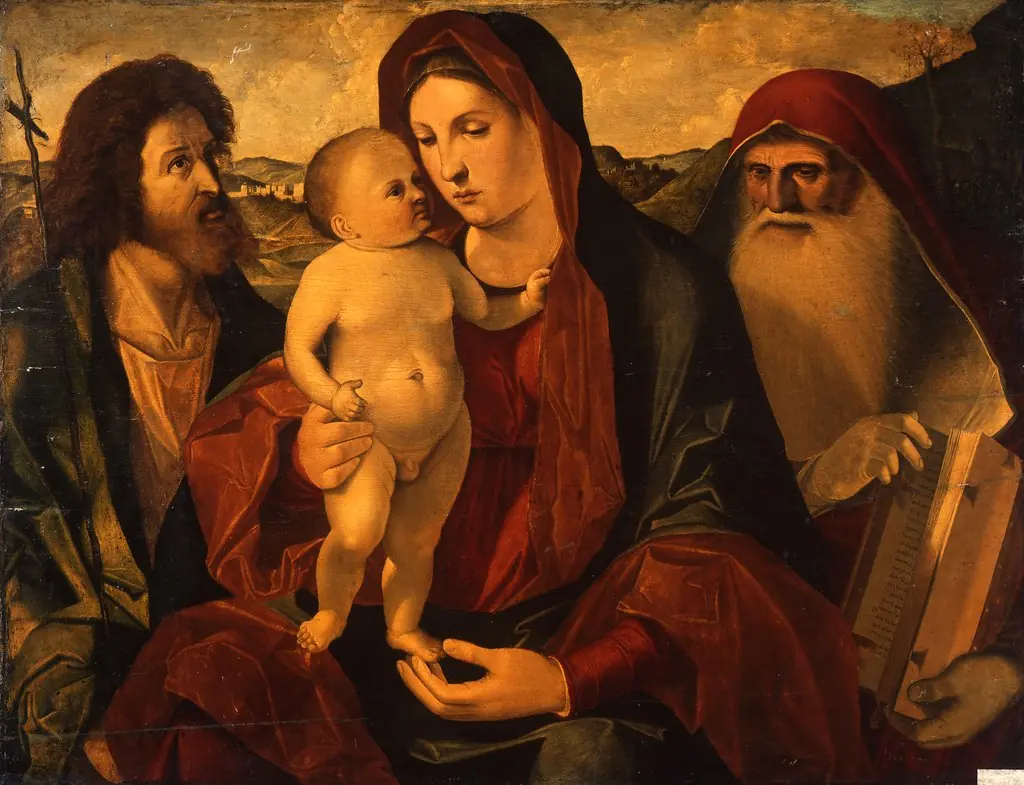
The painting was transferred from panel to canvas and is part of Titian's series of sacred conversations in landscape settings. A replica featuring Saint Catherine and Saint Jerome by a pupil of Titian was recorded in the Glasgow Corporation Galleries in 1904.
The painting is held by the Scottish National Gallery in Edinburgh, where it has been displayed on loan from the Bridgewater Collection. It is inventoried as part of the Bridgewater Loan, a long-term arrangement originating from the collection of the Earl of Ellesmere, who previously owned the work at Bridgewater House, Westminster.
The work has been exhibited at the Scottish National Gallery, though specific exhibition histories beyond its loan status are not detailed in the sources. Its presence in the gallery allows public viewing as part of the institution’s holdings.
Context
Scholarship has alternately aligned the painting with Palma Vecchio and with Titian’s early arc, with Morelli affirming its autograph status in the late nineteenth century and Crowe and Cavalcaselle initially attributing it to Palma. Gronau emphasized its Giorgionesque qualities and proposed a date around 1510–1512, while the Scottish National Gallery’s view places it closer to 1515–1520. The work’s status as a sacra conversazione in a landscape situates it within Titian’s early Venetian production, alongside contemporaneous compositions such as the Three Ages of Life.
Its reception centers on the chromatic orchestration and spatial division into contrasting shadowed and open halves, drawing the viewer’s gaze through intense reds and blues. A replica with Saint Catherine and Saint Jerome, noted by Gronau in 1904 as a pupil’s version, resides in Glasgow, underscoring the composition’s appeal within Titian’s circle.
Legacy
The painting's authorship was historically debated, with early critics like Crowe and Cavalcaselle attributing it to Palma il Vecchio, while Giovanni Morelli reasserted Titian's hand in the late nineteenth century. Georg Gronau later noted its Giorgionesque qualities, suggesting an earlier date around 1510 to 1512. The work's chromatic intensity, particularly its use of reds and blues, is cited as foreshadowing the artist's subsequent masterpieces.
A variant version featuring Saint Catherine and Saint Jerome, attributed to a pupil of Titian, was recorded in the Glasgow Corporation Galleries in 1904. The Edinburgh canvas remains a key example of Titian's early sacred conversations in landscape, with its attribution now widely confirmed by modern scholarship.
Overview
Titian’s early devotional work, executed in oil around 1515‑1520, brings together the Virgin Mary with the infant Christ, the youthful Saint John the Baptist, and a second, unidentified holy figure. The composition follows the conventional sacra conversazione format, arranging the saints in a serene, intimate setting. The painting is presently on loan to the Scottish National Gallery in Edinburgh, where it is displayed to the public.
Own this work as a print
Artist & collection
Artist
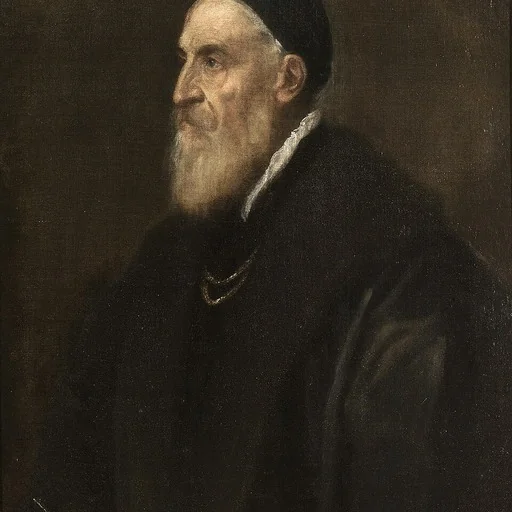
Tiziano Vecellio (Italian:; c. 1488/1490 – 27 August 1576), Latinized as Titianus, hence known in English as Titian ( TISH-ən), was an Italian Renaissance painter. The most important artist of Renaissance Venetian…

 The Adoration of the Shepherds
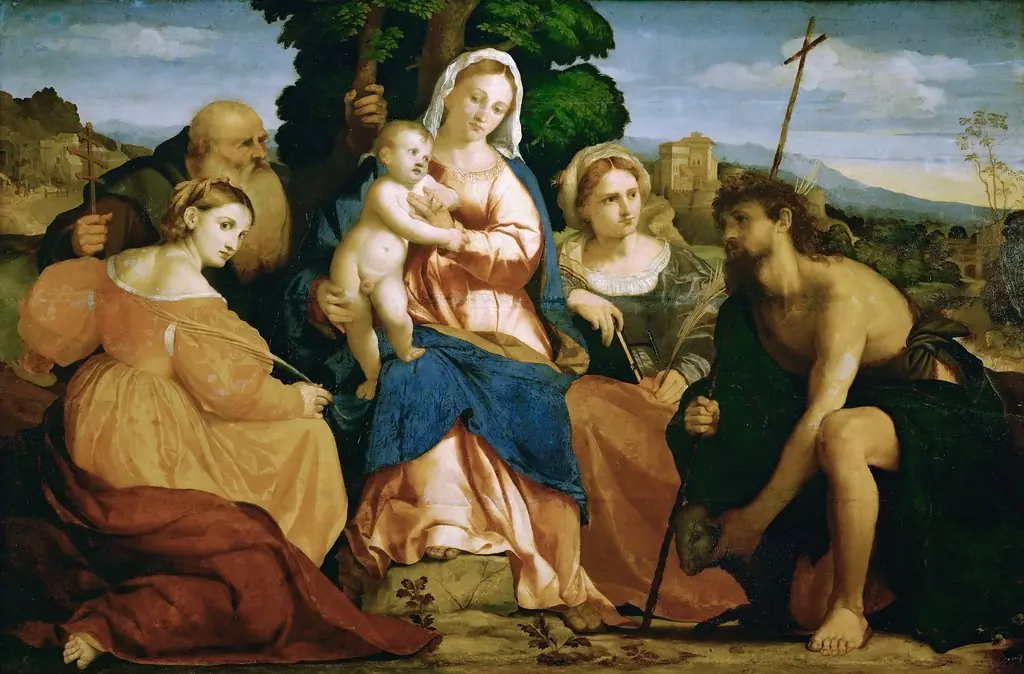 Sacred conversation
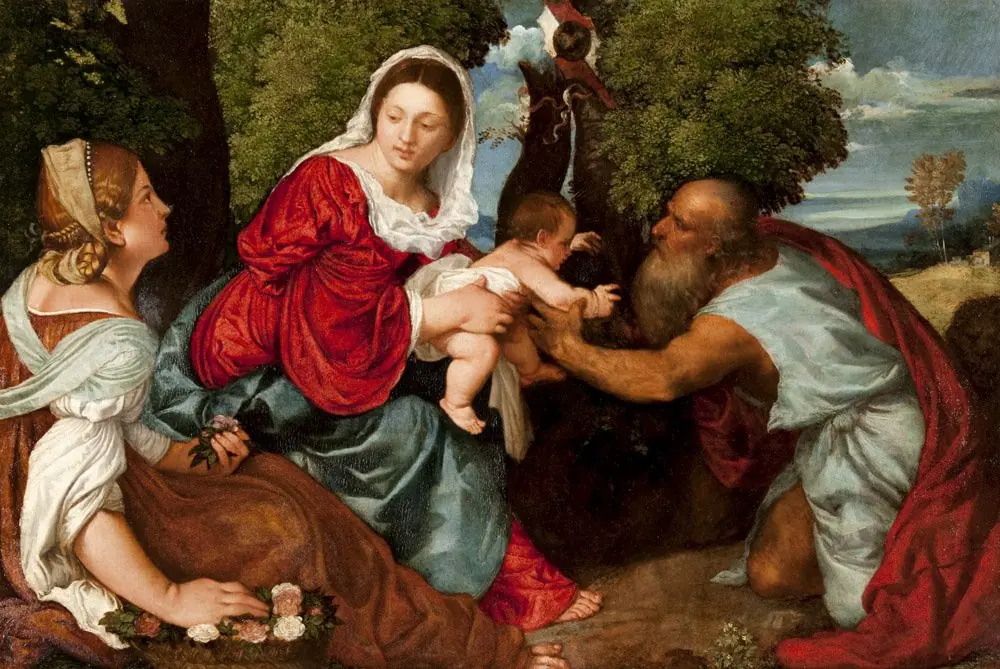 Madonna and Child with Saint Jerome and Saint Dorothy
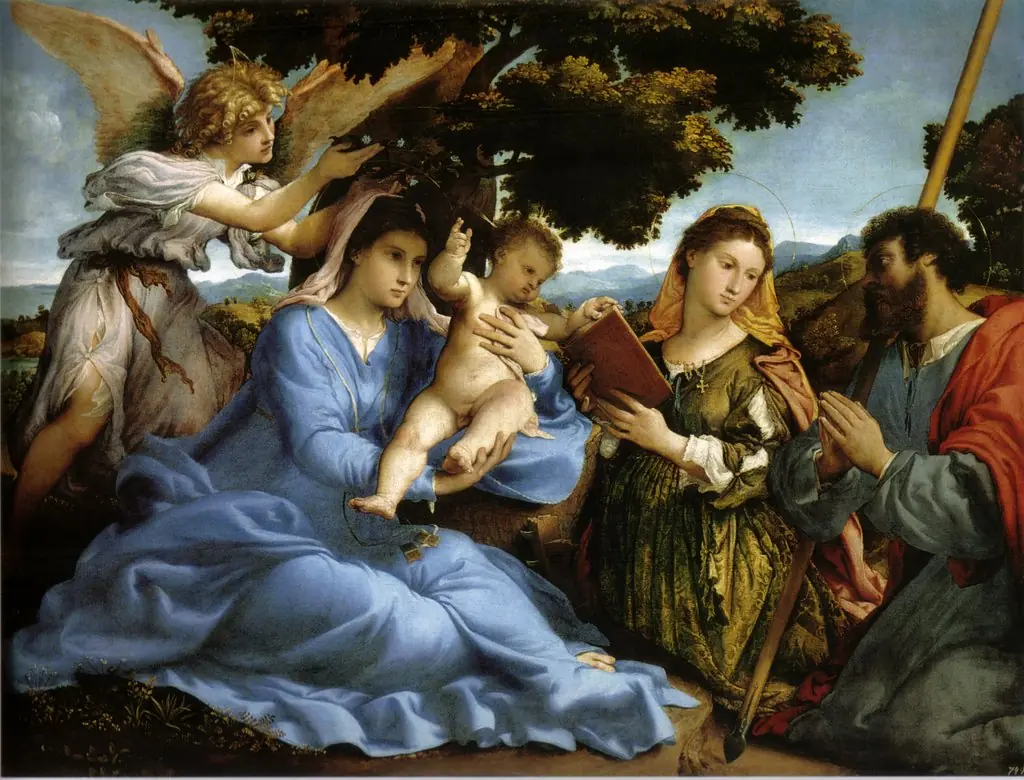 Madonna and child with Saint Catherine, Saint James the Greater, and an angel
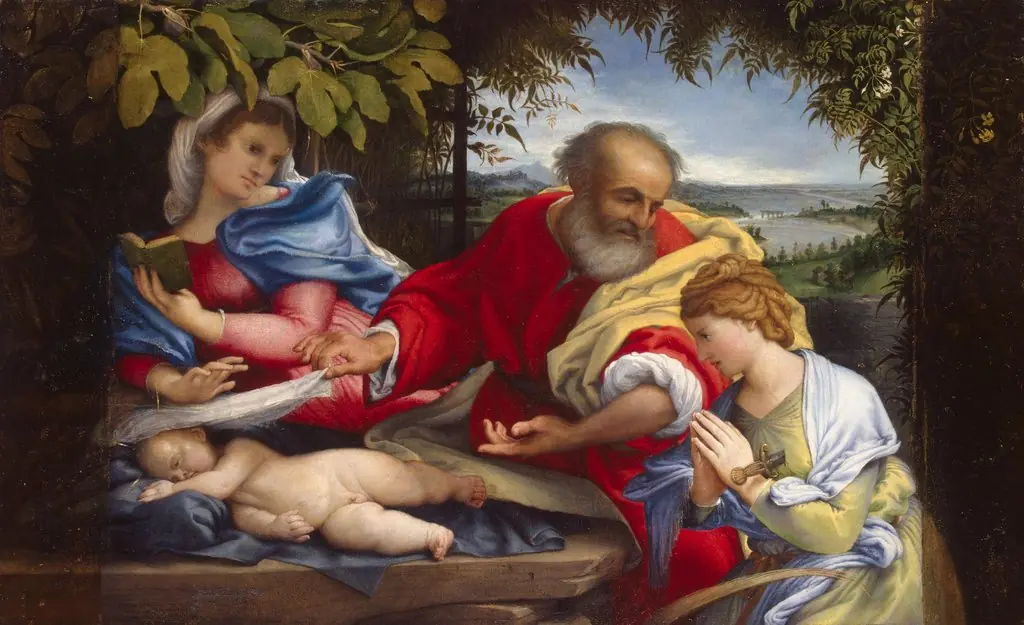 Rest on the Flight into Egypt with St Justine
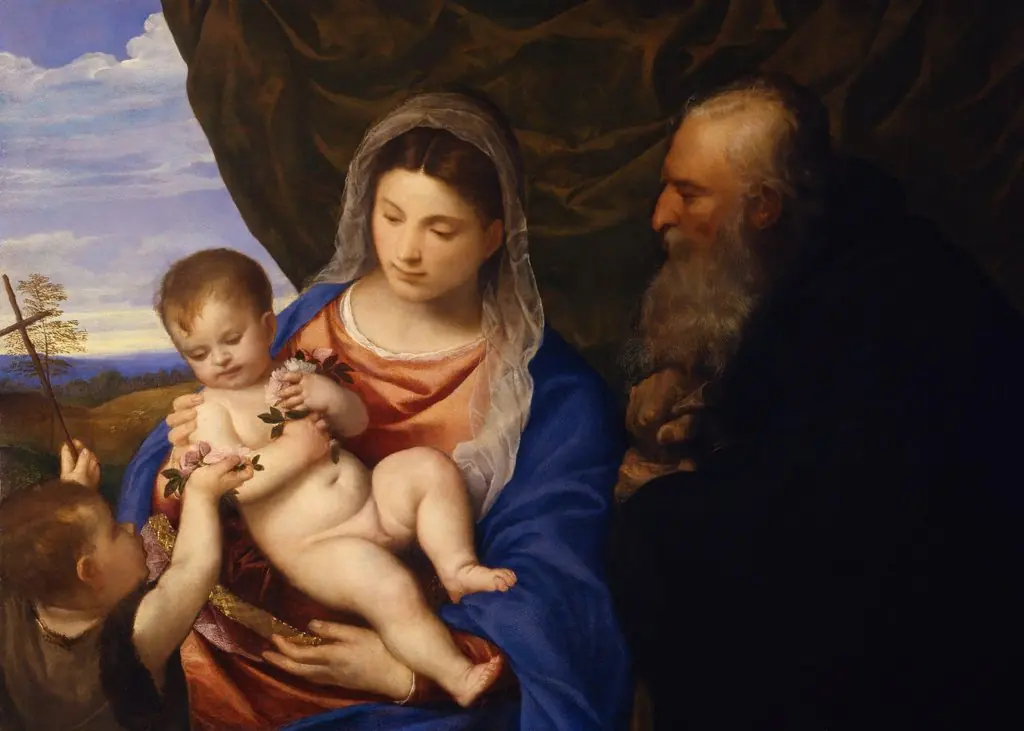 Madonna of the Roses
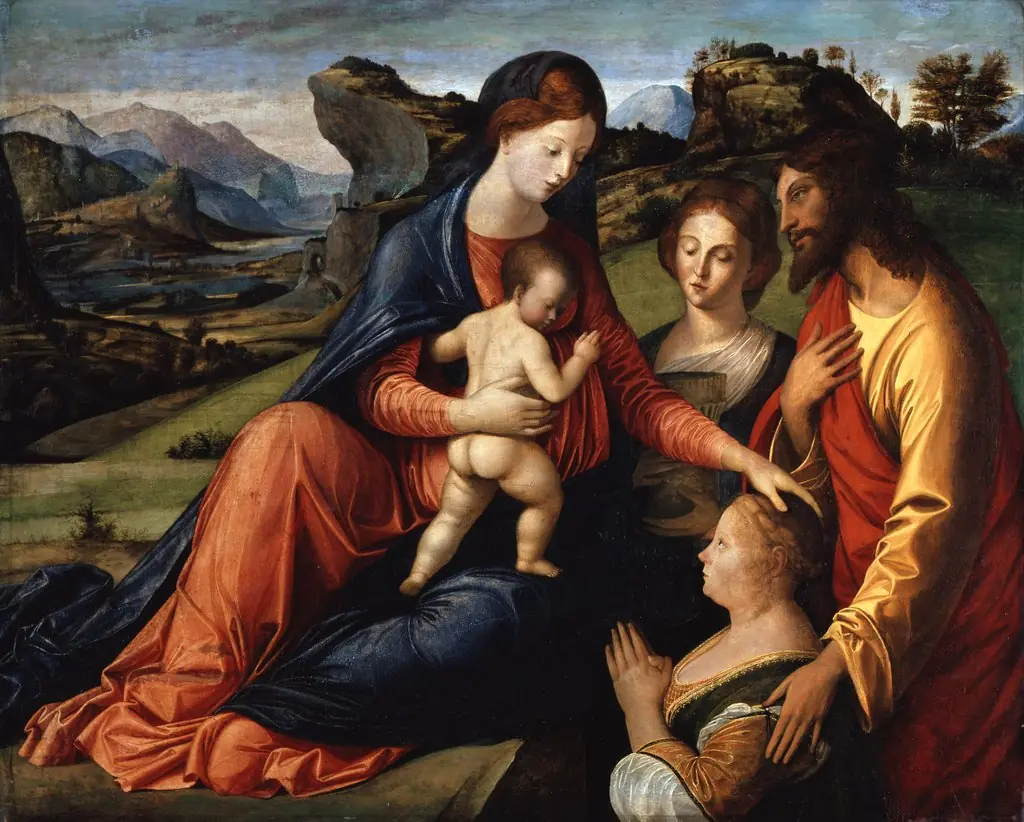 Virgin and Child with Saint Barbara, Saint John the Baptist and a female donor
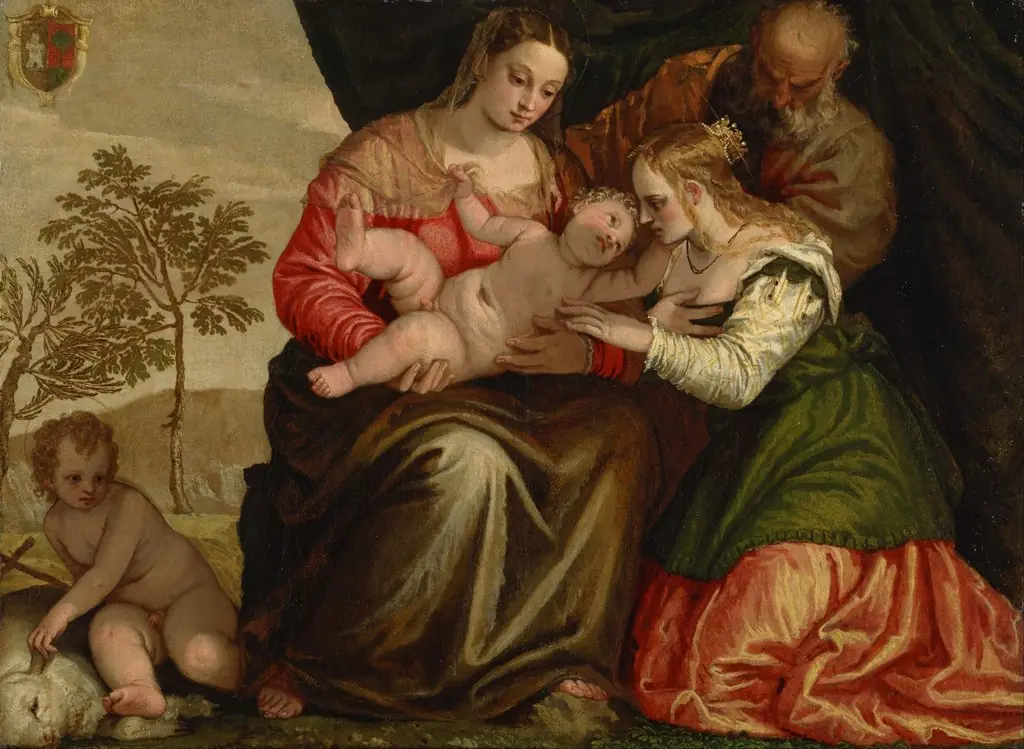 The Mystic Marriage of St. Catherine
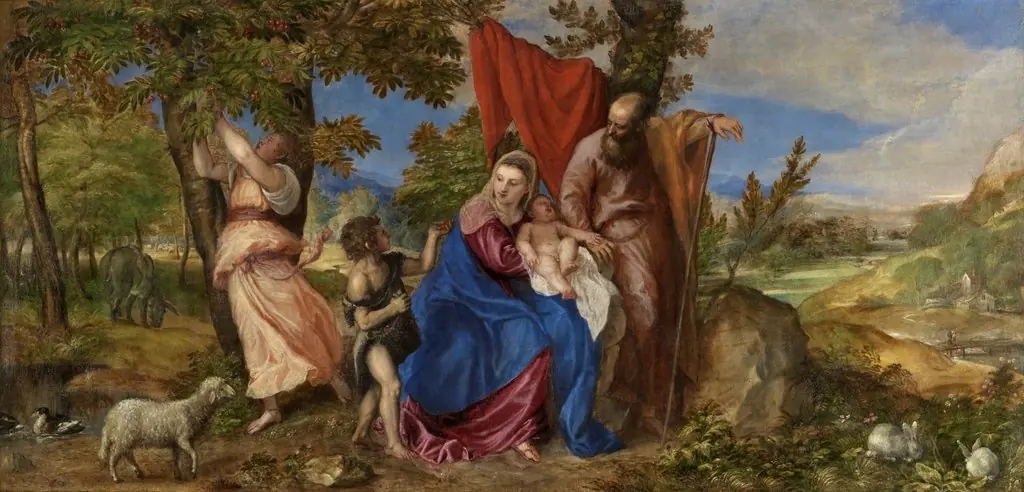 Rest on the Flight into Egypt
 Virgin and Child with Saints,
 Neitsyt Maria, Jeesus-lapsi, Johannes Kastaja ja Pyhä Antonius Apotti
- The Virgin and the Child with St. John the Baptist and St. Jerome