Artwork
南宋 佚名 舊傳五代周文矩 琉璃堂人物圖 卷|Scholars of the Liuli Hall
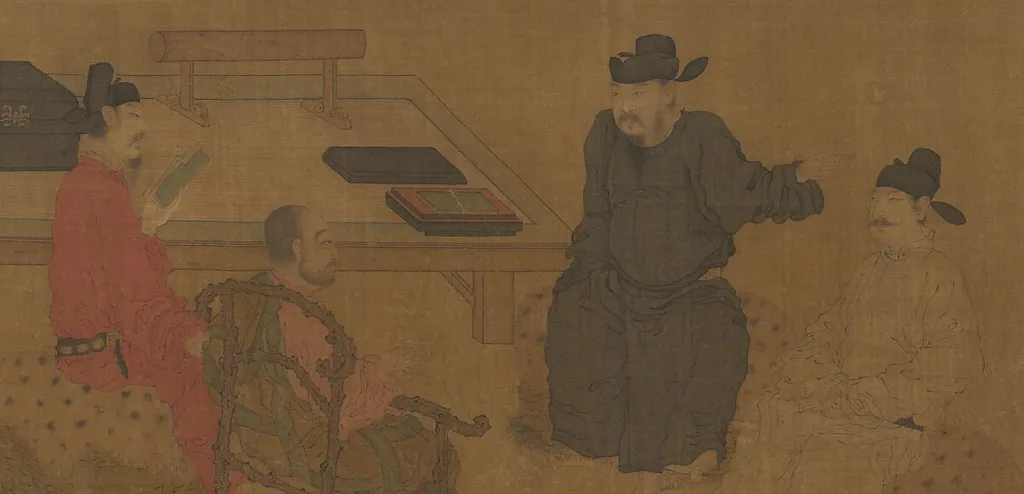
南宋 佚名 舊傳五代周文矩 琉璃堂人物圖 卷|Scholars of the Liuli Hall is an ink painting. It dates from 1283 and is held in the collection of the Metropolitan Museum of Art. Scholars of the Liuli Hall is a handscroll painting, rendered with ink and color on silk, originating from the Southern Song dynasty.
About this work
Subject & Meaning
While traditionally attributed to the Five Dynasties painter Zhou Wenju, the extant work is dated to 1283 and executed by an unknown artist.
The handscroll depicts a genre scene of scholars gathered within a setting identified in historical records as the Literary Garden. The composition features multiple men seated at tables and chairs, engaged in scholarly pursuits alongside books, which serve as central iconographic elements representing intellectual life and literati culture. While traditionally attributed to the Five Dynasties painter Zhou Wenju, the extant work is dated to 1283 and executed by an unknown artist.
The imagery of men in a garden setting with reading materials symbolizes the idealized courtly and scholarly environment, reflecting the values of learning and refined leisure. The specific arrangement of figures and objects conveys a narrative of intellectual exchange, rooted in the broader tradition of depicting the Liuli Hall as a place of literary assembly.
Technique & Style
Scholars of the Liuli Hall is executed as a handscroll in ink and color on silk, a traditional support for figural painting in China. The work belongs to the genre-scene category, depicting scholars gathered around a table with books and chairs within an interior setting. The silk ground carries the layered application of ink and pigment characteristic of Southern Song painting practice, allowing for both fine linear drawing and softer tonal washes.
The composition is organized as a continuous horizontal scroll, suited to the gradual unfolding of figures and furnishings across the viewing surface. Attributed traditionally to the Five Dynasties master Zhou Wenju but now regarded as a Southern Song work by an anonymous hand, the painting reflects the refined brush handling and intimate scale associated with later reworking of earlier figural models.
History & Provenance
The handscroll known as Scholars of the Liuli Hall is traditionally attributed to the Five Dynasties painter Zhou Wenju, though modern scholarship identifies the extant work as an anonymous creation from the Southern Song dynasty. The painting was executed in 1283, serving as a later reproduction or reinterpretation of an earlier composition titled Literary Garden. Currently held by the Metropolitan Museum of Art, the work is executed in ink and color on silk.
While the traditional attribution links the imagery to Zhou Wenju's style, the physical artifact dates to the late thirteenth century, reflecting the continued interest in depicting scholar-officials in garden settings during the Southern Song period.
Overview
Scholars of the Liuli Hall is a handscroll painting, rendered with ink and color on silk, originating from the Southern Song dynasty. This artwork depicts a tranquil interior scene, featuring a group of men engaged in scholarly pursuits. The composition offers a quiet observation of intellectual life, inviting viewers into a world characterized by its calm and contemplative atmosphere.
Artist & collection

 Untitled
 明/清 佚名 冒氏先人小像二幅 卷|Two Ancestors of the Mao Family
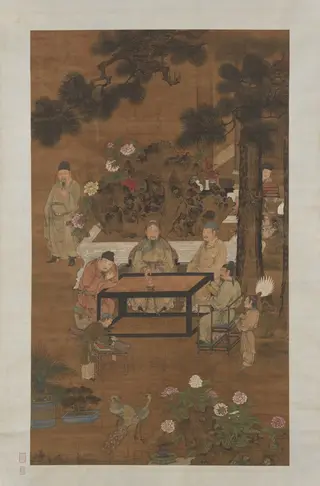 The Eighteen Scholars (zither)
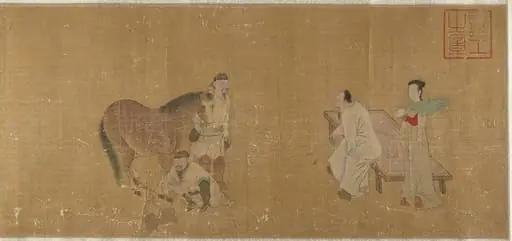 明/清 佚名 舊傳趙孟頫 相馬圖 卷|Judging a Horse
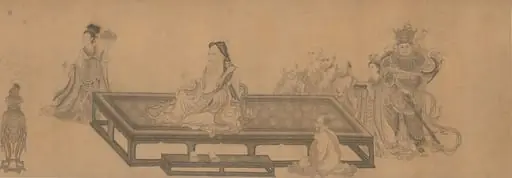 元 王振鵬 維摩不二圖 卷|Vimalakirti and the Doctrine of Nonduality
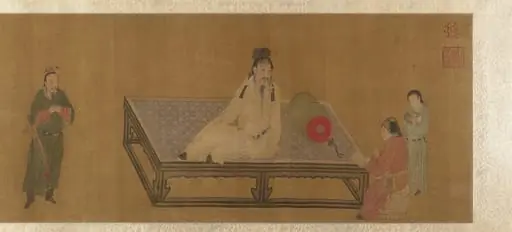 明/清 佚名 倣宋徽宗 明皇訓儲圖摹本 卷|Copy of Tang Ming Huang Instructing the Prince
 The Eighteen Scholars (Calligraphy)
 Untitled
 History of the Life of Tao Yuanming
 明 傳謝環 杏園雅集圖 卷|Elegant Gathering in the Apricot Garden