Artwork
Altar frontal from Cardet
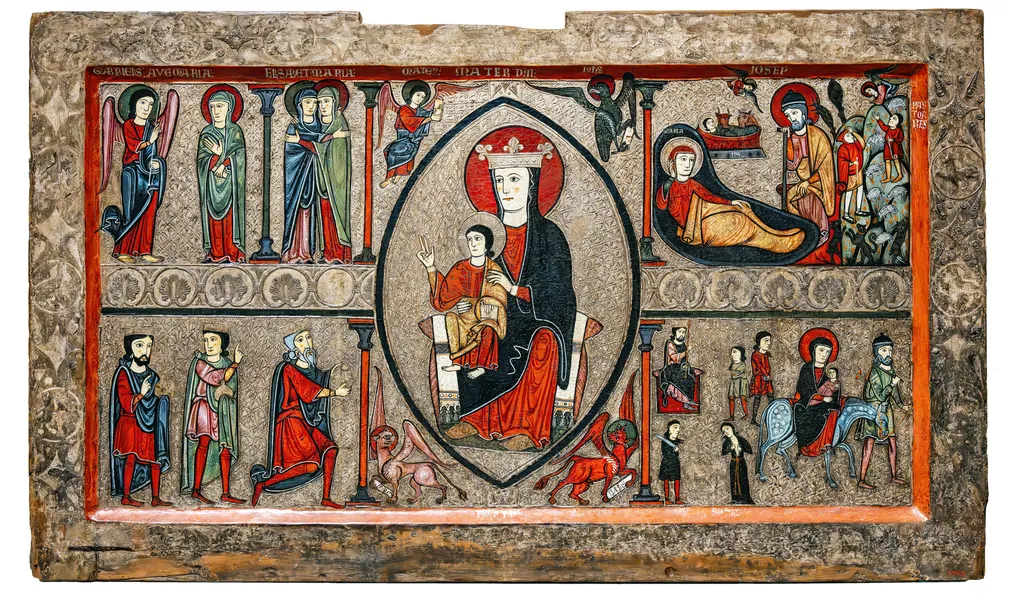
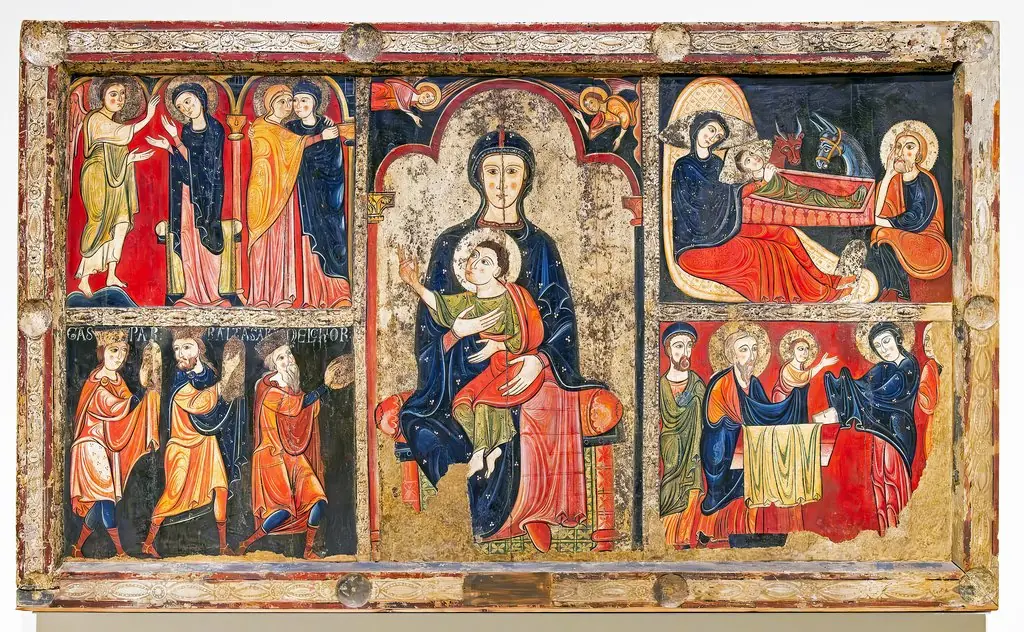
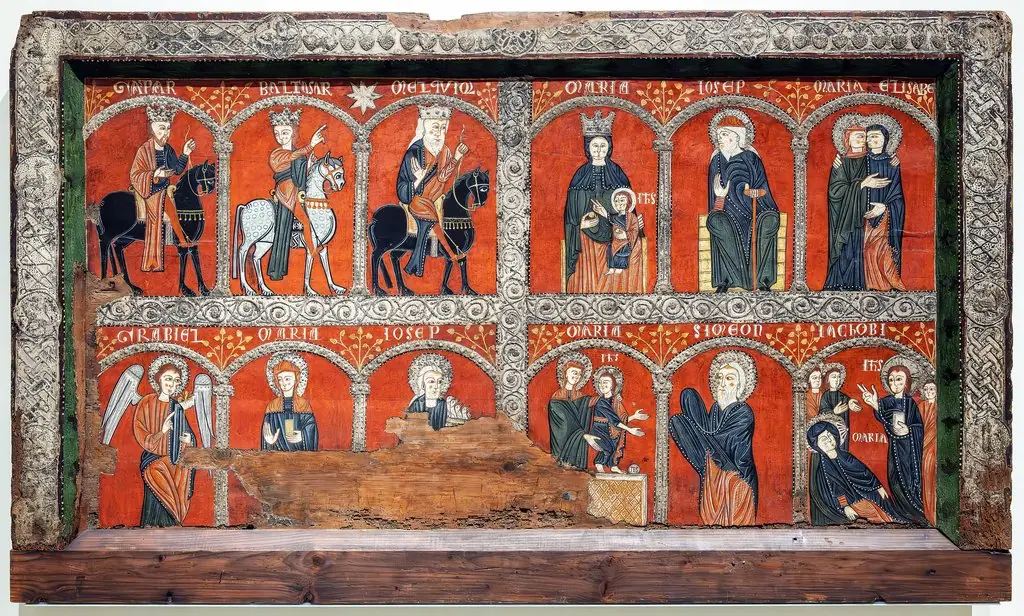
Altar frontal from Cardet is an unspecified painting by the Romanesque artist Unknown. It dates from 1250 and is held in the collection of the Museu Nacional d'Art de Catalunya.
About this work
Overview
The work is now conserved at the Museu Nacional d'Art de Catalunya in Barcelona, where it entered in 1932 as part of the Plandiura Collection.
The Altar frontal from Cardet is a painted wooden altar panel from the second half of the thirteenth century, attributed to the Ribagorça Workshop and the painter Iohannes. Measuring 97 by 162 centimeters, it was executed in tempera on wood with stucco reliefs and remnants of varnished metal plate. The work is now conserved at the Museu Nacional d'Art de Catalunya in Barcelona, where it entered in 1932 as part of the Plandiura Collection. It is regarded as one of the finest and most representative products of the Ribagorça Workshop, a regional center that synthesized Romanesque traditions with emerging early Gothic formulas.
Subject & Meaning
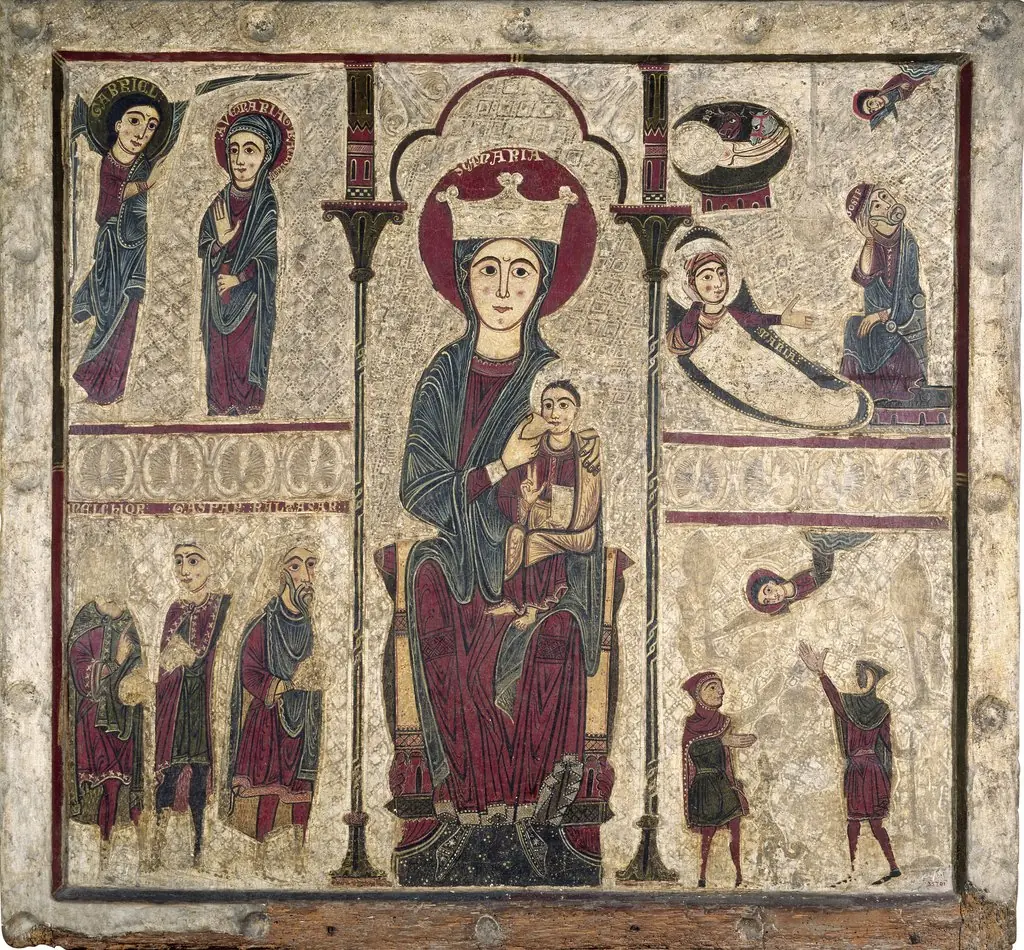
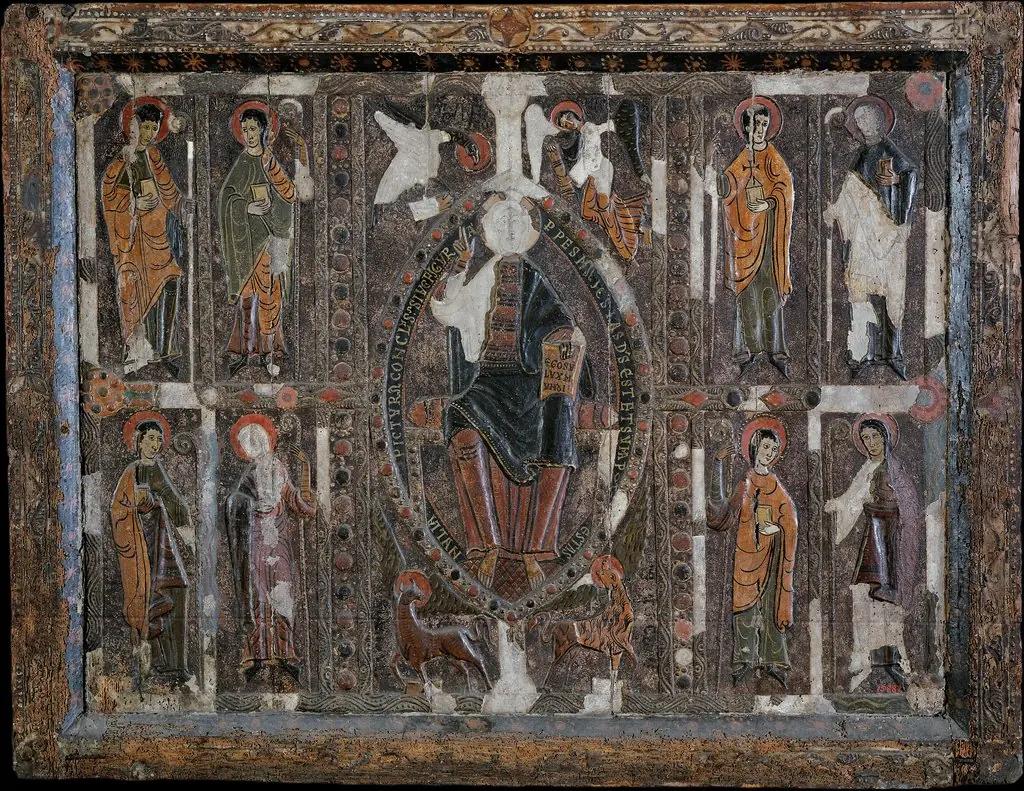
The panel is organized around a central oval medallion containing the enthroned Virgin and Child, both haloed, with the crowned Virgin in dark blue and red robes and the seated child raising one hand in blessing. This central group is enclosed within an almond-shaped mandorla supported by winged hybrid creatures and surrounded by the Tetramorph, the four symbolic beings associated with the Evangelists. Flanking this core image, thin columns divide narrative compartments depicting scenes from Christ's infancy cycle: the Annunciation to Mary, the Visitation of Saint Elizabeth, the Nativity, the Annunciation to the Shepherds, the Epiphany with the Magi and their offerings, the Slaughter of the Innocents, and the Flight into Egypt. Latin inscriptions run along the upper border. The iconographic program thus moves from announcement and incarnation through adoration to persecution and exile, framing the central Madonna and Child as the theological anchor of salvation history.
Technique & Style
The frontal is executed in tempera on wood with extensive use of stucco reliefs in the backgrounds and frames. These reliefs were originally coated with fine layers of metal and yellow varnish, a technique known as colradura or corladura, intended to simulate the appearance of precious metalwork. The palette is dominated by deep reds, blues, black, and gold against a patterned gold ground. Figures are stylized with frontal poses, large eyes, and elongated proportions; light is even and nonnaturalistic with minimal shading. The pictorial handling is highly narrative and descriptive, with fine linear drawing and flat color application. Decorative foliate patterns run along horizontal dividers. The surface now shows visible crackling, and the outer edges reveal worn, unpainted wood. Some gilding has been lost over time, though the colors remain vivid. The workshop's characteristic subtle facial modeling and the innovative use of relief for three-dimensional effect mark a transition toward early Gothic sensibilities.
History & Provenance
The frontal originates from the church of Sant Martí de Gia or Xia in the valley of Benasque, Alta Ribagorça, Huesca, in the western Catalan Pyrenees. It was acquired by the Museu Nacional d'Art de Catalunya in 1932 from the Plandiura Collection, having been removed from its original liturgical setting in the early twentieth century. The museum's accession number is 003903-000. Exceptionally, the lower frame preserves remnants of the painter's signature, the name Iohannes or Juan, a rare instance of authorship attribution for this period. The frontal is displayed in the museum's Romanesque galleries within the thematic context of "The voices of the Romanesque," where it is accompanied by audio elements linking its iconography to Gregorian chants such as "Vox in Ramà." High-resolution digital reproductions are accessible through the museum's online portal.
Context
Catalonia preserves the largest concentration of twelfth- and thirteenth-century painted altar frontals in Europe. These panels served as alternatives to costly metalwork furnishings, decorating the front of the altar in the most sacred space of the church. The Ribagorça Workshop, active in the mid-thirteenth century, represents a localized Pyrenean tradition that incorporated early Gothic formulas, notably narrative impulse and refined facial illumination, alongside Romanesque stucco relief techniques. The altar frontals from Gia and Cardet are the most representative works of this workshop. The inscription on the Gia frontal identifies the painter Iohannes and permits the deciphering of a similar inscription on the Cardet panel. Yet detailed analysis of panel joinery, frame construction, incisions, stucco reliefs, and volumetric pictorial devices reveals multiple hands at work within the same workshop. The Cardet frontal shares stylistic affinities with the Rigatell frontal, and the workshop's prolific output suggests strong contemporary demand for such visually striking works.
Legacy
The Altar frontal from Cardet remains a key monument in the study of Catalan Romanesque and early Gothic painting, valued for its exceptional preservation of the painter Iohannes's signature, its technical sophistication in stucco and metalwork simulation, and its comprehensive infancy cycle. As a centerpiece of the Museu Nacional d'Art de Catalunya's Romanesque collection, it continues to anchor scholarly discussion of workshop practice, regional identity, and the transition from Romanesque to Gothic in the Iberian Peninsula. Its digital dissemination and museum presentation within an immersive audio context ensure continued public engagement with medieval Pyrenean devotional culture.
Artist & collection