Artwork
Brahman Rishabhadatta's speech, folio 5 from a Kalpa-sutra
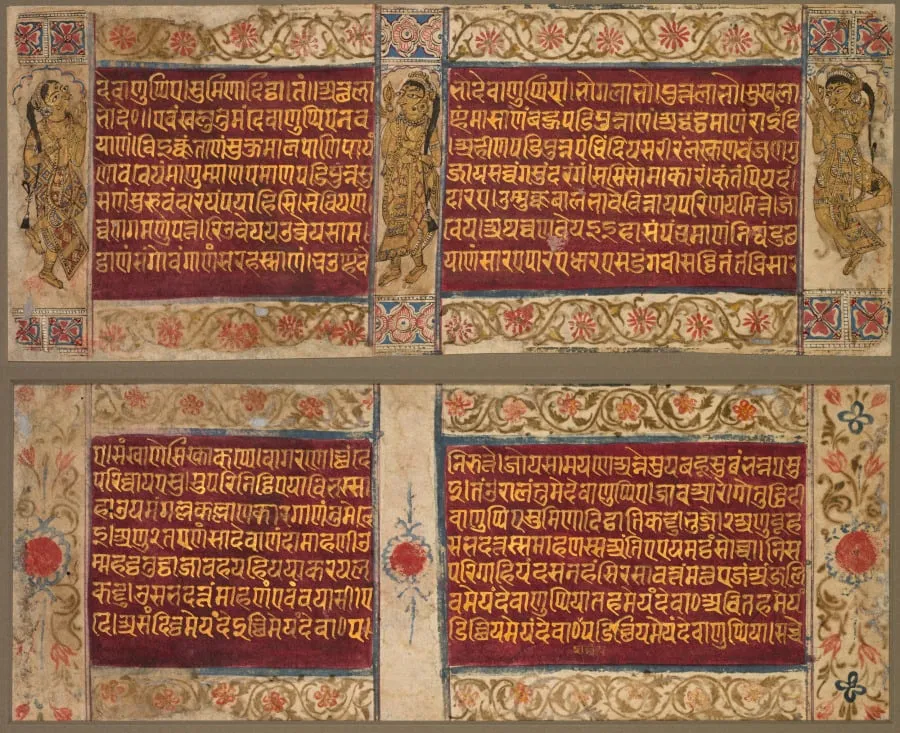
Brahman Rishabhadatta's speech, folio 5 from a Kalpa-sutra is an unspecified painting by the Mughal Painting artist Unknown. It dates from 1488 and is held in the collection of the Cleveland Museum of Art. This folio originates from a handwritten copy of the Kalpa-sutra, a sacred Jain text detailing the lives of the Tirthankaras.
- Accession no.
- 1979.23
- Credit line
- Gift in memory of Herbert F. Leisy
About this work
Overview
Produced in western India, likely Gujarat, during the 15th century, it reflects the devotional practice of commissioning illuminated manuscripts.
This folio originates from a handwritten copy of the Kalpa-sutra, a sacred Jain text detailing the lives of the Tirthankaras. Produced in western India, likely Gujarat, during the 15th century, it reflects the devotional practice of commissioning illuminated manuscripts. The use of gold leaf and intricate patterns signals both spiritual reverence and the donor’s social standing.
Each page was crafted as an act of piety, intended to purify karma and honor the teachings within.
Subject & Meaning
The scene depicts Brahman Rishabhadatta, the first Tirthankara, delivering a sermon to a gathering of followers beneath a canopy. Above, celestial dancers peer through cusped arches, symbolizing heavenly approval of the teaching. The white robe of the figure signifies purity, while the surrounding audience represents the transmission of doctrine. The celestial presence underscores the sacredness of the moment, linking earthly devotion with divine recognition.
Technique & Style
The painting employs mineral pigments and extensive gold leaf on a deep blue background, a hallmark of Gujarat’s manuscript tradition. Fine brushwork renders minute details in clothing, architecture, and ornamentation. The figures are stylized with elongated eyes and graceful postures, typical of Jain artistic conventions.
The composition balances symmetry and spatial depth, guiding the viewer’s gaze from the earthly sermon to the heavenly realm above.
History & Provenance
Created in the 15th century, likely for a wealthy Jain patron, this folio was part of a larger manuscript used in ritual recitation and veneration. Such manuscripts were often kept in temple libraries or private collections, handled with ceremonial care. Its survival suggests it was preserved through generations, possibly passed among religious communities or later collected by institutions interested in Jain heritage.
Context
In medieval Gujarat, Jain communities invested heavily in manuscript production as a form of religious merit-making. The Kalpa-sutra, containing biographies of the Tirthankaras, was especially revered. Wealthy patrons commissioned these works not only for spiritual cleansing but also to affirm their status within a tightly knit religious society. The visual splendor of such texts mirrored the cosmic order Jainism sought to uphold.
Legacy
This folio exemplifies the enduring tradition of Jain manuscript illumination, influencing later regional styles across western India. Its preservation allows modern scholars to study devotional practices, artistic techniques, and social hierarchies within medieval Jain communities. Though no longer used in ritual, such works remain vital cultural artifacts, offering insight into the intersection of faith, art, and patronage in pre-modern India.
Artist & collection









 Untitled
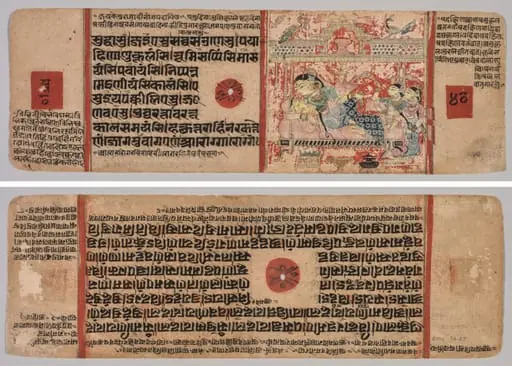 Folio 40 from a Kalpa-sutra: Text (recto); Birth of Mahavira (verso)
 Untitled
 Kalpa-sutra Manuscript with 24 Miniatures: Folio 60, text (recto); Sthulabhadra as a Lion (verso)
 Untitled
 Tantric Manuscript, "Sangrahani Sutra"
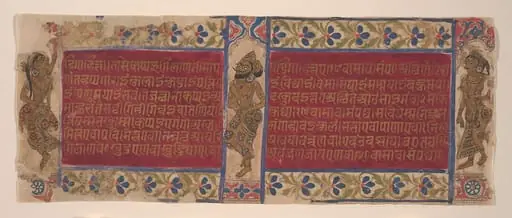
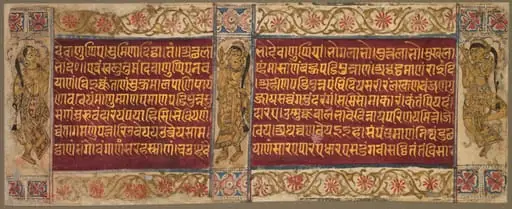 Celestial Dancers, folio 5 (recto), from Brahman Rishabhadatta's speech, from a Kalpa-sutra