Artwork
Kasuga Shrine Mandala
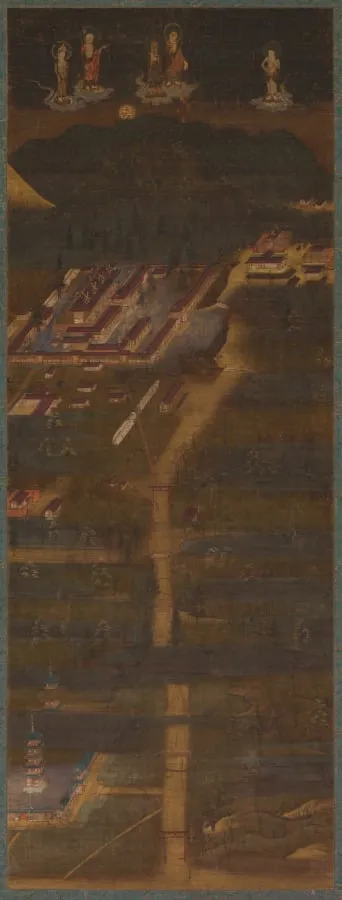
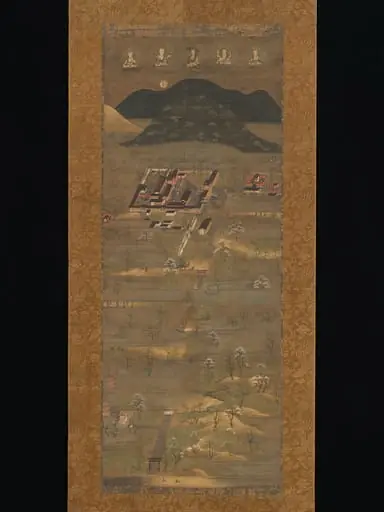
Kasuga Shrine Mandala is an unspecified painting by Unknown. It dates from 1304 and is held in the collection of the Cleveland Museum of Art. The work depicts a winding golden road that ascends toward a cluster of five Shinto shrine structures, rendered in red and white.
- Accession no.
- 2015.137
- Credit line
- Leonard C. Hanna Jr. Fund
About this work
The five figures at the bottom aren’t people, they’re the Buddhist forms of the shrine’s gods, blending two religions in one picture.
You see a golden path winding up a hill to five red-and-white shrine buildings, with a sacred mountain range behind them. Tiny deer dot the landscape, and the sun or moon glows above the peaks.
This painting maps Kasuga Taisha, a real Shinto shrine in Nara. The five figures at the bottom aren’t people, they’re the Buddhist forms of the shrine’s gods, blending two religions in one picture.
To see how other artists painted sacred Japanese sites, look up the subject japan, kamakura period (1185–1333).
Overview
The work depicts a winding golden road that ascends toward a cluster of five Shinto shrine structures, rendered in red and white. Behind the buildings a stylized mountain range rises, centered by Mount Mikasa, with a luminous celestial body, interpreted as sun or moon, glowing above. Small deer are scattered across the scene, and five ethereal figures hover on clouds above the peaks.
Subject & Meaning
The composition maps the layout of Kasuga Taisha in Nara, illustrating its five main shrine halls. The five floating figures represent the Buddhist avatars associated with the shrine’s native deities, reflecting the historical syncretism between Shinto and Buddhism. The deer, regarded as messengers of the shrine’s kami, reinforce the sacred atmosphere of the site.
Technique & Style
Executed with a flat, decorative palette, the painting employs bold outlines and a limited color range of gold, red, white, and muted earth tones. The use of a golden pathway creates a visual axis that guides the viewer’s eye upward, while the stylized mountains and celestial disc are rendered in simplified, almost emblematic forms typical of Kamakura-period religious art.
History & Provenance
Created during Japan’s Kamakura period (1185–1333), the piece was likely commissioned for devotional use at Kasuga Taisha or a related temple. It has remained in the collection of the shrine’s custodial institutions, passing through various temple archives before entering a museum collection in the early twentieth century.
Context
In the medieval Japanese context, the blending of Shinto shrine imagery with Buddhist iconography was common, reflecting the doctrine of shinbutsu shūgō. The painting thus serves both as a topographical guide to the sacred precinct and as a visual affirmation of the intertwined religious practices of the era.
Artist & collection