Artwork
Mahavira Gives Away his Possessions, Folio 35 (verso), from a Kalpa-sutra
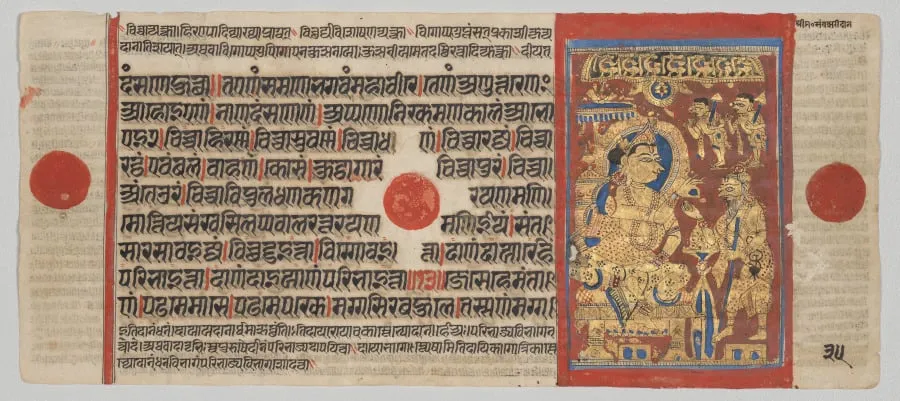
Mahavira Gives Away his Possessions, Folio 35 (verso), from a Kalpa-sutra is an unspecified painting by the Indian Miniature artist Unknown. It dates from 1488 and is held in the collection of the Cleveland Museum of Art. This folio, numbered 35 verso, originates from a manuscript of the Kalpa-sutra, a sacred Jain text.
- Accession no.
- 1932.119.35.b
- Credit line
- Edward L. Whittemore Fund
About this work
Overview
This folio, numbered 35 verso, originates from a manuscript of the Kalpa-sutra, a sacred Jain text. It depicts the moment when Mahavira, the 24th Tirthankara, renounces worldly goods. Rendered in vibrant pigments on paper, the scene is richly detailed with ornate patterns and structured composition, reflecting regional Indian manuscript traditions rather than Renaissance influences.
Subject & Meaning
Mahavira, identified by his crown and halo-like blue disc, sits on a throne as he distributes his possessions to followers and ascetics. This act symbolizes the Jain principle of non-attachment and the renunciation of material wealth as a path to spiritual liberation. The surrounding figures, including monks and laypeople, emphasize the communal witness to this pivotal moment in his life.
Technique & Style
While the composition is orderly, its flattened perspective and decorative emphasis align with Indian miniature traditions, not European Renaissance techniques.
The painting employs mineral pigments and fine brushwork typical of western Indian manuscript illumination. Intricate textile patterns, architectural details, and layered spatial arrangement reflect the conventions of Jain artistic practice. While the composition is orderly, its flattened perspective and decorative emphasis align with Indian miniature traditions, not European Renaissance techniques.
History & Provenance
Created in the 15th or 16th century, likely in Gujarat or Rajasthan, this folio once belonged to a larger illustrated Kalpa-sutra manuscript. Such texts were commissioned by Jain patrons for ritual use and study. The work’s survival suggests careful preservation within monastic or private collections, though its specific provenance prior to modern acquisition remains undocumented.
Context
Jain manuscript painting flourished between the 14th and 17th centuries, particularly in western India, where communities supported the production of devotional texts. The Kalpa-sutra, detailing the lives of the Tirthankaras, was a favored subject. These illustrations served both didactic and devotional purposes, reinforcing religious ideals through visual narrative in a literate but not universally reading society.
Legacy
Folios like this one remain vital to understanding Jain visual culture and the transmission of religious narratives through art. Though individual artists are unnamed, their work exemplifies a refined, localized aesthetic that persisted for centuries. Today, such manuscripts are studied for their historical, theological, and artistic significance within South Asian heritage.
Artist & collection









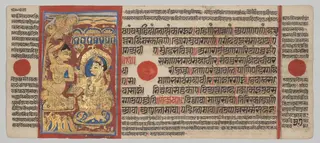 Mahavira's Initiation Tonsure, Folio 37 (verso), from a Kalpa-sutra
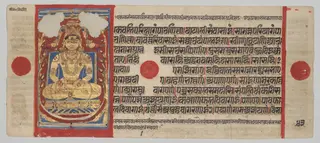 Mahavira in the Realm of Liberation (Nirvana), Folio 43 (verso), from a Kalpa-sutra
 Text, Folio 63 (verso), from a Kalpa-sutra
 Text, Folio 41 (verso), from a Kalpa-sutra
 Text, Folio 34 (verso), from a Kalpa-sutra
 Text, Folio 11 (verso), from a Kalpa-sutra
 Text, Folio 2 (verso), from a Kalpa-sutra
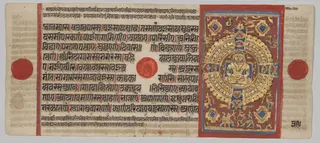 Mahavira's Omniscience and First Teaching (Samavasarana), Folio 39 (verso), from a Kalpa-sutra
 Text, Folio 33 (verso), from a Kalpa-sutra
 Text, Folio 35 (recto), from a Kalpa-sutra