Artwork
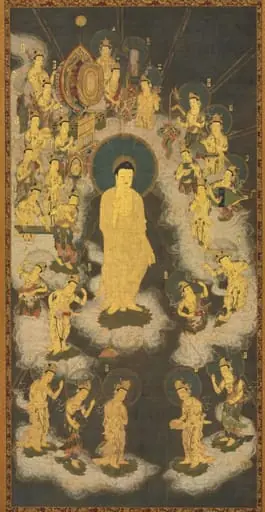
山王本地仏曼荼羅|Mandala of the Sannō Shrine Deities
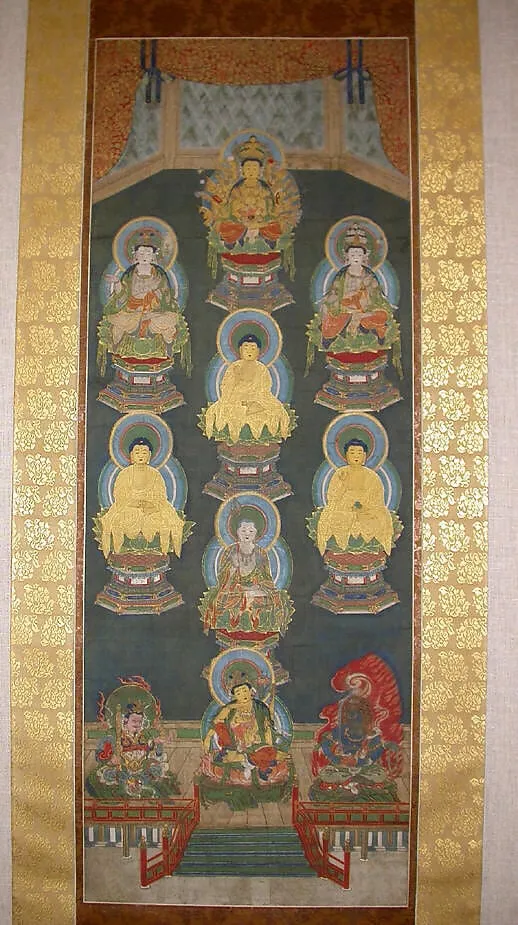
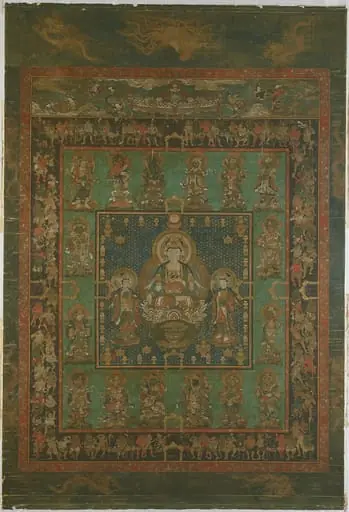
山王本地仏曼荼羅|Mandala of the Sannō Shrine Deities is an ink painting. It dates from 1649 and is held in the collection of the Metropolitan Museum of Art. The Mandala of the Sannō Shrine Deities is a hanging scroll crafted from ink and gold on silk.
- Accession no.
- X.78
- Credit line
- Museum Accession
About this work
Subject & Meaning
The piece thus serves both ritual and didactic purposes, representing the deities' roles in Buddhist worship.
The hanging scroll titled 山王本地仏曼荼羅 (Mandala of the Sannō Shrine Deities) portrays Buddhist deities linked to the Sannō shrine, illustrating a syncretic blend of Shinto and Buddhist iconography. Classified as a painting from 1649 and created in Japan, it is rendered in ink and gold on silk. Its subject functions as a mandala that visualizes the protective divine hierarchy associated with the shrine, embodying concepts of spiritual guardianship and the integration of Buddhist cosmology within a Shinto context. The piece thus serves both ritual and didactic purposes, representing the deities' roles in Buddhist worship.
Technique & Style
The work is a hanging scroll painted in ink and gold on silk, a medium typical of Japanese Buddhist paintings of the mid-seventeenth century. The support is a silk ground, with the ink providing the linear outlines and shading while gold leaf or pigment adds luminous accents to the deity figures. These material choices define the piece's technique and contribute to its visual presence as a devotional image.
History & Provenance
Created in 1649 in Japan, this hanging scroll depicting the Sannō shrine deities was executed by an anonymous artist using ink and gold on silk. It is now in the collection of the Metropolitan Museum of Art, New York, accessioned among the museum's Japanese paintings, and measures approximately 107.3 cm in height by 42.9 cm in width. The work's early ownership history and the path of transmission from Japan to the museum remain undocumented in available records, and no exhibition history is recorded in the cited sources.
Overview
The Mandala of the Sannō Shrine Deities is a hanging scroll crafted from ink and gold on silk. It presents a radiant gold circle populated by numerous small, red-robed deities, depicted as if seated upon clouds. This painting functions as a visual representation of sacred figures, typical of Buddhist devotional art.
Context
The absence of an artist's signature on this scroll suggests its creation as a devotional offering rather than a work emphasizing individual artistic identity. This anonymity aligns with practices where the production of religious art was often considered an act of spiritual merit, prioritizing the sacred subject matter over personal recognition.
Artist & collection

 阿弥陀二十五菩薩来迎図|Welcoming Descent of Amida Buddha and Twenty-five Bodhisattvas
 Tsong Khapa, Founder of the Geluk Order
 Untitled
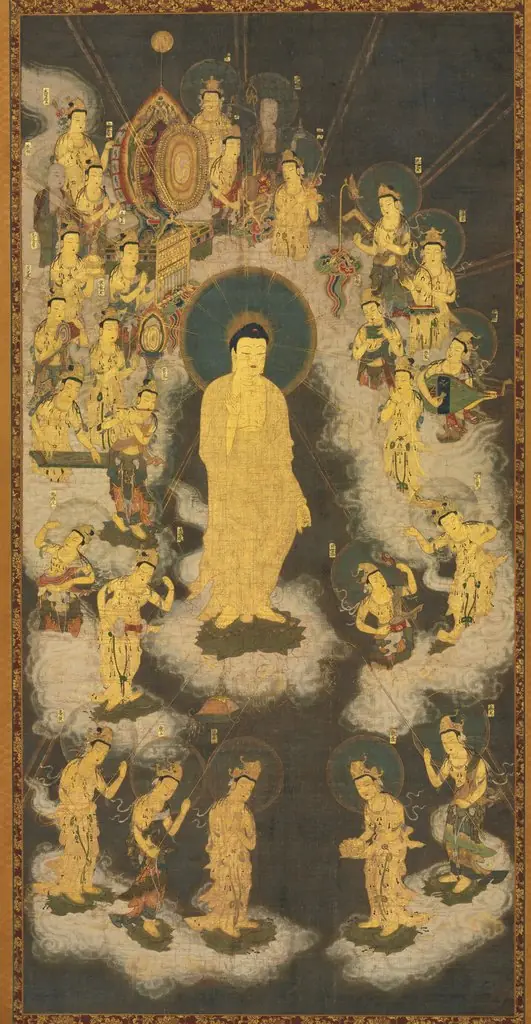 Welcoming Descent of Amida (Amida Raigō)
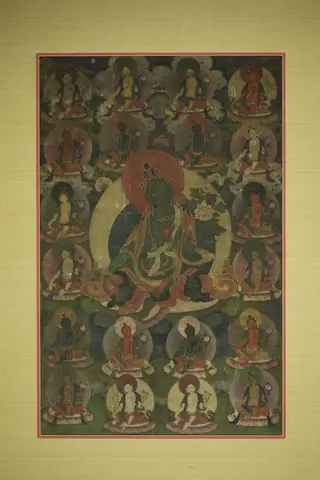 Painted Banner (Thangka) of Green Tara Surrounded by Twenty Manifestations
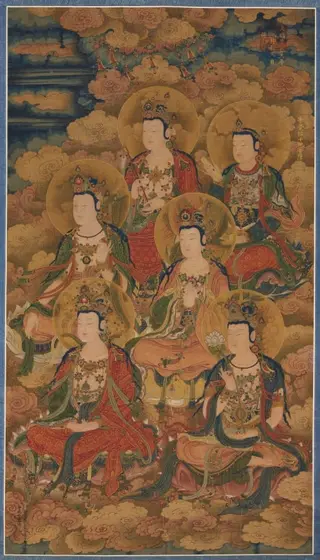 The Bodhisattvas of the Ten Stages in Attaining the Most Perfect Knowledge
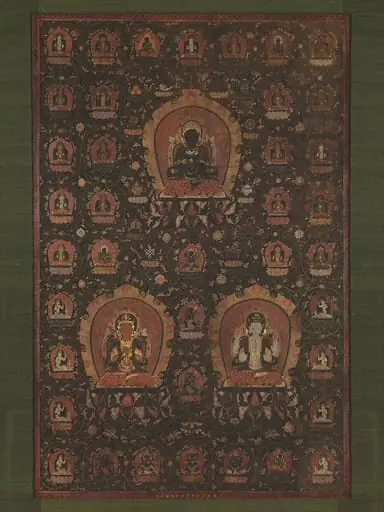 明 佚名 釋教三尊曼陀羅圖 軸|Mandala of Vajradhara, Manjushri and Sadakshari -Lokeshvara
 Welcoming Descent of Amida (Amida Raigō)