Artwork
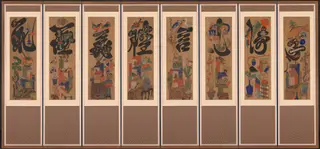
Munja-Chaekgeori Screen (Character-Books Screen)
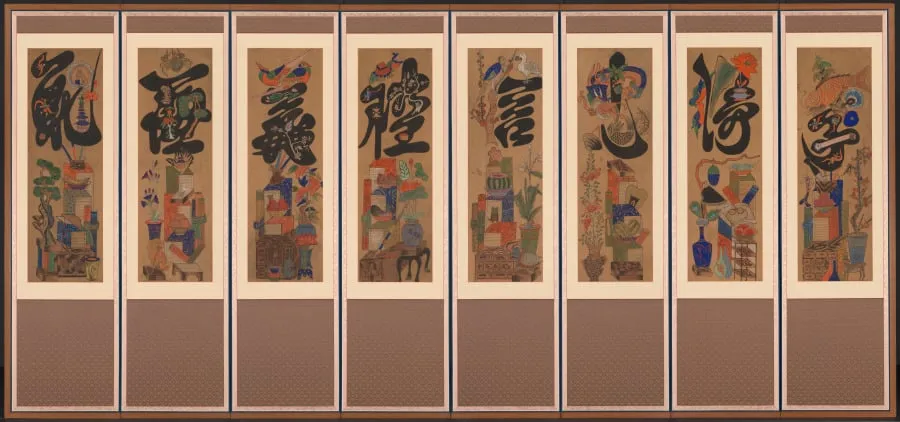
Munja-Chaekgeori Screen (Character-Books Screen) is an unspecified painting by the Korean Minhwa artist Unknown. It dates from 1904 and is held in the collection of the Cleveland Museum of Art.
- Accession no.
- 2017.6
- Credit line
- Severance and Greta Millikin Purchase Fund
About this work
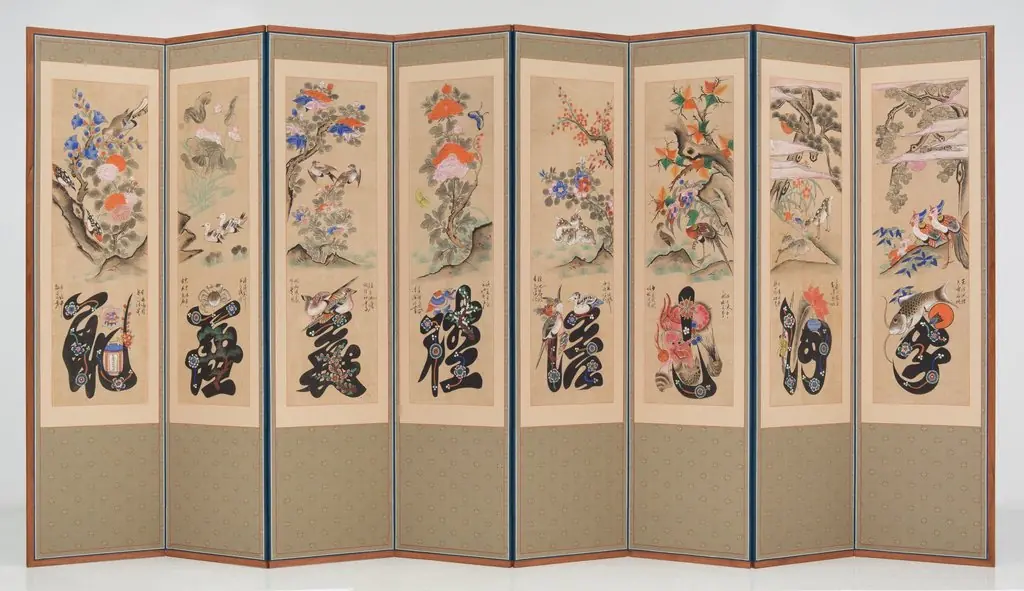
The top half spells out Confucian values, respect for parents, loyalty, trust, while the bottom half piles up everyday objects.
This folding screen shows eight panels of books, vases, and Chinese characters stacked like shelves. The top half spells out Confucian values, respect for parents, loyalty, trust, while the bottom half piles up everyday objects.
The mix feels playful yet serious. Books and porcelain sit next to words about duty, as if learning and living well belong together. No one knows who painted it, but the screen was made for a Joseon scholar’s home.
To see more screens like this, look up korea, joseon dynasty (1392–1910).
Overview
The work is a folding screen composed of eight panels that juxtapose two distinct visual themes: a lower register filled with depictions of books, decorative objects, and everyday items, and an upper register bearing classical Chinese characters. The characters, read from right to left, enumerate eight Confucian virtues prized in the Joseon period.
Subject & Meaning
The lower imagery belongs to the chaekgeori tradition, which celebrates scholarly paraphernalia and material culture, while the upper script reflects the munja genre, emphasizing moral instruction. By pairing these elements, the screen presents a dialogue between the material pleasures of learned life and the ethical ideals of filial piety, loyalty, trust, propriety, righteousness, modesty and humility.
Technique & Style
Painted in the Korean court style of the Joseon dynasty, the screen employs delicate brushwork and a restrained palette to render books, vases and other objects with a sense of three‑dimensionality. The characters are rendered in a formal calligraphic hand, contrasting with the more decorative, almost whimsical treatment of the objects below.
History & Provenance
The artist’s identity remains unknown, but the screen was likely commissioned for the private study of a Joseon scholar, reflecting the era’s practice of integrating instructional texts with visual enjoyment in domestic spaces.
Context
During the Joseon era, Confucian values guided both public conduct and private education. Chaekgeori paintings, popular among the literati, celebrated the accumulation of books as a sign of scholarly attainment, while munja inscriptions served as moral reminders. This screen merges the two, embodying the tension between material culture and ethical restraint.
Artist & collection