Artwork
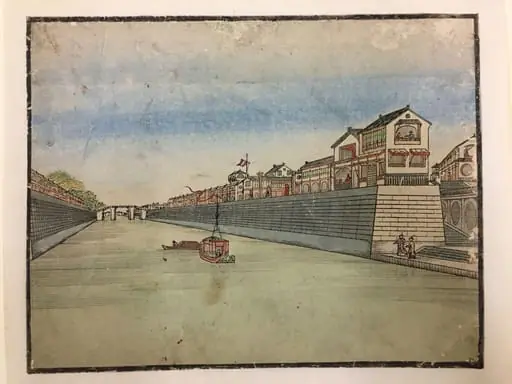
Perspective Print Depicting Wan-Nian Qiao Bridge in Suzhou
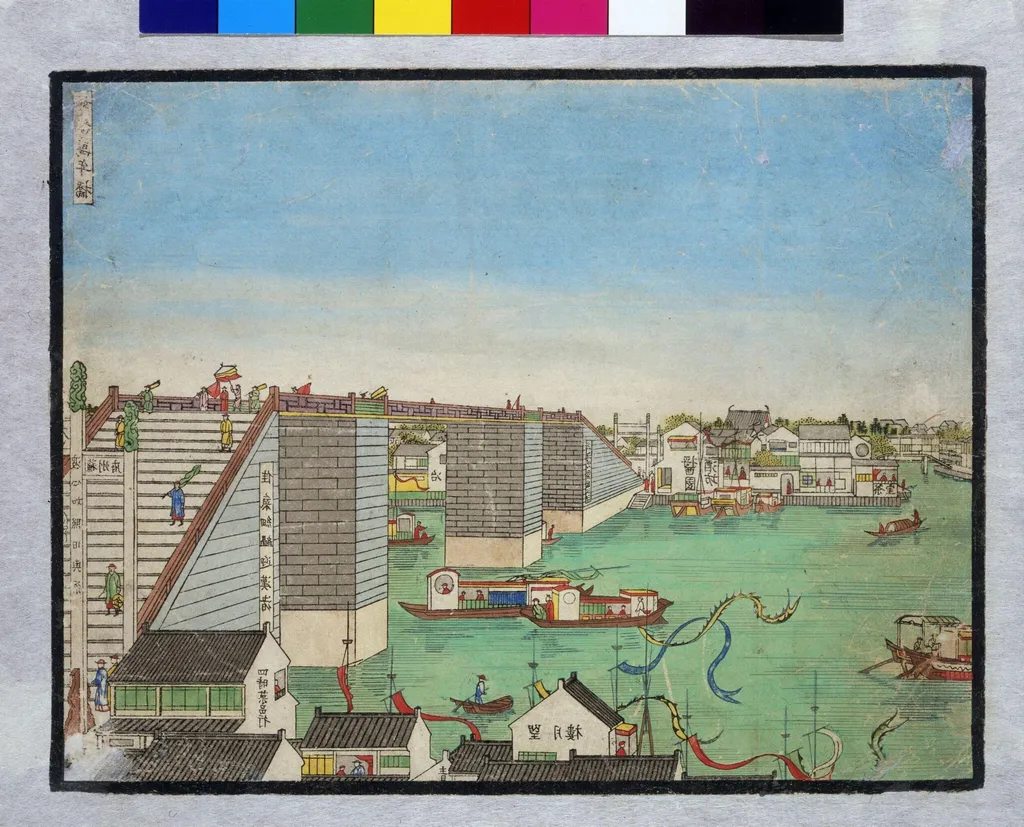
Perspective Print Depicting Wan-Nian Qiao Bridge in Suzhou is a print by the Romanticist artist Unknown. It dates from 1750 and is held in the collection of the Victoria and Albert Museum.
About this work
Overview
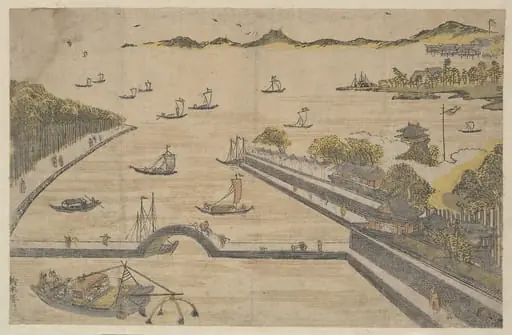
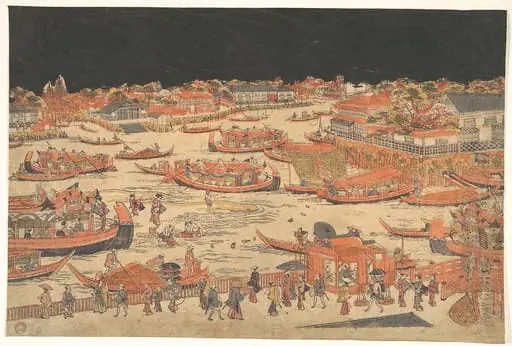
The work is a woodblock print portraying the Wan‑Nian Qiao Bridge in Suzhou, showing the arched span crossing a canal with boats navigating the water below.
The work is a woodblock print portraying the Wan‑Nian Qiao Bridge in Suzhou, showing the arched span crossing a canal with boats navigating the water below. The composition employs linear perspective to give the impression of depth, making the structures recede into the distance. The image was intended for viewing through a small optical device that reverses the print, allowing the scene to be seen correctly when viewed through a magnifying lens.
Subject & Meaning
The scene captures a bustling riverside setting: the bridge arches over the water, while figures in boats and on the banks suggest everyday activity in the city. By rendering the canal as deep and the architecture as diminishing with distance, the print conveys a sense of spatial order that was novel to Chinese viewers, linking a familiar locale with a newly introduced visual logic.
Technique & Style
The print utilizes the European linear‑perspective system introduced by Jesuit artists at the Qing court, a method uncommon in traditional Chinese woodcuts. To accommodate the peep‑box format, the design is carved in reverse, so that the final image appears correctly when reflected in a mirror. The delicate carving and fine lines reproduce architectural details and the movement of water, while the reversed inscription testifies to its intended optical presentation.
History & Provenance
Produced in the early eighteenth century, the print belongs to a series of New‑Year woodblocks that circulated widely in Suzhou, a hub for commercial printmaking. Such works were distributed in large numbers for festive occasions, reaching a broad audience beyond elite circles. The piece entered the collection of the Victoria and Albert Museum, where it remains part of the museum’s Asian prints holdings.
Context
During the Qing dynasty, Jesuit missionaries at the imperial court introduced Western artistic concepts, including perspective, to Chinese craftsmen. Suzhou’s thriving print industry quickly adopted these ideas, integrating them into popular visual culture. The resulting perspective prints served both as entertainment and as a means of disseminating foreign visual techniques among the urban populace, especially during the celebratory New‑Year period.
Artist & collection