Artwork
Saint Bartholomew
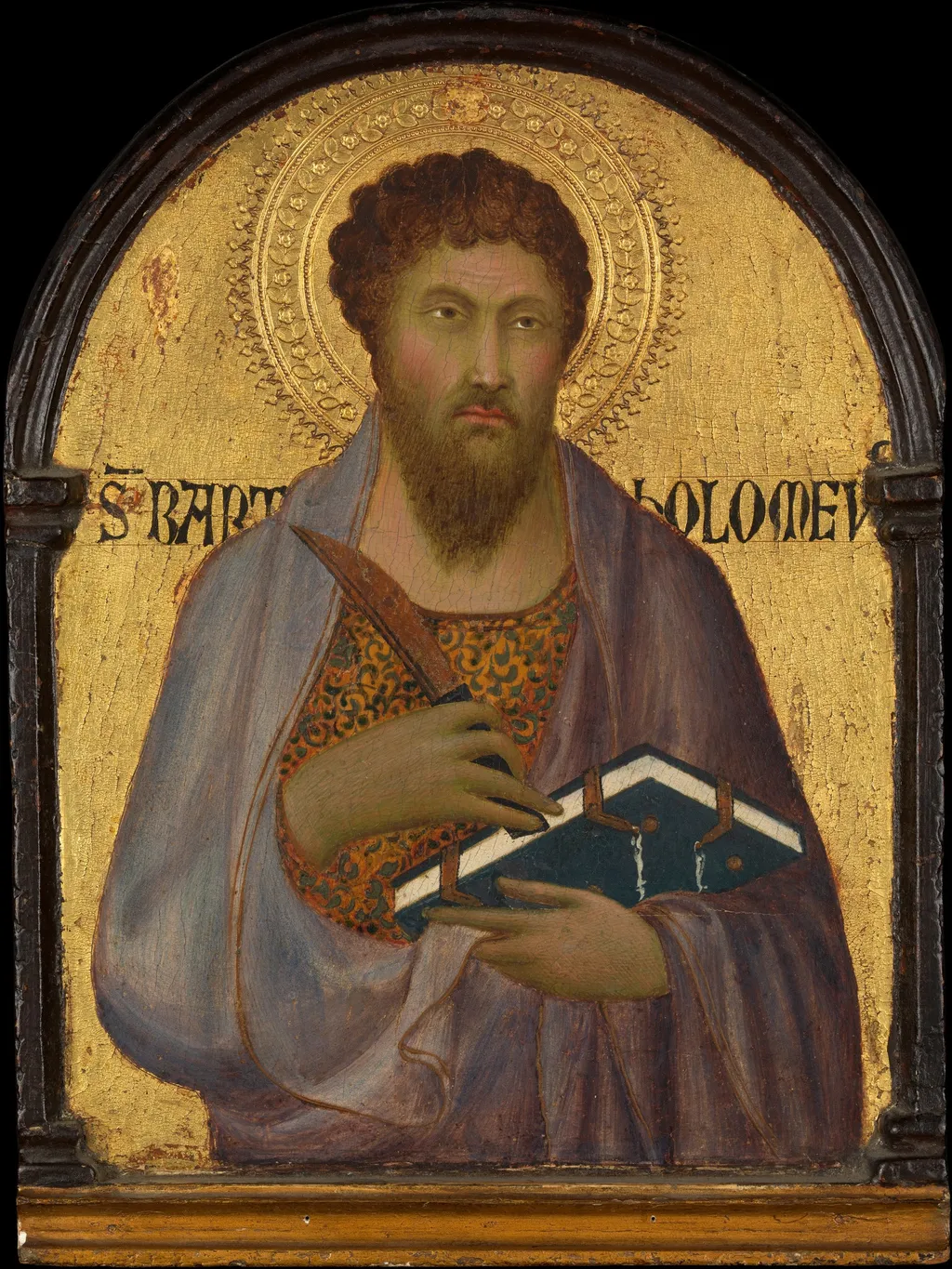
Saint Bartholomew is a tempera painting. It dates from 1317 and is held in the collection of the Metropolitan Museum of Art.
About this work
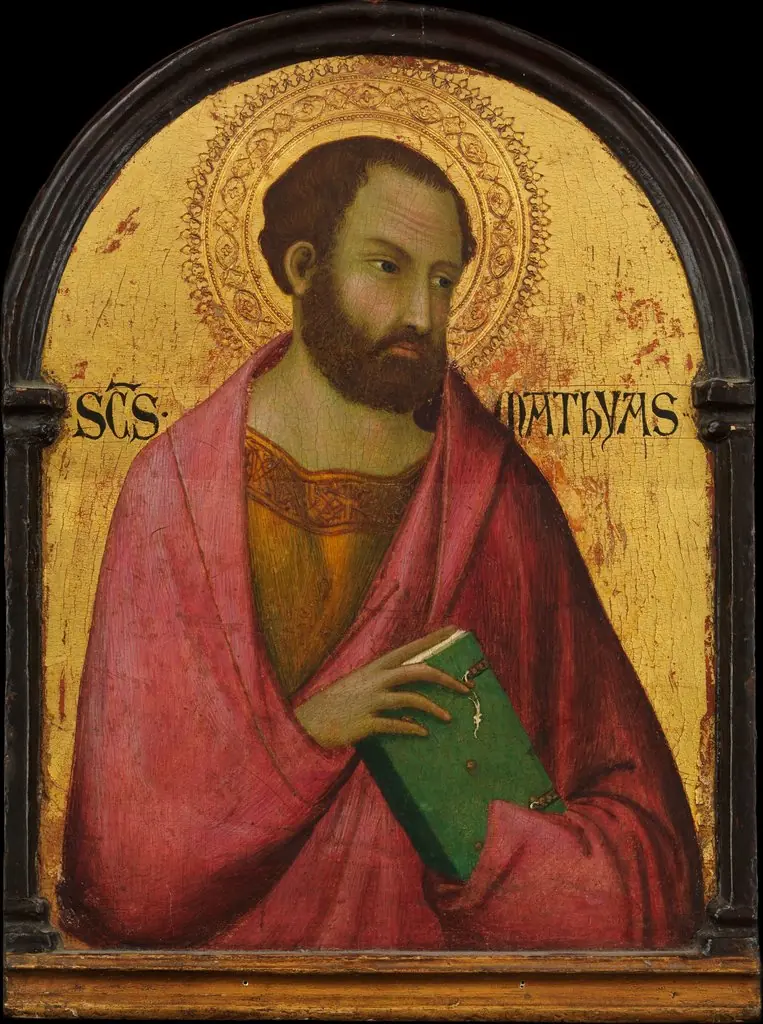
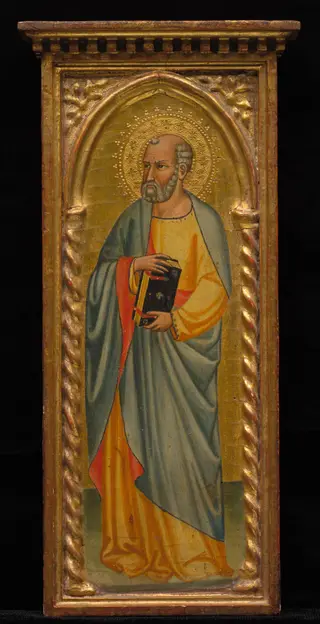
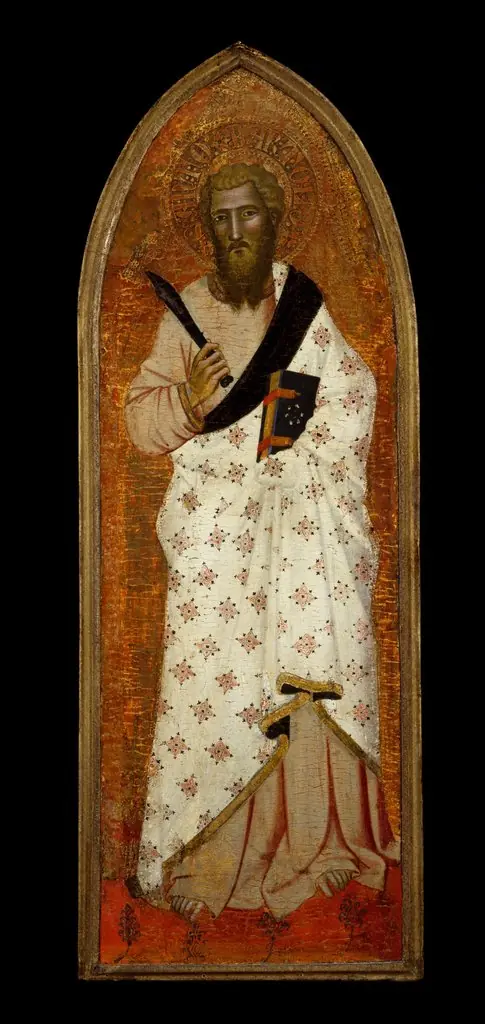
A bearded man in a gold-lined halo holds a closed book, his sleeves patterned in red and gold against a gold ground edged with black lettering. The name 'S Bartholomew' is written above him. Painted in tempera in 1317, the surface is flat and shiny in the manner of early religious art.
Subject & Meaning
The work belongs to the religious genre, indicating its function as an object of veneration rather than a secular portrait.
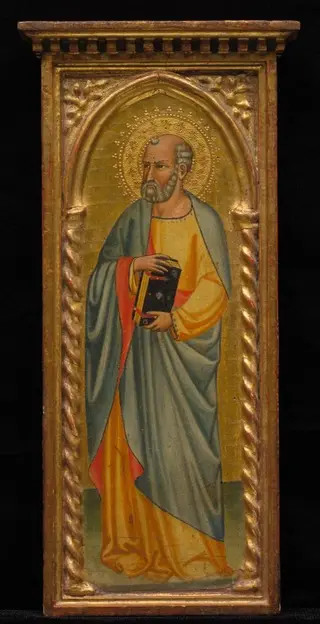
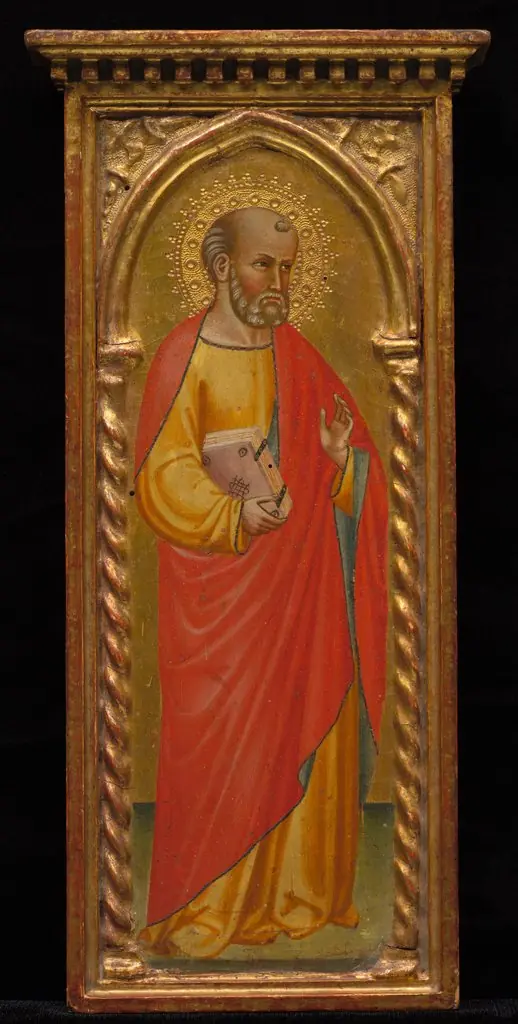
The panel portrays Bartholomew the Apostle, one of the twelve disciples of Christ, rendered in a manner consistent with early fourteenth-century Sienese devotional imagery. The saint is shown as a male figure accompanied by a book, a standard attribute in medieval Christian iconography that signals apostolic teaching, scriptural authority, and the evangelizing mission associated with Bartholomew. The work belongs to the religious genre, indicating its function as an object of veneration rather than a secular portrait.
Created in 1317, the painting reflects the workshop practice of Simone Martini, whose Sienese milieu frequently produced small-scale images of individual apostles for private devotion or as components of larger altarpiece programs. The combination of the saint's identity and the book attribute situates the image within the broader tradition of depicting apostles as bearers of the Gospel, emphasizing Bartholomew's role as a witness to and transmitter of Christian doctrine.
Technique & Style
Executed in 1317 by the Workshop of Simone Martini, this religious painting utilizes tempera applied to a wooden panel support. The work measures 26.4 cm in height and 19.7 cm in width, presenting a compact format typical of devotional imagery from the period. The composition features Saint Bartholomew the Apostle as the central figure, depicted holding a book, which serves as a primary iconographic attribute identifying the man as the specific saint.
While the sources confirm the medium and dimensions, they do not provide specific details regarding the current physical condition of the panel, surface handling, or technical analysis of the paint layers beyond the identification of tempera.
History & Provenance
The painting titled Saint Bartholomew was created in 1317 in the workshop of Simone Martini, executed in tempera on panel. It depicts the apostle Bartholomew holding a book, a standard attribute for the saint. The work measures 26.4 × 19.7 cm and is classified as religious art.
After its production, the piece entered the collection of the Metropolitan Museum of Art, where it has been preserved and exhibited. Its attribution to the early 14th‑century Italian school reflects the stylistic characteristics of Martini’s workshop.,
The painting Saint Bartholomew, executed in tempera around 1317, is housed in the Metropolitan Museum of Art in New York. Its dimensions are 26.4 cm by 19.7 cm, and it belongs to the Workshop of Simone Martini, a religious work classified as a painting. The work is recorded in the museum’s collection, though an explicit accession or inventory number is not provided in the available documentation. No exhibition history is documented in the supplied sources.
Overview
This tempera painting depicts Saint Bartholomew, a figure from Christian tradition. The artwork presents a single, standing male figure, whose identity is confirmed by an inscription. Characteristic of early religious art, the piece emphasizes spiritual representation through its medium and stylistic choices, rather than naturalistic detail.
Artist & collection