Artwork
Section of an Illustrated Tale of Genji Poetry Contest
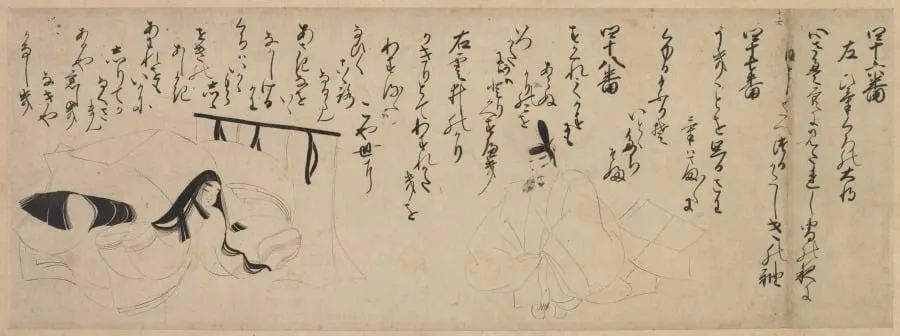
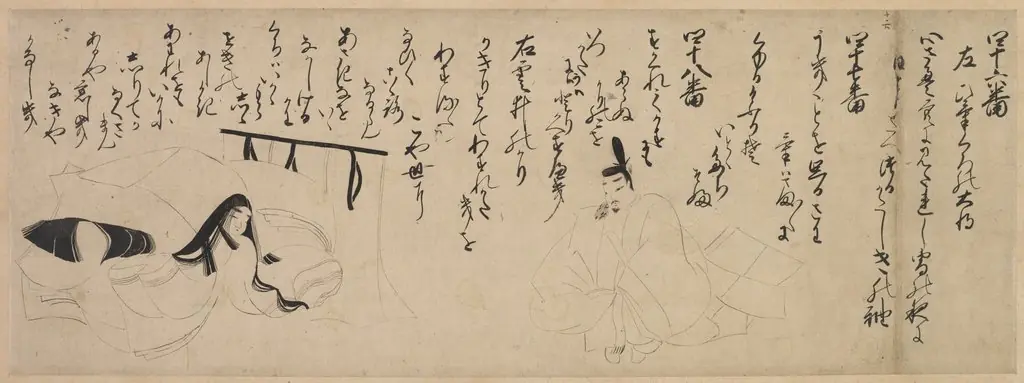
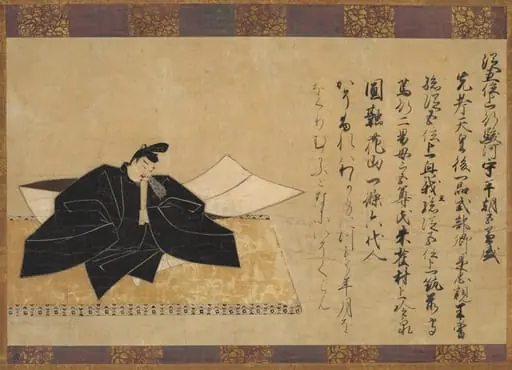
Section of an Illustrated Tale of Genji Poetry Contest is an unspecified painting by the Nanga artist Unknown. It dates from 1404 and is held in the collection of the Cleveland Museum of Art. This narrow hanging scroll illustrates a scene from a poetry contest drawn from the classic 11th‑century novel The Tale of Genji.
- Accession no.
- 1989.119
- Credit line
- Gift of Mr. and Mrs. Leighton R. Longhi
About this work
You see a narrow strip of paper with two figures facing each other: a woman in layered robes and a bearded man in court dress.
You see a narrow strip of paper with two figures facing each other: a woman in layered robes and a bearded man in court dress. Above their heads float tiny black numbers and lines of Japanese script.
This scroll was once part of a long, unrolled story showing a poetry contest from The Tale of Genji, a 1,000-year-old novel. The woman’s nickname, “Goose in Fog,” comes from a sad line she hums in the book. The artist left no name, so we don’t know who painted it or what colors were used.
To see more scrolls like this, look up japan, muromachi period (1392–1573).
Overview
This narrow hanging scroll illustrates a scene from a poetry contest drawn from the classic 11th‑century novel The Tale of Genji. Two figures, a woman in layered court robes and a bearded gentleman in formal attire, stand opposite one another, their dialogue rendered as numbered verses of waka poetry that hover above their heads.
Subject & Meaning
The female participant is identified by the nickname “Kumoi no kari” (literally “Goose in Fog”), a reference to a melancholy line she sings in the narrative. Opposite her is the poet known as Higekuro no taishō, or “General Blackbeard.” The scroll displays three of his verses (numbers 46–48) from the chapter “The Handsome Pillar,” followed by three responsive verses attributed to Kumoi no kari, drawn from the chapters “The Plum Tree Branch,” “New Wisteria Leaves,” and “Evening Mist.”
Technique & Style
Executed on a thin strip of paper, the work employs delicate line drawing to delineate the figures and their garments, while the poetry is inscribed in small black characters above each participant. The composition is linear, emphasizing the exchange of verses rather than elaborate background detail, a typical approach for narrative scrolls of the period.
History & Provenance
The scroll formed part of a longer handscroll that once presented the entire poetry contest from The Tale of Genji. The artist’s identity remains unknown, and no surviving pigment analysis confirms the original colour scheme. The fragment survived as an independent hanging scroll, preserving a segment of the larger narrative.
Context
Poetry contests were a popular literary motif in Japanese court culture, especially during the Muromachi period (1392–1573), when illustrated scrolls often visualized scenes from classical texts. This piece reflects that tradition, linking visual art with the highly stylized waka form that defined aristocratic communication.
Artist & collection









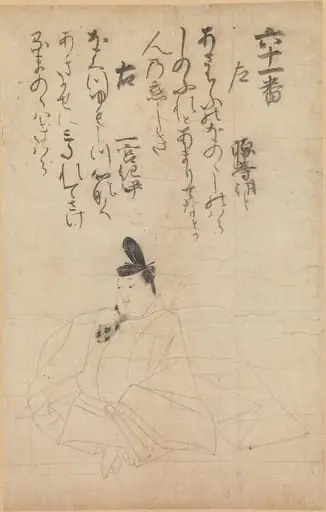 Untitled
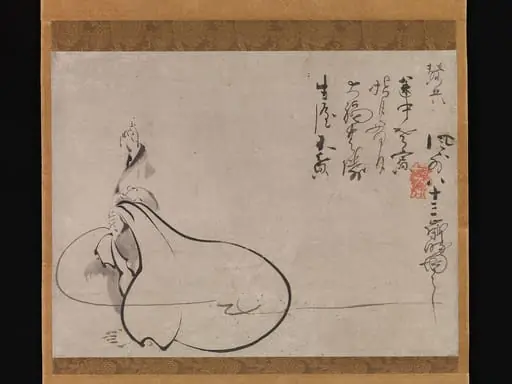 風外慧薫筆 指月布袋図|Hotei Pointing at the Moon
 Untitled
 清原元輔 「為重本 時代不同歌合絵巻」 断簡 |The Poet Kiyohara Motosuke, from the “Tameshige Version” of Thirty-six Poetic Immortals (Tameshige-bon Jidai fudō utawase emaki)
 Untitled
 The Thirty-Six Poetic Immortals (Sanjūrokkasen)
 Daruma
 Listening to the Wind in the Pines
 Untitled
 Untitled
 Taira no Kanemori of the Thirty-Six Poetic Immortals
- Section of an Illustrated Tale of Genji Poetry Contest