Artwork
The Sheep-eater exhibiting his powers at Fategarh in Uttar Pradesh on 3 March 1796
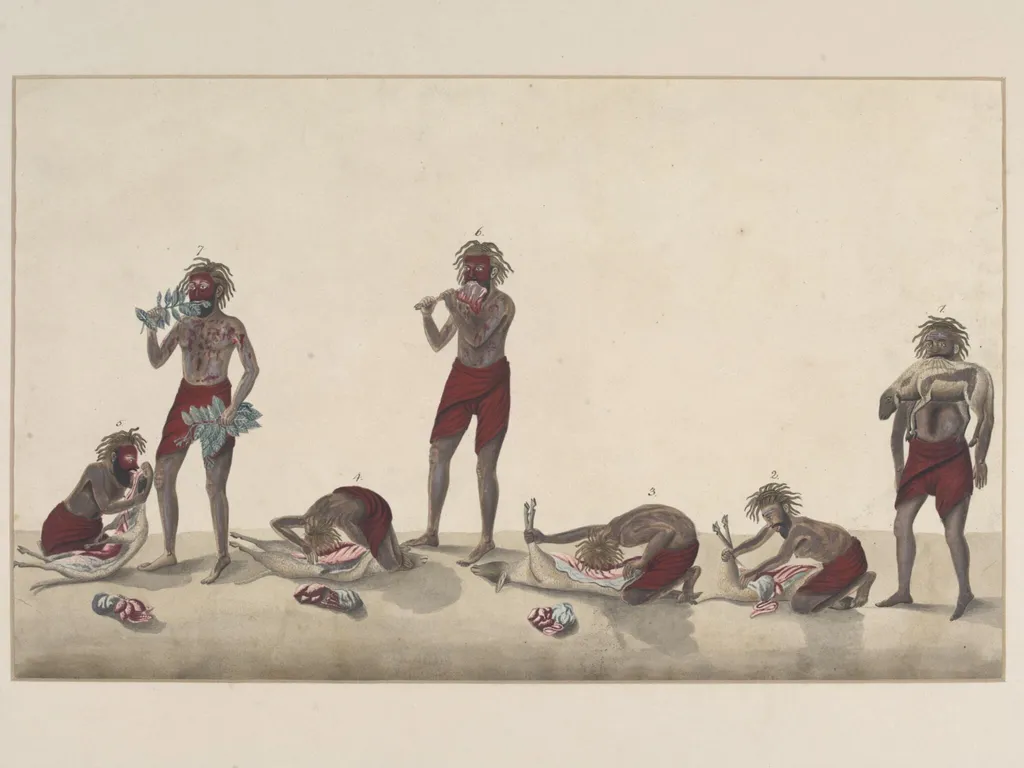
The Sheep-eater exhibiting his powers at Fategarh in Uttar Pradesh on 3 March 1796 is a paint painting by the Patna School of Painting artist Unknown. It dates from 1800 and is held in the collection of the Victoria and Albert Museum.
About this work
Overview
This Company painting records a public display by a notorious sheep‑eater at Fatehgarh in the Indian province of Uttar Pradesh on 3 March 1796. Executed for a British audience in colonial India, the work captures the moment when the performer, an Aghorî ascetic, demonstrates his reputed ability to consume an entire sheep raw.
Subject & Meaning
The sequence underscores the sect’s extreme practices and the spectacle’s shock value for contemporary viewers.
The central figure is an Aghorî, a member of a radical Hindu ascetic order that rejects cooked food. The composition depicts successive phases of the act: grasping the animal, opening its belly, drinking its blood, extracting ribs and throat, devouring the hindquarters, and finally chewing a bitter leaf salad. The sequence underscores the sect’s extreme practices and the spectacle’s shock value for contemporary viewers.
Technique & Style
Rendered in the typical Company style, the painting combines Indian miniature conventions with European oil techniques. The artist employs a relatively flat, narrative layout, using clear outlines and modest shading to delineate each stage. While the surface lacks heavy impasto, the brushwork conveys texture in the flesh and foliage, catering to the British patrons’ taste for documentary detail.
History & Provenance
The performance was witnessed by Major‑General Hardwicke, who later presented a paper on the event to the Royal Asiatic Society in 1832. The painting likely originated from a workshop serving the East India Company, intended to inform and intrigue British officials about exotic local customs.
Context
Sheep‑eating was a ritualistic display associated with the Aghorîs, who pursued spiritual liberation through acts that transgressed conventional taboos. In the late eighteenth century, such spectacles attracted colonial curiosity, feeding a market for visual records that blended ethnographic interest with entertainment.
Artist & collection