Artwork
Untitled
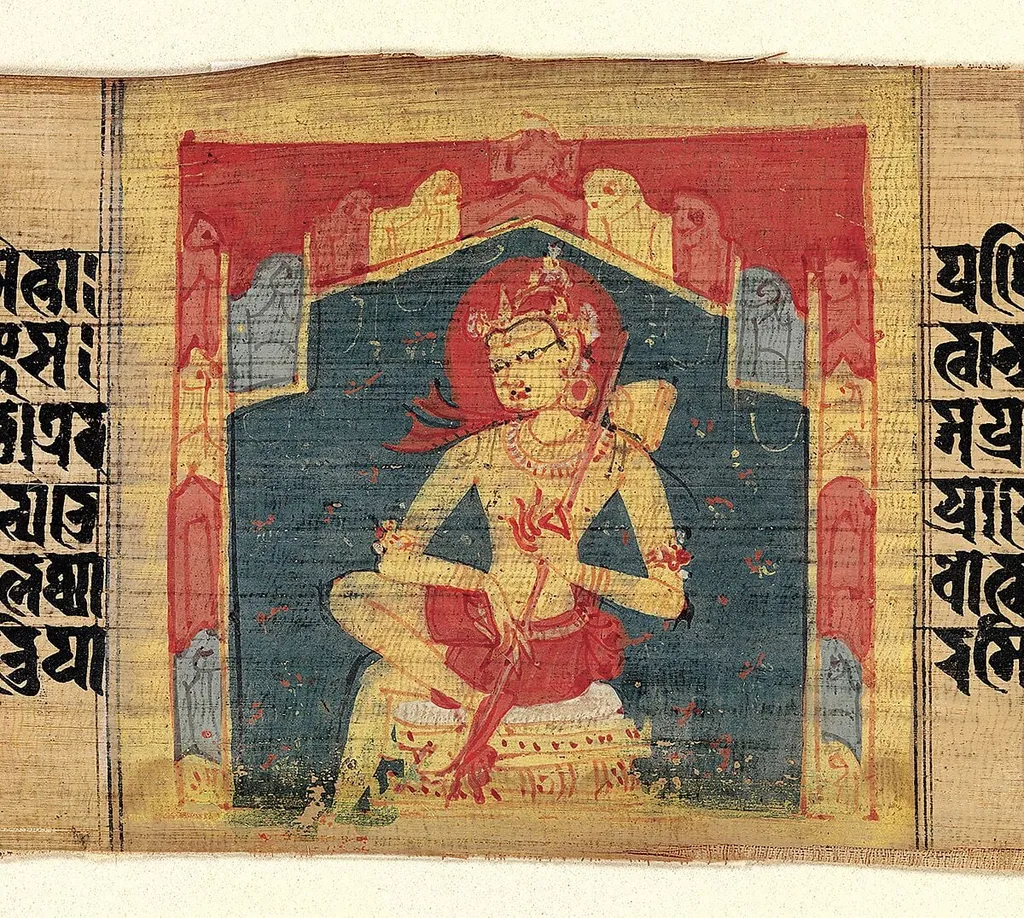
Untitled is a watercolor painting. It dates from 1090 and is held in the collection of the Metropolitan Museum of Art.
About this work
Subject & Meaning
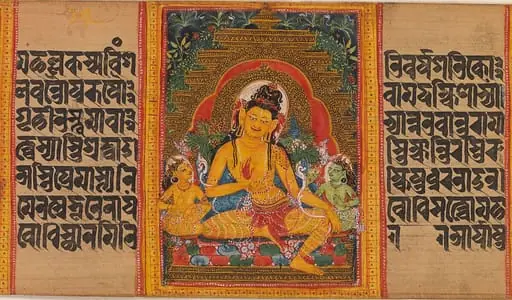
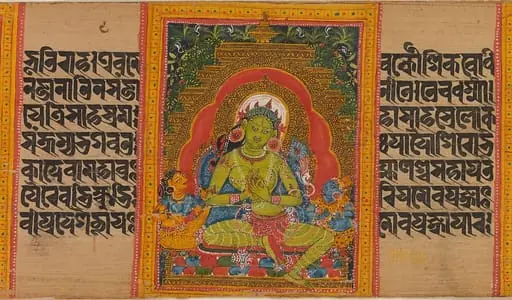
The work is classified as religious art and centers on Buddhist iconography, depicting a Bodhisattva engaged with a musical instrument.
This palm-leaf painting, dated 1090 and executed in opaque watercolor, belongs to a dispersed Pancavimshatisahasrika Prajnaparamita manuscript, a key Buddhist Mahayana text. The work is classified as religious art and centers on Buddhist iconography, depicting a Bodhisattva engaged with a musical instrument. The pairing of a Bodhisattva figure with a musical attribute reflects the manuscript's devotional context, in which enlightened beings are rendered as serene, idealized presences suited to contemplative veneration.
The elongated horizontal format of the leaf accommodated sequential narrative or iconographic programs typical of such Prajnaparamita manuscripts, where sacred figures and symbolic attributes were arranged to guide meditation and ritual recitation. Together, the Bodhisattva subject and the musical instrument motif signal the painting's role as a sacred image within a Buddhist liturgical and philosophical tradition.
Technique & Style
The work is executed in opaque watercolor on a palm leaf support, a format characteristic of early medieval Indian manuscript production. Its elongated horizontal format is reflected in the modest height of 5.7 cm against a width of 57.2 cm, indicating the leaf was cut and prepared to accommodate a continuous horizontal composition typical of dispersed Pancavimsatisahasrika Prajnaparamita manuscripts. The painting depicts a Bodhisattva associated with Buddhism alongside a musical instrument, rendered in a religious idiom consistent with the manuscript tradition from which the leaf originates.
Made in India and dated to 1090, the leaf survives as a detached fragment, now held in the Metropolitan Museum of Art. The opaque watercolor medium on an organic palm-leaf support would have required careful preparation of the leaf surface and application of mineral and organic pigments bound in an aqueous medium, though specific pigment composition and current condition are not documented in the available sources.
History & Provenance
The work titled Untitled is an opaque watercolor on palm leaf painted circa 1090 in India by an anonymous artist as a leaf from a dispersed pancavimsatisahasrika prajnapramita manuscript. Its subject matter includes a Bodhisattva and a musical instrument within a Buddhist context. The piece was subsequently acquired by the Metropolitan Museum of Art, where it remains on view.
Its creation is documented only through stylistic analysis and manuscript scholarship, with no surviving records of commission or subsequent owners prior to its museum acquisition.
The palm-leaf painting is held in the collection of the Metropolitan Museum of Art, where it is catalogued as an anonymous religious work dated to 1090 and made in India. According to the Wikidata record, the leaf is identified as a folio from a dispersed Pancavimsatisahasrika Prajnaparamita manuscript. No specific inventory or accession number is provided in the available sources, and no exhibition history is documented.
Context
The work is an anonymous Indian painting from 1090, created on a palm leaf using opaque watercolor. It forms part of a dispersed Pancavimsatisahasrika Prajnapramita manuscript and depicts a Bodhisattva with a musical instrument, situating it within the religious art genre of early medieval India. Held in the Metropolitan Museum of Art, the piece is referenced in scholarly discussions of South Asian Buddhist manuscript illumination and is recognized as an example of the stylistic and thematic concerns of 11th‑century Indian Buddhist painting.
Overview
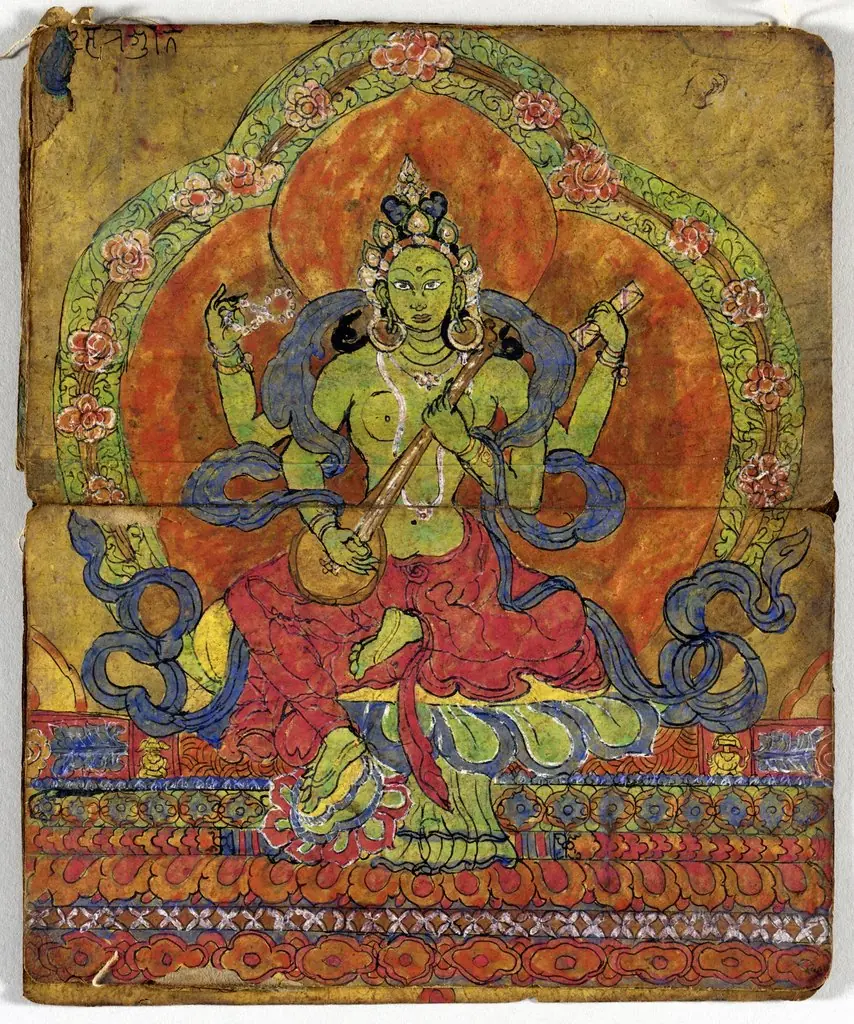
This untitled painting, rendered in opaque watercolor on a palm leaf, depicts a serene blue figure seated on a lotus, playing a stringed instrument. Created over nine centuries ago in Bengal, it exemplifies the artistic practices of a period when paper was not yet widely available. The artwork's small scale and vibrant palette are characteristic of its historical context.
Artist & collection

- Untitled
 Untitled
 Untitled
 Untitled
 Leaf from a Jain Manuscript: Kalpa-sutra: text (verso)
 Untitled
 Text, Folio 5 (recto), from a Manuscript of the Perfection of Wisdom in Eight Thousand Lines (Ashtasahasrika Prajnaparamita-sutra)
 Text, folio 186 (recto), from a Manuscript of the Perfection of Wisdom in Eight Thousand Lines (Ashtasahasrika Prajnaparamita-sutra)
 Book of Buddhist Images
 Untitled
 Perfection of Wisdom in Eight Thousand Lines: Ashtasahasrika Prajnaparamita: Decorated Leaf
 Untitled