Artwork
Worship of Dvaraka Nathji at Kankroli
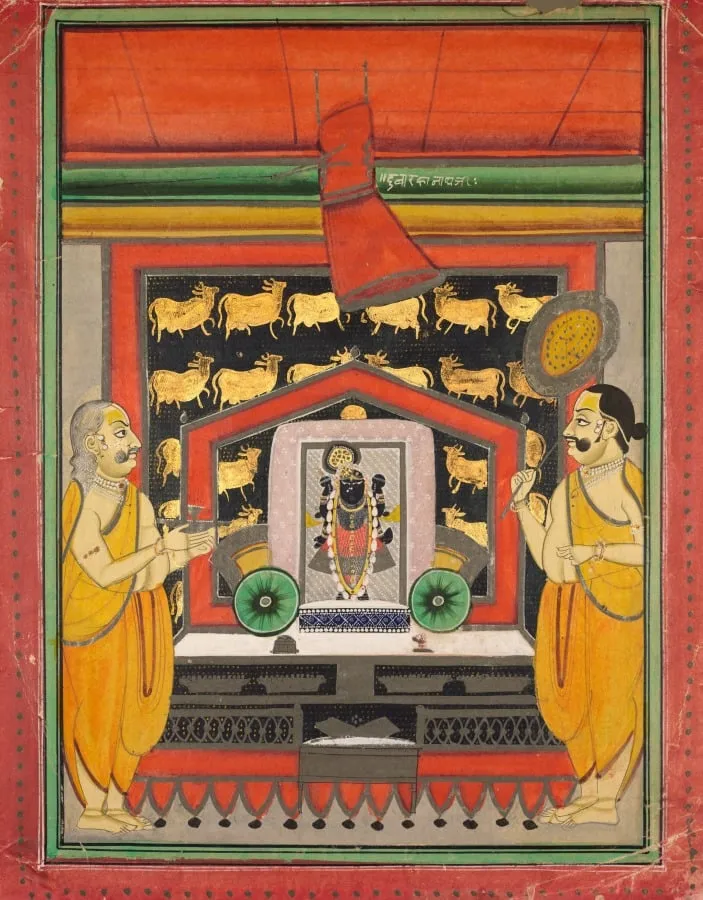
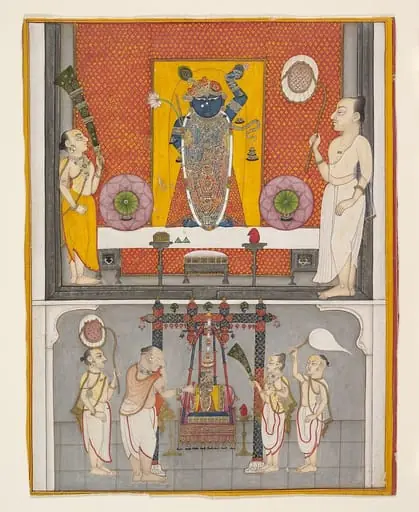
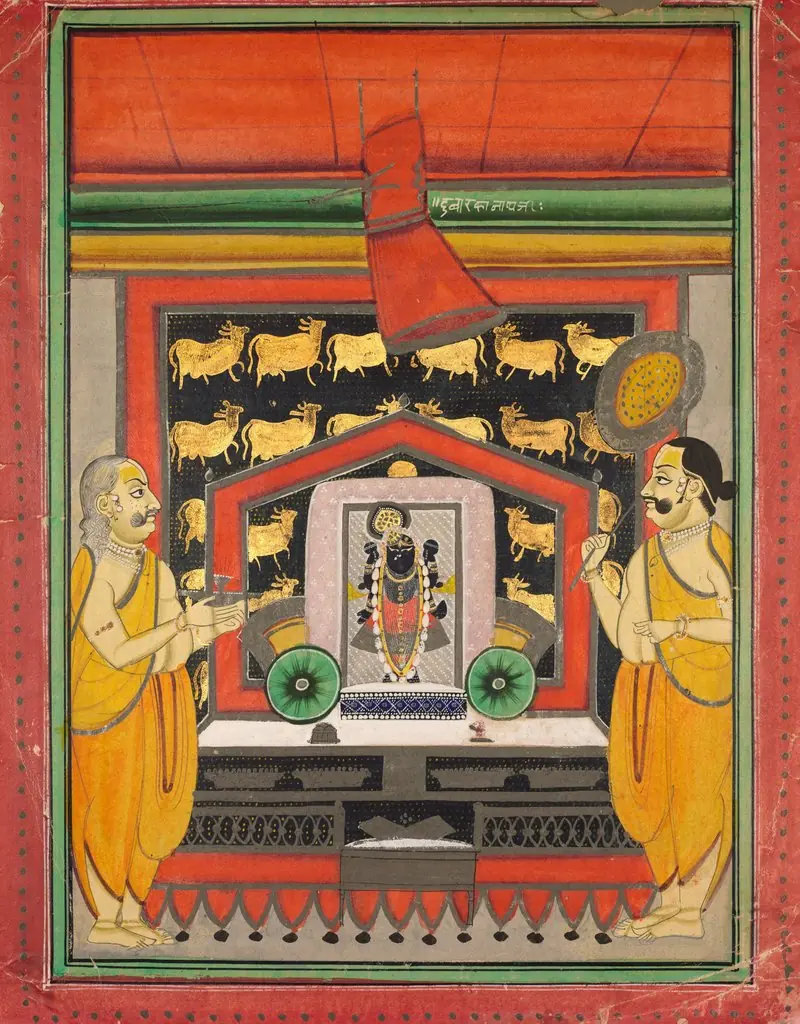
Worship of Dvaraka Nathji at Kankroli is an unspecified painting by the Patna School of Painting artist Unknown. It dates from 1880 and is held in the collection of the Cleveland Museum of Art. A devotional painting from northwestern India depicts the sacred idol of Dvaraka Nathji, a form of Krishna, enshrined at Kankroli.
- Accession no.
- 2001.161
About this work
Overview
A devotional painting from northwestern India depicts the sacred idol of Dvaraka Nathji, a form of Krishna, enshrined at Kankroli. The artwork captures the moment of worship, with devotees kneeling before the idol, framed by a richly detailed textile backdrop. This is not merely an image but a ritual object, central to the Pushti Marg tradition, where the idol is regarded as a living presence.
Subject & Meaning
The four-armed statue represents Krishna in his divine form, with the additional pair of arms said to have manifested during a playful game of hide-and-seek with Radha. This miracle affirms his intimate connection with devotees. The golden cows surrounding the altar recall Krishna’s pastoral youth in Gokul, symbolizing his role as protector of cattle and the pastoral ideal central to Pushti Marg theology.
Technique & Style
The painting employs fine brushwork and mineral pigments on cloth, typical of pichvai art. Gold leaf highlights the cows and decorative motifs, creating luminous contrast against deep reds and blues. The composition is symmetrical and hierarchical, placing the idol at the center, with worshippers rendered smaller to emphasize spiritual scale rather than naturalism.
History & Provenance
The artwork originates from the temple town of Kankroli, near Nathdwara, where the Dvaraka Nathji idol has been venerated since the 17th century. Pichvai paintings like this were commissioned to adorn temple altars during seasonal festivals. Their production was closely tied to temple rituals, with artists belonging to hereditary lineages trained in devotional iconography.
Context
Unlike other Hindu traditions, worship here centers on the idol’s daily life, dressing, feeding, and adorning it as a beloved child.
This painting belongs to the Pushti Marg sect, founded by Vallabha in the 15th century, which emphasizes loving devotion to Krishna as a living, accessible deity. Unlike other Hindu traditions, worship here centers on the idol’s daily life, dressing, feeding, and adorning it as a beloved child. Pichvai backdrops change with the season and festival, aligning visual narrative with liturgical rhythm.
Legacy
Pichvai paintings like this one continue to be produced for temples in Rajasthan and Gujarat, preserving centuries-old techniques and theological symbolism. Though modern materials have been introduced, the iconography remains unchanged, serving as a living link between contemporary devotion and early Bhakti traditions. They are now also preserved in museum collections as cultural artifacts of sustained religious practice.
Artist & collection