Artwork
The Love Letter
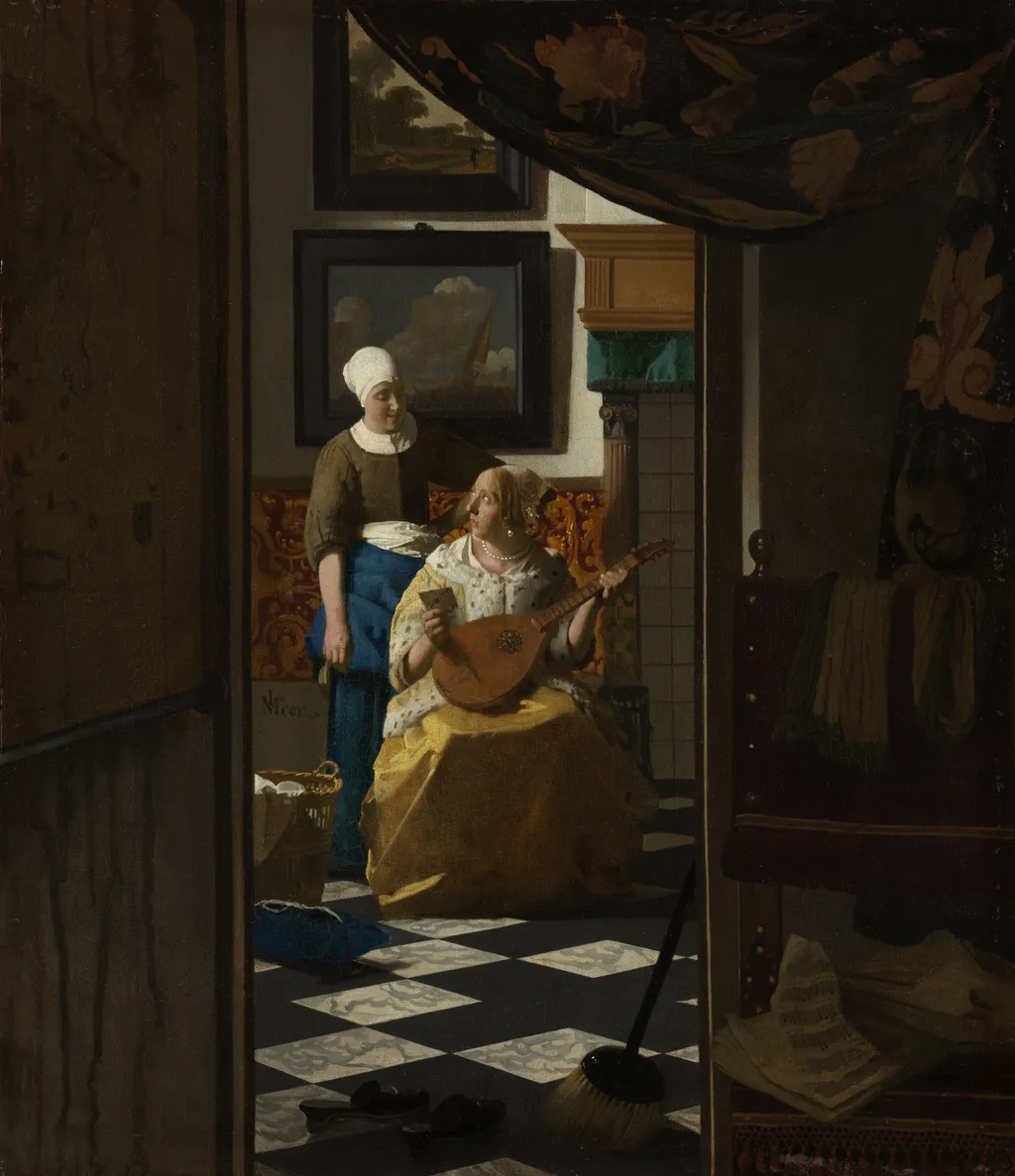
The Love Letter is an oil painting by the Dutch Golden Age artist Johannes Vermeer. It dates from 1668 and is held in the collection of the Rijksmuseum.
About this work
The painting shows a scene where a servant maid talks to her mistress about a letter.
The Love Letter is a painting by Johannes Vermeer. It's a genre painting from the 17th century.
The painting shows a scene where a servant maid talks to her mistress about a letter. This interaction between the two women is the main focus of the painting. The mistress holds the letter, and the servant maid is commenting on it.
You can learn more about the artist who created this painting, Johannes Vermeer.
Subject & Meaning
The painting depicts a private domestic scene where a servant presents a sealed letter to her mistress, who holds a cittern, a string instrument historically symbolizing carnal love. The work functions as a moral allegory warning against promiscuity within a 17th-century Dutch context. Visual cues reinforce this theme: a removed slipper and the instrument suggest sexual availability, while the mistress's expression conveys shock and the dilemma of choosing between virtue and vice.
The background paintings deepen the narrative; a stormy sea represents tempestuous love, contrasting with a landscape above showing a traveler on a straight path, symbolizing the absent husband and the righteous way. Additionally, a broom and discarded sewing cushion imply that domestic duties have been neglected in favor of the letter's contents.
Technique & Style
The Love Letter is an oil-on-canvas painting by Johannes Vermeer, dated to approximately 1668–1670, measuring 44 by 38.5 centimeters. The work employs a trompe-l'œil device, featuring a tied-up curtain in the foreground that suggests the viewer is peering into a private interior, a technique often used in Dutch Golden Age paintings to mimic protective real-world drapery. Vermeer utilizes a geometric perspective defined by a chequered floor with strong diagonals to create a sense of depth and three-dimensionality.
The composition is characterized by a restricted palette of blue and gold, with the latter appearing in the woman's dress and the fireplace's gilded ornamentation, while blue accents the maid's attire and floor. The painting suffered significant physical damage in 1971 when it was stolen and the canvas was crudely cut from its stretcher bars with a knife, requiring nearly a year of restoration to return it to its previous condition.
History & Provenance
The Love Letter is generally dated to the late 1660s, with most scholars placing its execution between 1668 and 1670. Painted in oil on canvas, it exemplifies Vermeer’s mature genre style. Its early ownership is uncertain, but a 1696 inventory of Wilanów Palace suggests it may have been in the collection of John III Sobieski, monarch of the Polish–Lithuanian Commonwealth.
By the early nineteenth century the work entered the private collection of Pieter van Lennep in Amsterdam, passing to his daughter Margaretha Catharina van Lennep and then to his son J.F. van Lennep. At auction on 29 March 1892 it was bought by J. Ankersmit for the Vereniging Rembrandt for 41,000 gulden (plus premium) and transferred to the Rijksmuseum in January 1893, where it has remained.
The Love Letter is held by the Rijksmuseum in Amsterdam, where it is inventoried as SK-C-1911.
It entered the museum’s collection in 1893 after the Vereniging Rembrandt purchased it at the 29 March 1892 Amsterdam auction (lot 14) for 41,000 guilders plus premium, totaling 45,100 guilders. The painting had previously belonged to Margaretha Catharina van Lennep and, before her, to her father Pieter van Lennep.
The work has been exhibited internationally, notably in Vermeer and the Masters of Genre Painting. Inspiration and Rivalry and in the 1971 Brussels loan exhibition at the Centre for Fine Arts, from which it was stolen on 23 September 1971 and recovered on 8 October 1971.
Context
Scholarship situates The Love Letter within Vermeer’s late Delft oeuvre and the broader Dutch genre tradition of moralized domestic scenes. The painting’s iconography, cupid’s bow absent yet implied through the cittern, removed slipper, and stormy seascape, has been read as a cautionary tale against infidelity, aligning with contemporary Dutch moralizing imagery. Its inclusion in Vermeer and the Masters of Genre Painting (2017–2018) underscored its dialogue with peers such as Gerard ter Borch and Pieter de Hooch, while its singular integration of a seascape among interior motifs marks a rare departure within Vermeer’s oeuvre.
Critical reception emphasizes the trompe-l'œil curtain and perspectival devices as hallmarks of Vermeer’s technical mastery, situating the work within the period’s trompe-l'œil curtain paintings and the broader Dutch tradition of illusionistic interiors. The theft of 1971, widely documented in art-historical accounts, became a defining episode in the painting’s modern reception, reinforcing its status as a touchstone of Dutch Golden Age genre painting and public fascination with its private, intimate narrative.
Legacy
The painting's modern legacy was dramatically shaped by its 1971 theft, which transformed it from a revered masterpiece into a global symbol of art activism. Stolen by Mario Pierre Roymans, who cut the canvas with a vegetable peeler to demand famine relief for Bengali refugees, the incident sparked intense debate regarding the work's preservation versus its political utility. While an international committee of experts recommended full restoration to its pre-theft condition, a group of Dutch artists and sociologists argued the damaged canvas should remain unrestored and displayed to highlight the suffering of the Third World.
The Rijksmuseum ultimately rejected this proposal, restoring the work to its original state. This event remains a defining chapter in the artwork's history, illustrating the complex intersection of cultural heritage, moral conscience, and institutional conservation.
Overview
Johannes Vermeer's painting, The Love Letter (Dutch: De liefdesbrief), is an oil on canvas work created in the 17th century. This genre scene depicts an intimate domestic moment, characteristic of the artist's focus on everyday life. The painting is currently housed in the collection of the Rijksmuseum Amsterdam, where it remains a notable example of Dutch Golden Age art.
Own this work as a print
Artist & collection
Artist
Johannes Vermeer ( vər-MEER, vər-MAIR, Dutch:; see below; also known as Jan Vermeer; October 1632 – 15 December 1675) was a Dutch painter who specialized in domestic interior scenes of middle-class life.