Artwork
The Chess Players
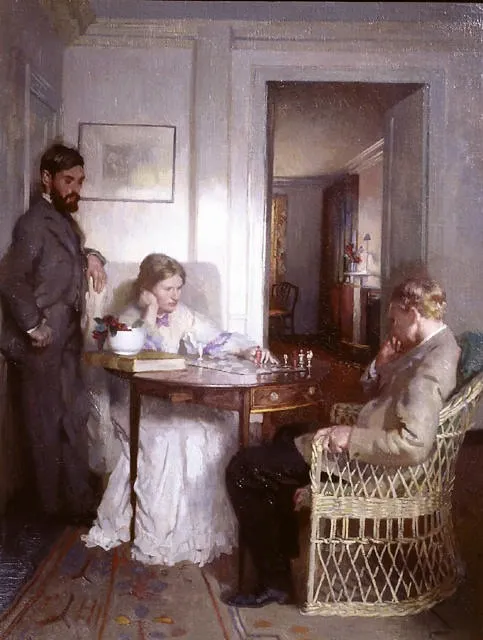
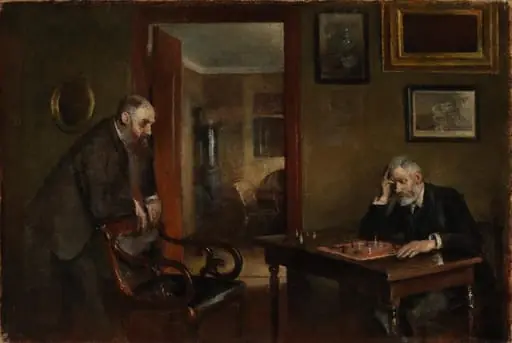
The Chess Players is an oil painting by the Post-Impressionist artist William Orpen. It dates from 1896 and is held in the collection of the Ashmolean Museum.
About this work
Subject & Meaning
Their presence suggests a personal rather than public narrative, linking the game to private conversation and domestic routine.
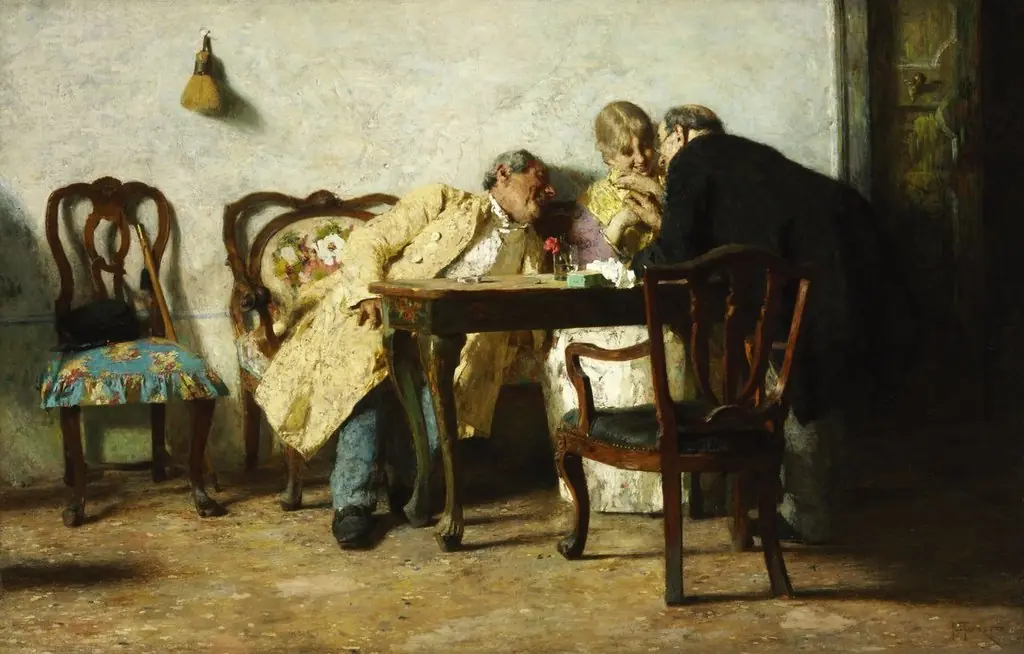
The painting depicts two men engaged in a game of chess, a domestic scene that captures quiet intellectual contest. One participant is identified as Grace Orpen, the artist's wife, while the other is Francis Meynell, a close associate. Their presence suggests a personal rather than public narrative, linking the game to private conversation and domestic routine.
The work reflects late Victorian interest in leisure activities among the educated classes, using the chessboard as a subtle metaphor for strategic thought and social interaction.
Technique & Style
The Chess Players is an oil painting executed on canvas, a medium consistent with William Orpen's genre painting practice of the early 1890s. The work measures 92 cm in height by 71 cm in width, a relatively intimate vertical format suited to a tightly composed interior scene of two figures at a chessboard. Classified as a genre painting, it depicts the players and onlookers with the naturalistic handling typical of late-Victorian figure painting.
No source documents the painting's current condition, surface handling, or specific stylistic qualities beyond its genre classification and oil-on-canvas execution.
History & Provenance
Created by William Orpen in 1892, The Chess Players is an oil painting on canvas measuring 92 cm in height and 71 cm in width. The work depicts Grace Orpen, Francis Meynell, and Everard Meynell engaged in a game of chess. Its provenance traces to Florence Weldon (née Tebb), who bequeathed the painting to the Ashmolean Museum in Oxford in 1937.
The museum currently holds the piece under accession number WA1937.45. While the creation date is firmly established as 1892, some records describe the work as dating to the period before 1902.
The Chess Players is held in the collection of the Ashmolean Museum in Oxford. The work was acquired by the museum in 1937 through the bequest of Florence Weldon (née Tebb), who provided it under the accession number WA1937.45. While the painting dates to 1892, Art UK records the work as created prior to 1902, reflecting the museum's cataloging of the piece before its formal accession. The oil on canvas painting remains part of the Ashmolean's permanent holdings.
Legacy
William Orpen's 1892 painting The Chess Players has been recognized for its nuanced portrayal of domestic intellectual life and its technical mastery of early modern portraiture. Its inclusion in the Ashmolean Museum's collection has ensured continued scholarly attention to Orpen's role in shaping British genre painting at the turn of the century. The work remains frequently reproduced in academic publications on late Victorian art and is often cited in studies of gender and leisure in Edwardian society.
Overview
Created in 1896, The Chess Players is an oil painting by Irish artist William Orpen. The work presents an intimate interior scene illuminated by gentle daylight, where three figures are absorbed in a game of chess. Rendered in a post‑impressionist idiom, the composition functions as a genre picture, capturing a moment of domestic leisure rather than a formal portrait.
Context
At the turn of the 20th century, Orpen was based in London, navigating between Irish artistic traditions and the cosmopolitan demands of the British elite. The work’s post‑impressionist leanings align with contemporary shifts toward looser color and light treatment, while its domestic subject matter reflects a broader interest among artists in depicting everyday middle‑class life.
Artist & collection
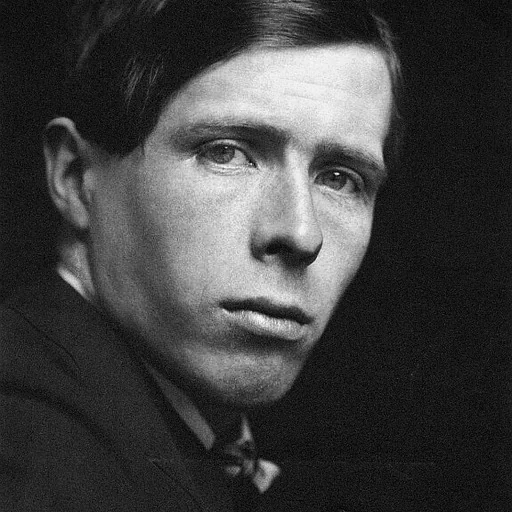
Artist
Major Sir William Newenham Montague Orpen (27 November 1878 – 29 September 1931) was an Irish artist who mainly worked in London.