Artwork
Pipa (Loquats)
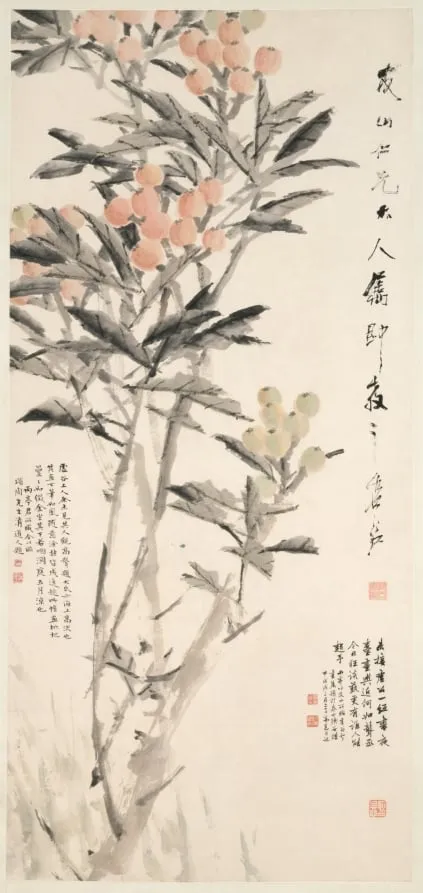
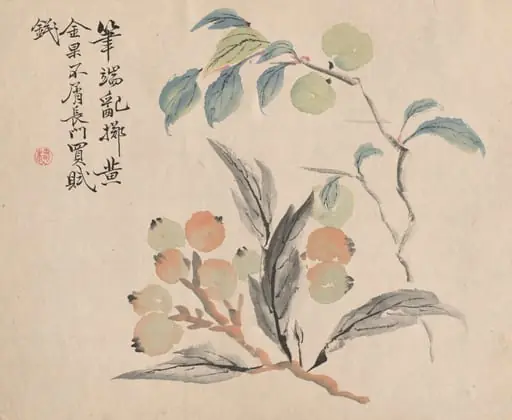
Pipa (Loquats) is an unspecified painting by the Chinese Orthodox School artist Xu Gu. It dates from 1888 and is held in the collection of the Cleveland Museum of Art.
- Accession no.
- 1999.6
- Credit line
- John L. Severance Fund
About this work
In 19th-century China, loquats meant luck and plenty, artists often painted them for merchants who wanted to show off their success.
You see a small tree branch heavy with golden loquats, leaves curling at the edges.
The fruit spills past the paper’s edge, as if the painting can’t contain it all. In 19th-century China, loquats meant luck and plenty, artists often painted them for merchants who wanted to show off their success. Xugu left the military to paint full-time, trading swords for brushes.
If you like this quiet abundance, look up Qing dynasty (1644-1911) next.
Overview
Pipa (Loquats) is a painting depicting a branch laden with loquat fruit and leaves.
Subject & Meaning
The loquat, a symbol of abundance and good fortune in 19th-century China, is the painting's central subject. The overflowing fruit may signify prosperity and wealth, reflecting the aspirations of the artist's patrons.
Technique & Style
The composition is characterized by the extension of the branch beyond the paper's edges, creating a sense of abundance and emphasizing the fruit's profusion.
History & Provenance
The artist, Xugu, abandoned his military career during the Taiping rebellion to become a monk and painter, eventually gaining recognition in Shanghai.
Artist & collection
Artist
Xū Gǔ (Hsü Ku, simplified Chinese: 虚谷; traditional Chinese: 虛谷; pinyin: Xū Gǔ); (c. 1824–1896) was a Chinese painter and poet during the Qing Dynasty (1644–1912).

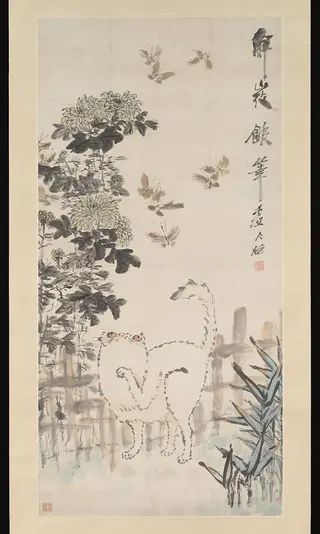 清 虛谷 蝶貓圖 軸|Cat and Butterfly
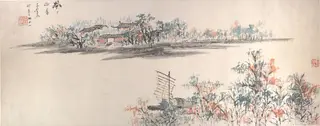 清 虛谷 秋帆圖 冊頁|Sailing in Autumn
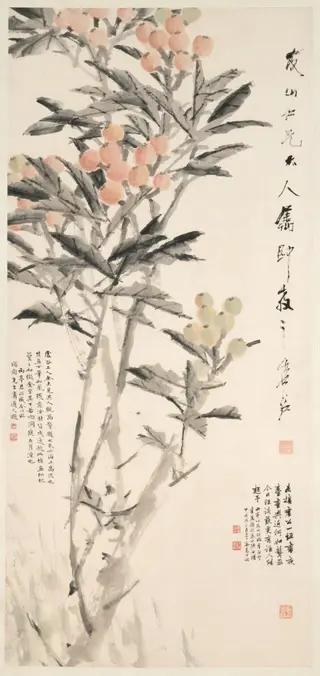 Pipa (Loquats)
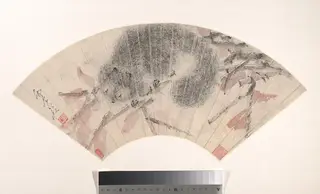 清 虛谷 松鼠 扇面|Squirrel on an Autumn Branch
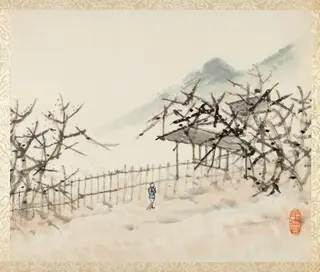 Landscapes for Liu Songfu
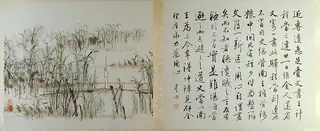 Bridge on a Reed Pond, from an album of Landscapes and Calligraphy for Liu Songfu
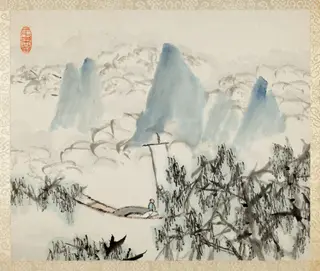 Landscape with Figure, from an album of Landscapes and Calligraphy for Liu Songfu
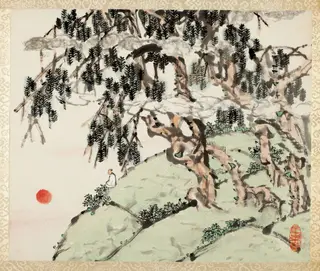 Landscape and Figure, from an album of Landscapes and Calligraphy for Liu Songfu