Artwork
Woman in a Chemise
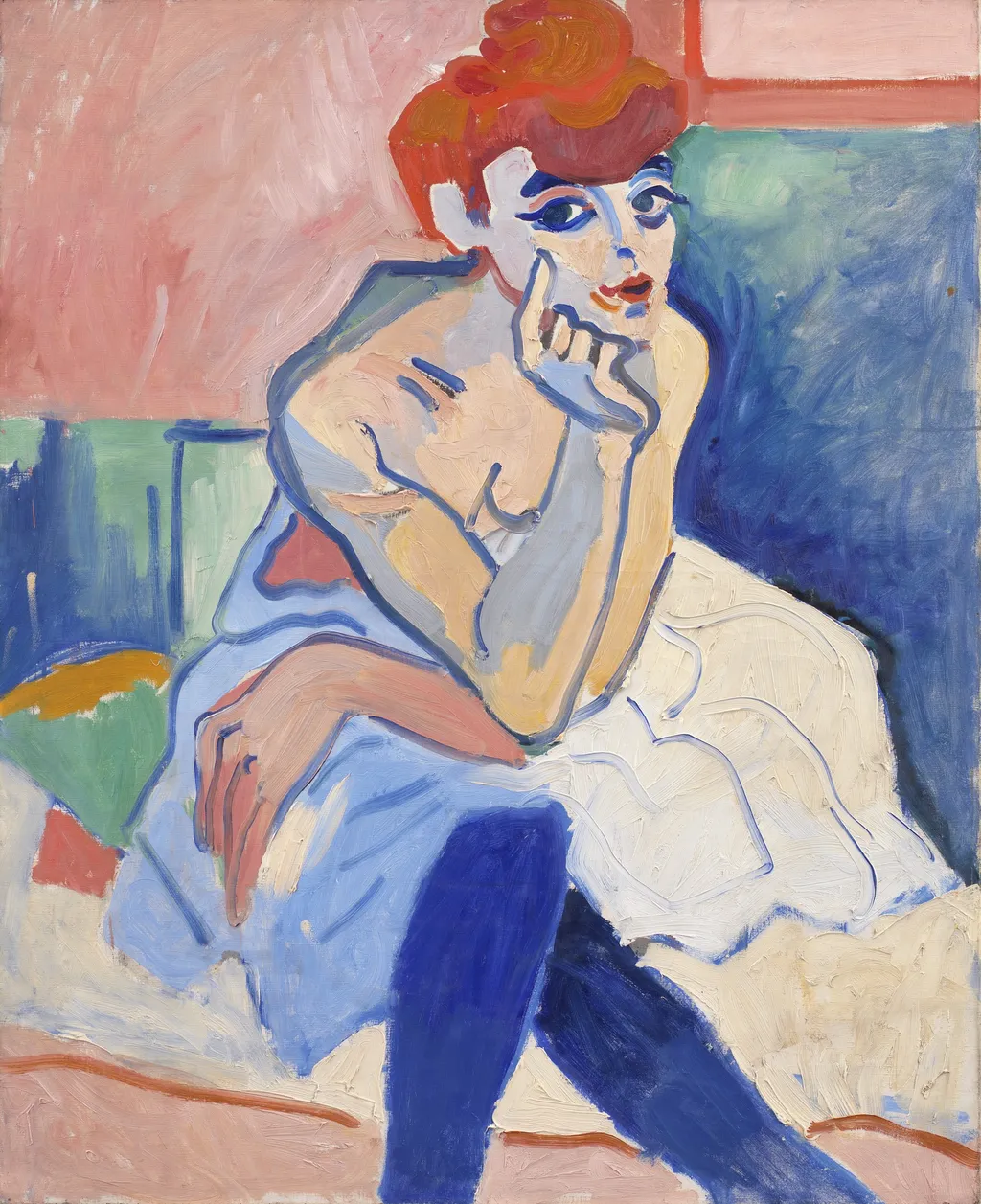
Woman in a Chemise is an oil painting by the Fauvist artist André Derain. It dates from 1906 and is held in the collection of the Statens Museum for Kunst.
About this work
Overview
Woman in a Chemise (French: La Femme en chemise; Danish: Kvinde i chemise) is an oil on canvas painting by the French artist André Derain, executed in 1906.
Woman in a Chemise (French: La Femme en chemise; Danish: Kvinde i chemise) is an oil on canvas painting by the French artist André Derain, executed in 1906. Measuring 100 by 81 centimetres, this portrait is held in the collection of the Statens Museum for Kunst in Copenhagen, where it is regarded as one of the museum's ten masterpieces. Painted in the immediate aftermath of Derain's pivotal summer with Henri Matisse in Collioure, the work exemplifies the radical colour and handling that defined Fauvism, the movement that shocked the Parisian art world and marked a decisive break from naturalistic representation.
Subject & Meaning
The painting depicts a red-haired woman seated on the edge of a bed, her body angled slightly to the right while her head turns to confront the viewer directly. She wears only a white chemise and blue stockings, her hair piled atop her head. Her left hand rests against her cheek with extended fingers, and her right hand lies open on her lap. The model was a dancer from Le Rat Mort (The Dead Rat), a celebrated nightclub in Montmartre frequented by artists including Henri de Toulouse-Lautrec. Her confident, unflinching gaze and casual posture subvert traditional conventions of the passive female subject. The informal attire and setting, combined with her direct address to the viewer, suggest a modern, unidealised portrayal of contemporary Parisian life rather than allegory or myth. The triangular composition lends the figure a monumental presence despite the informal execution.
Technique & Style
Derain worked in oil on canvas, employing a technique characterised by visible, unblended brushstrokes that create a textured surface throughout. Bold blue outlines define the figure's contours, while the background divides into flat zones of pink, green, and blue. The palette consists of pinks, blues, greens, and warm flesh tones, with no traditional modelling or naturalistic light source; colour areas sit adjacent without gradual transitions. The deliberate distortion of anatomy, particularly in the woman's hand, contributes to the work's expressive force. The composition is built upon triangular structures that give the seated figure her monumental quality. These formal choices, derived from the experiments Derain had undertaken with Matisse in Collioure, demonstrate the Fauvist commitment to using colour to convey emotion and sensory experience rather than to imitate optical reality.
History & Provenance
The painting was created in 1906, shortly after Derain's transformative summer in Collioure with Henri Matisse. It initially entered the collection of the Parisian dealer Daniel-Henry Kahnweiler. Following the First World War, Kahnweiler's holdings were confiscated and sold at auction. The Danish collector Johannes Rump (1861-1932) acquired the painting at a Paris auction in May 1923. Rump, an early advocate for French modernism, offered the work to the Statens Museum for Kunst that same year, but the donation was initially rejected by director Karl Madsen, who doubted that the radical experiments of the Fauves met the quality standards of the national museum. The museum reversed its position, and Rump's collection was accepted in 1928. The painting has since remained at the Statens Museum for Kunst. On 1 December 2024, the work was targeted by activists from the Danish group Nødbremsen (The Emergency Brake), who threw orange paint at it; damage was limited because the canvas was protected by glass.
Context
Woman in a Chemise occupies a crucial position in the emergence of Fauvism. In the summer of 1905, Derain spent nine weeks with Matisse in the Mediterranean fishing village of Collioure, where the intense southern light inspired their use of explosive, non-naturalistic colour. This collaborative period produced the breakthrough works that, when exhibited in Paris, provoked scandal and earned the movement its name, derived from fauve (wild beast). Derain's painting applies the lessons of that revolutionary summer to a subject drawn from Parisian nightlife, bridging the avant-garde's engagement with both colour theory and modern urban experience. The choice of a Montmartre dancer as subject connects the work to a tradition of artists depicting performers and nightlife, from Degas to Toulouse-Lautrec, even as its formal radicality breaks decisively with those precedents. The initial rejection of Rump's gift by the Statens Museum for Kunst illustrates the resistance that Fauvist innovation encountered within established institutional frameworks, even as collectors and dealers were rapidly recognising its significance.
Legacy
Woman in a Chemise has become a cornerstone of the Statens Museum for Kunst's collection, celebrated as one of its ten masterpieces and a highlight of its holdings of French modernism. The painting's reputation rests on its encapsulation of the Fauvist moment, when colour was liberated from descriptive function and became an autonomous vehicle for emotional and expressive force. The work's public profile was significantly raised by the 2024 attack, which brought international attention to both the painting and the broader phenomenon of climate activism targeting museum collections. The incident, and the protective glass that prevented damage, also underscored the evolving challenges of preserving culturally significant works in an era of political protest. The painting continues to serve as a key document in scholarly accounts of Derain's development, the Collioure experiments, and the wider Fauvist movement, representing a decisive chapter in the early twentieth-century dismantling of academic naturalism.
Own this work as a print
Artist & collection

Artist
André Derain was a French artist, painter, sculptor and co-founder, with Henri Matisse, of Fauvism.