Artwork
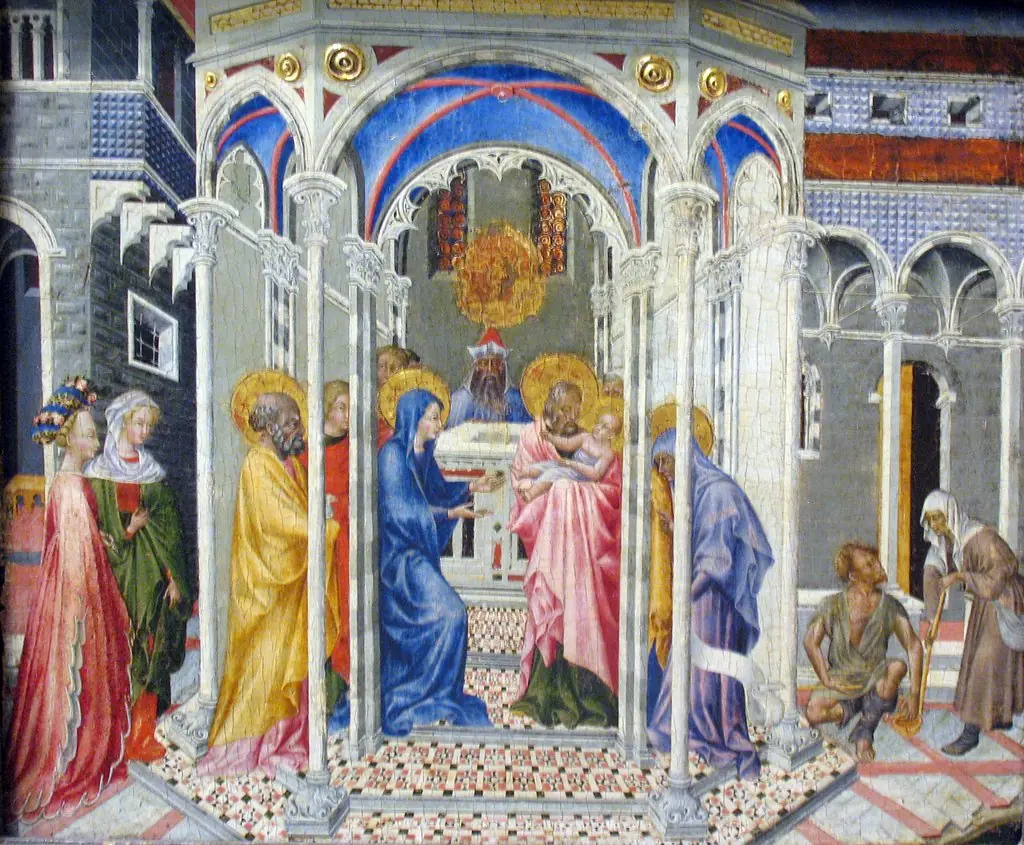
The Presentation of the Virgin in the Temple
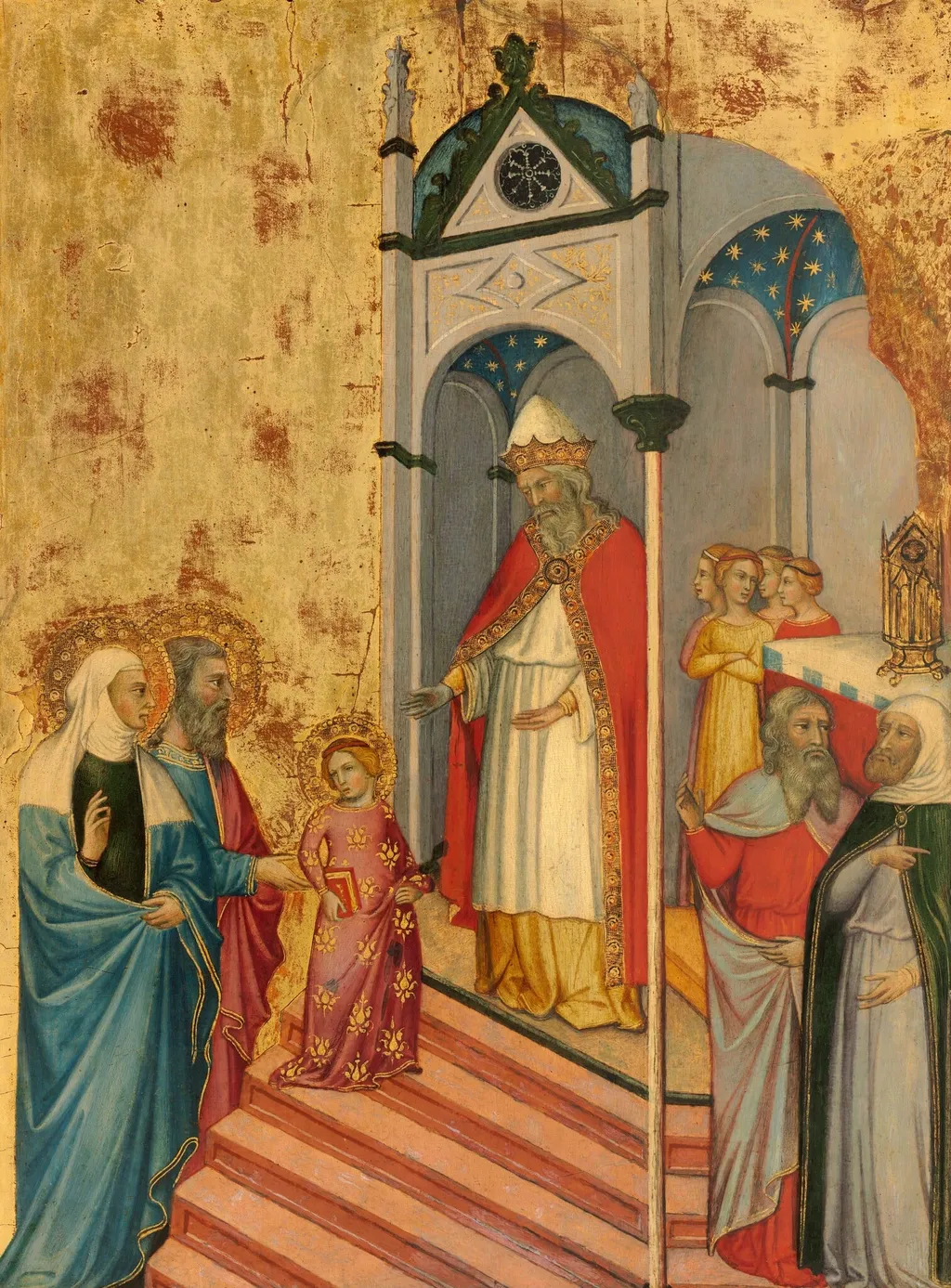
The Presentation of the Virgin in the Temple is a tempera painting by the Renaissance artist Andrea di Bartolo. It is held in the collection of the National Gallery of Art.
About this work
Technique & Style
Created around 1400 by Andrea di Bartolo, this religious work is executed in tempera on a poplar panel.
Created around 1400 by Andrea di Bartolo, this religious work is executed in tempera on a poplar panel. The piece is classified as a painting depicting the Presentation of Mary. While specific details regarding the artist's brushwork, the panel's current physical condition, or its precise dimensions are not elaborated upon in the available records, the fundamental material composition is clearly established as tempera paint applied to a wood support made of poplar.
History & Provenance
Andrea di Bartolo created the tempera on poplar panel known as The Presentation of the Virgin in the Temple around the year 1400. The work's modern provenance traces back to a figure identified in records as Contessa Giustiniani of Genoa, though scholarship suggests she likely acted as an art dealer or agent rather than a long-term collector. On July 15, 1930, Count Alessandro Contini Bonacossi sold the painting, along with seven others from the same group, to the Samuel H. Kress Foundation in New York.
This transaction was documented in a bill of sale that included the specific panel. The National Gallery of Art in Washington, D.C., subsequently received the work as a gift from the Kress Foundation in 1939, where it remains part of the Samuel H. Kress Collection.
The painting is held in the collection of the National Gallery of Art in Washington, D.C., specifically within the Samuel H. Kress Collection. Its accession history traces back to Count Alessandro Contini Bonacossi of Rome, who sold the work in July 1930 to the Samuel H. Kress Foundation. Although earlier provenance records attribute the panel to a Contessa Giustiniani of Genoa, scholarship suggests she likely acted as a dealer rather than a collector. The foundation subsequently gifted the artwork to the National Gallery of Art in 1939.
The provided sources do not contain information regarding specific exhibitions where this work has been displayed.
Context
The Presentation of the Virgin in the Temple by Andrea di Bartolo is catalogued within the National Gallery of Art's systematic survey of fifteenth-century Italian painting by Miklós Boskovits and David Alan Brown, situating the work within scholarly discourse on Sienese painting of the early Quattrocento. Boskovits and Brown also address the panel's provenance, noting that the supposed Giustiniani collection in Genoa lacks documented existence and that the contessa Giustiniani was likely a dealer or agent rather than a collector, with the works acquired on the art market shortly before 1930. The panel forms part of a group of three (NGA 1939.1.41, 1939.1.42, and 1939.1.43), tracing a shared history from Contini Bonacossi's 1930 sale to the Samuel H. Kress Foundation and its subsequent 1939 gift to the NGA.
Elisabeth Gardner's _Bibliographical Repertory of Italian Private Collections_ further documents the Giustiniani holdings, reinforcing the painting's trajectory through early-twentieth-century Italian art trade networks into American institutional collections.
Legacy
The painting entered the Samuel H. Kress Foundation in July 1930 and was donated to the National Gallery of Art in 1939, where it remains as part of the Kress Collection. Its provenance, passing through the hands of Count Alessandro Contini Bonacossi and the Giustiniani network, illustrates the early‑20th‑century art market that fed major American museum collections. Today the work is cited as an example of Andrea di Bartolo’s Trecento style within the NGA’s Italian Renaissance holdings, contributing to the gallery’s reputation for preserving Sienese‑influenced panel paintings.
Overview
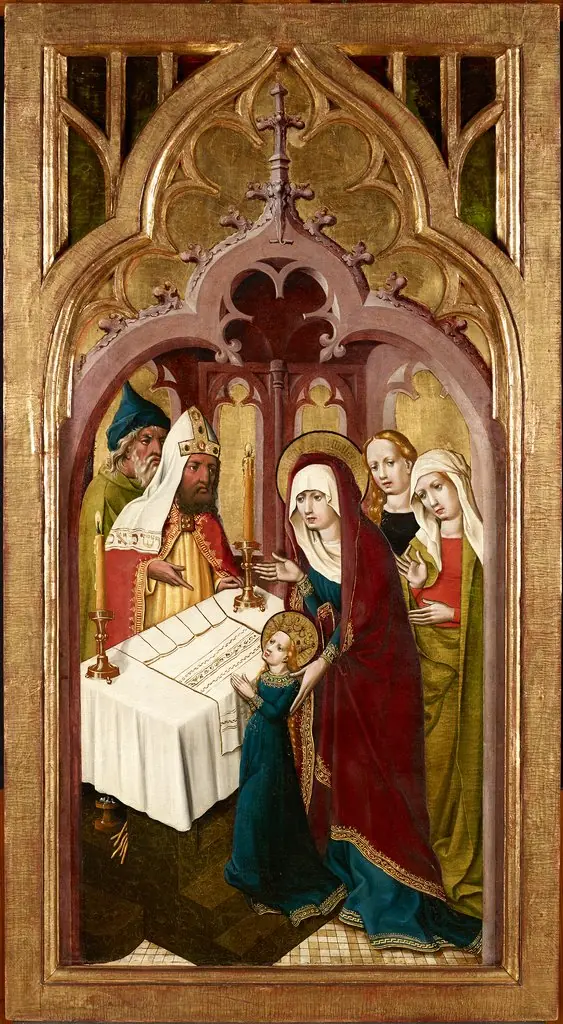
Andrea di Bartolo's painting, The Presentation of the Virgin in the Temple, created around 1402, is a religious work executed in tempera on a poplar panel. It illustrates the biblical narrative of Mary's introduction to the Temple in Jerusalem. The composition captures a moment of solemn transition, central to Christian tradition, rendered with the characteristic precision of early fifteenth-century Sienese art.
Subject & Meaning
The painting depicts a young Mary, clad in a red garment, ascending a flight of stairs, guided by a woman in blue. She glances back, perhaps in a moment of hesitation or farewell, as a robed figure awaits her at the summit with an outstretched hand, signifying acceptance. Spectators observe the event from the background, contributing to the scene's reverent and solemn atmosphere, which underscores the spiritual significance of Mary's dedication.
Own this work as a print
Artist & collection


![Christ on the Cross [reverse], by Andrea di Bartolo](https://artifactworldgallery.com/img/andrea-di-bartolo--christ-on-the-cross-reverse--6bfe980f802a6327-w320.webp)
![Madonna of Humility, The Blessing Christ, Two Angels, and a Donor [obverse], by Andrea di Bartolo](https://artifactworldgallery.com/img/andrea-di-bartolo--madonna-of-humility-the-blessing-christ-two-angels-and-a-don--d37c382429905539-w320.webp)