Artwork
Judith with the Head of Holofernes
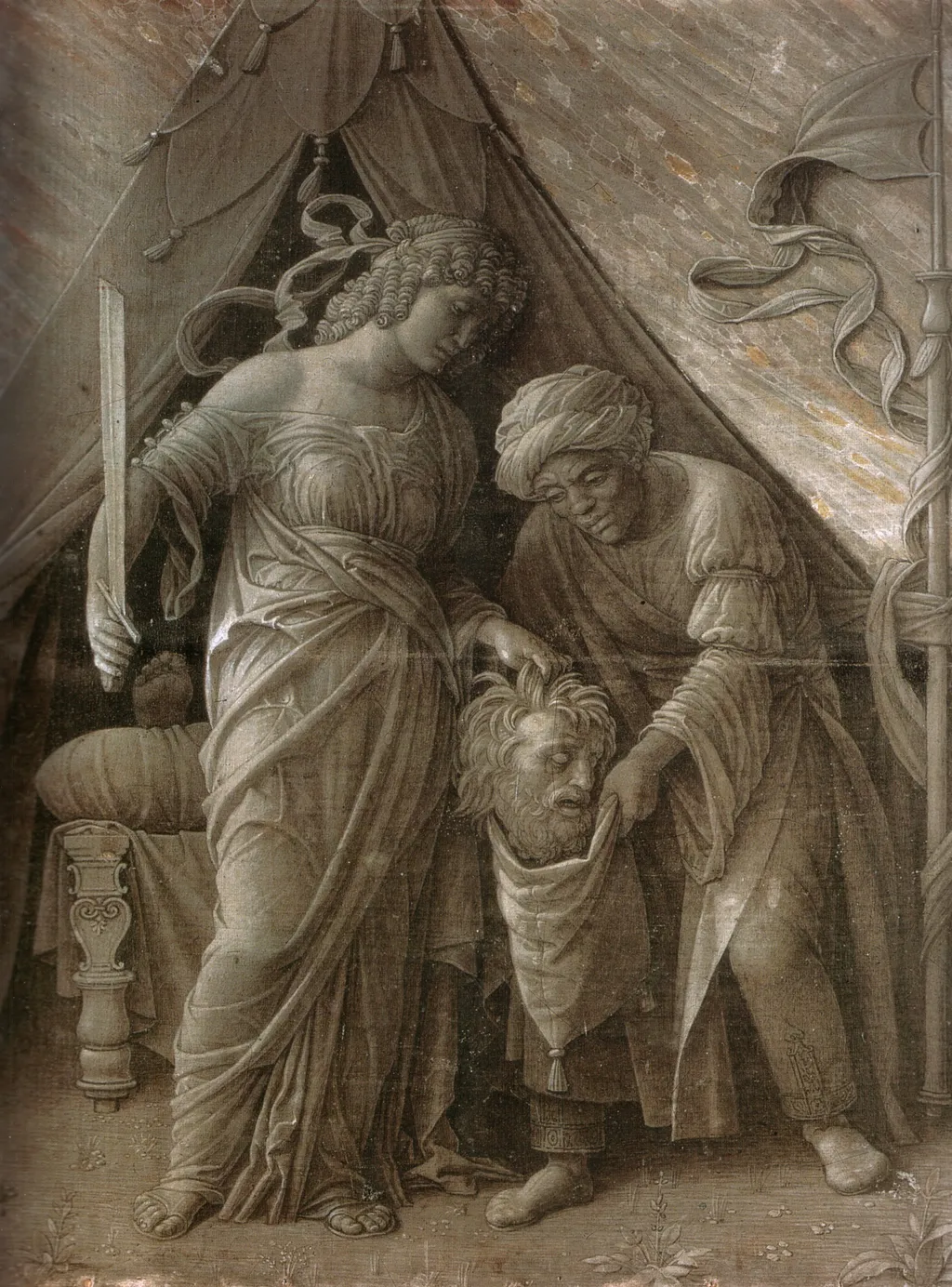
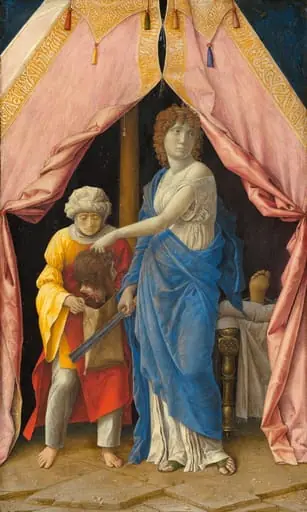
Judith with the Head of Holofernes is a tempera painting by the Early Renaissance artist Andrea Mantegna. It dates from 1499 and is held in the collection of the National Gallery of Ireland.
About this work
Overview
Executed primarily in a grisaille palette, the painting exemplifies Mantegna's late career exploration of monochromatic, sculptural illusionism.
Judith with the Head of Holofernes is a tempera painting on linen by the Italian Renaissance master Andrea Mantegna, dated circa 1495 to 1497. Measuring 48.1 by 36.7 centimeters, the work belongs to the collection of the National Gallery of Ireland in Dublin. Executed primarily in a grisaille palette, the painting exemplifies Mantegna's late career exploration of monochromatic, sculptural illusionism. It depicts the biblical heroine Judith and her handmaid Abra carrying the severed head of the Assyrian general Holofernes, and stands as a significant example of the artist's demanding technique on unprepared canvas.
Subject & Meaning
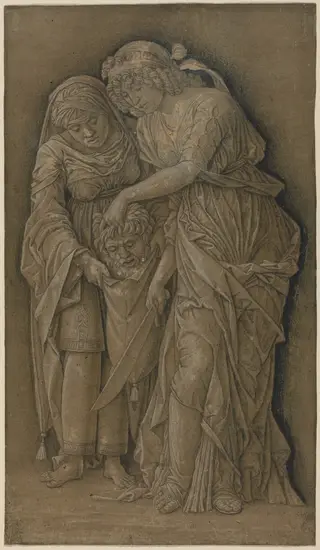
The painting captures the immediate aftermath of the biblical assassination of Holofernes. Judith stands upright, holding a sword in her right hand while grasping intimate apparel with her left. Her handmaid, wearing a wrapped turban, bends forward to hold a sack containing the severed, bearded head of the tyrant, whose eyes are closed. The two figures are positioned beneath a tent-like canopy formed by draped fabric, with a cushioned surface, a decorated urn, and sparse vegetation visible in the surroundings. A related circa 1491 drawing of the same subject in the Gabinetto dei disegni e delle stampe in Florence shows a similar composition of the two women before the triangular tent of Holofernes, with details such as the general's foot still visible on the bed inside the shadowy tent interior.
Technique & Style
Mantegna executed this work in glue tempera on linen, a challenging medium that almost entirely lacks a ground preparation. This unforgiving technique does not permit corrections or pentimenti, requiring precise and confident execution. The composition is tightly cropped, focusing on the interaction between the two figures and the severed head. The palette is restrained, dominated by warm browns, grays, and muted earth tones with subtle highlights, characteristic of the grisaille style. Light falling from the upper right creates strong contrasts between illuminated drapery and deep shadow beneath the canopy. White highlights and brown brushstrokes vivify the relief and enhance the illusionistic quality of the forms. The background is mottled to resemble fake marble. Brushwork is meticulous, with precise linear definition of folds, smooth gradations in flesh tones, and skillful rendering of textile textures, particularly in the elegant play of lines in the flag at right, which twists in the wind around its flagpole. The surface now displays fine craquelure throughout.
History & Provenance
The painting was acquired in Italy at an unknown time in the nineteenth century by Lewis Strange Wingfield. It subsequently passed into the collection of John Malcolm of Poltalloch in Scotland. In 1896, the work was sold to the director of the National Gallery of Ireland, where it remains today. During its early years of public display, skepticism regarding its authorship circulated among scholars. However, Bernard Berenson and Paul Kristeller both endorsed the painting in 1901. Over time, the work has come to be generally attributed to Mantegna, though some scholars reserve judgment, noting a more or less significant intervention by students and assistants. The difficulty of the unprepared linen technique, which precludes corrections, has led many experts to favor a predominantly autograph reading.
Context
The painting is part of a broader grisaille production that characterized Mantegna's output during the later years of his career, from circa 1495 until his death. These works were designed to rival sculpture and were highly appreciated in court circles. This appreciation was partly driven by a scarcity of active sculptors near Mantua and the great difficulty and expense of importing marble from neighboring territories. The work shares technical, formal, and thematic similarities with Mantegna's Samson and Delilah, now in London. Scholars have hypothesized that the two paintings may have hung together as a pair in one of the private rooms of Isabella d'Este in the Ducal Palace of Mantua.
Own this work as a print
Artist & collection
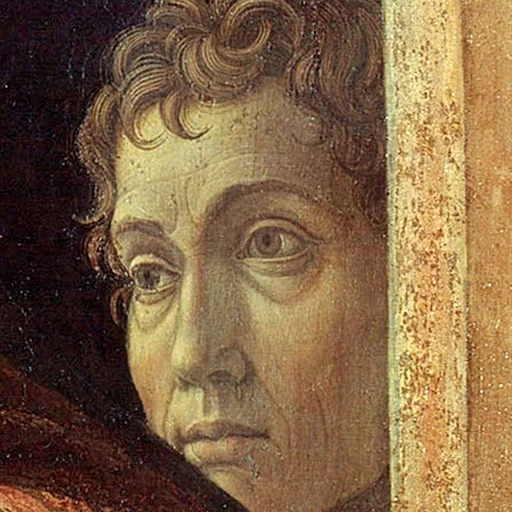
Artist
Andrea Mantegna (UK: US:; Italian:; c. 1431 – September 13, 1506) was an Italian Renaissance painter, a student of Roman archaeology, and the son-in-law of Jacopo Bellini. Like other artists of the time, Mantegna…