Artwork
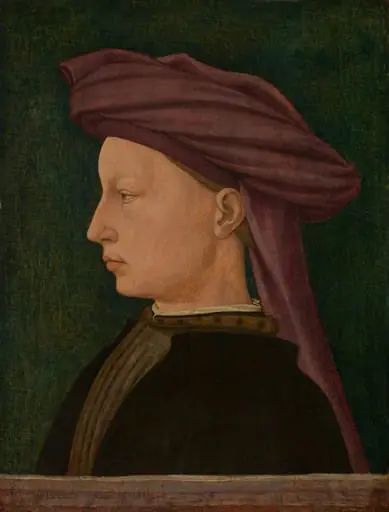
Portrait of a Man
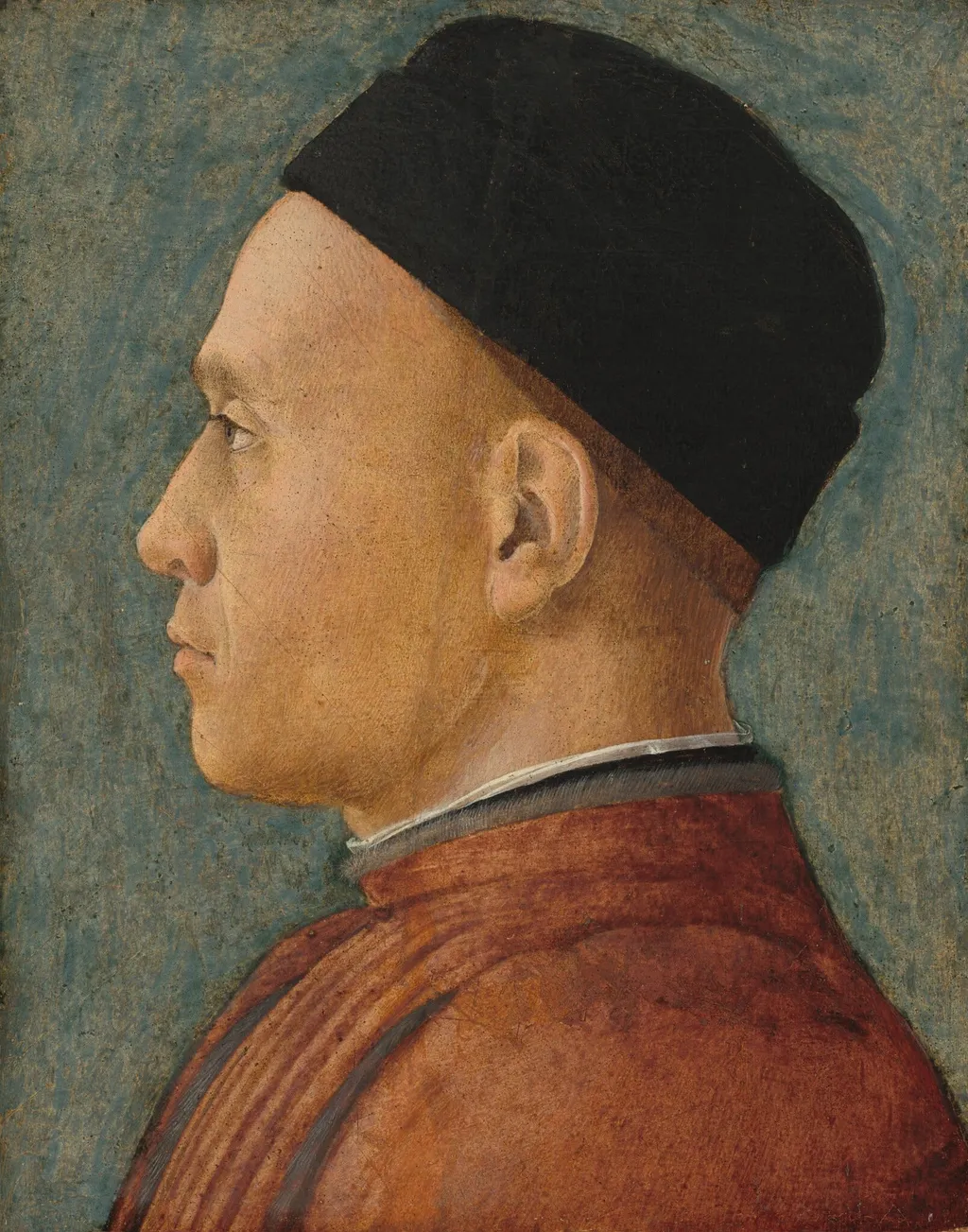
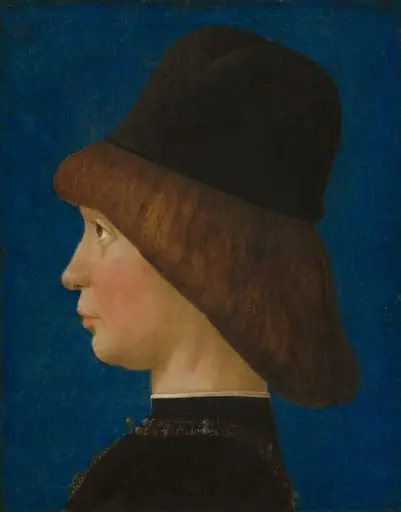
Portrait of a Man is a tempera painting by the Early Renaissance artist Andrea Mantegna. It dates from 1470 and is held in the collection of the National Gallery of Art.
About this work
Subject & Meaning
The sitter is identified in some records as the Hungarian humanist Janus Pannonius, though the identification remains contested.
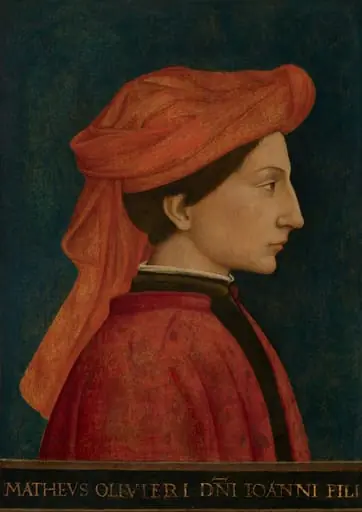
The work shows a man rendered in profile bust, set against a dark bluish background; he wears a brown tunic with a white collar and a black cap, a costume typical of early Renaissance humanist portraiture. The sitter is identified in some records as the Hungarian humanist Janus Pannonius, though the identification remains contested. The composition follows the profile convention popular in Italian courts and includes a subtle trompe-l'œil parapet, emphasizing the sitter's intellectual presence. These elements convey a representation of an educated elite figure rather than a specific narrative scene.
Technique & Style
The Portrait of a Man is executed in tempera, originally painted on a wooden panel that was subsequently transferred to canvas and then to hardboard, a complex relocation that has affected the legibility of the painted surface. The work measures 24.2 by 19.1 cm, making it an intimate, small-scale panel portrait. Stylistically, the sitter is rendered in strict profile as a bust against a dark bluish ground, a humanist convention in Italian portraiture of the period that drew on Roman imperial coin effigies.
He wears a brown or reddish tunic trimmed with fur over an undergarment with a visible white collar, topped by a black cap. The modeling employs very fine, small touches of white to suggest light, a technique comparable to Mantegna's frescoes in the Ovetari Chapel. According to Millard Meiss, the painting originally included a trompe-l'œil parapet at the lower edge. Its state of preservation has been cited as a factor complicating assessment of its pictorial quality.
History & Provenance
The Portrait of a Man by Andrea Mantegna was created around 1460–1470, a dating supported by stylistic comparison with the Camera degli Sposi frescoes and by archival records. Its earliest documented ownership was a private collection at Gaál in Hungary, noted before 1906. The work passed to Dr. Ludwig Keleman in Budapest, was sold in 1929 by his widow to the art dealer Jacques Seligmann & Co., and entered the Samuel H. Kress Foundation collection in May 1950.
It was gifted to the National Gallery of Art in 1952. Scholars attribute the portrait to Mantegna's early mature period and link its subject to humanist figures such as Janus Pannonius.
The painting is held in the National Gallery of Art in Washington, D.C., as part of the Samuel H. Kress Collection. Its documented history begins in 1906 within the private Gaál collection in Hungary, before the work passed to Dr. Ludwig Keleman in Budapest and then, in 1929, to Jacques Seligmann & Co. in Paris and New York. The Samuel H. Kress Foundation acquired the piece in May 1950 and donated it to the National Gallery of Art in 1952.
Publicly, the portrait was first exhibited in 1939 at the Masterpieces of Art exhibition at the New York World's Fair, where it was catalogued as number 233. It later appeared in the 1941 Twenty-Second Loan Exhibition of Old Masters at the Detroit Institute of Arts and the 1949 Early European Paintings exhibition at the Society of the Four Arts in Palm Beach.
Context
Scholarly debate regarding this portrait centers on its attribution and chronology. Wilhelm Suida first identified the work as by Andrea Mantegna in 1946, an opinion supported by Burton Fredericksen, Federico Zeri, Ronald Lightbown, and Alberta De Nicolò Salmazo. Conversely, Giles Robertson and Alessandro Conti attribute it to a young Giovanni Bellini, citing the close stylistic symbiosis between the brothers-in-law during the 1450s.
Fern Rusk Shapley, Giovanni Agosti, Mauro Lucco, and Sergio Marinelli argue for an early date prior to 1460, linking the fine white brushwork to Mantegna's Ovetari Chapel frescoes. Others date it to the 1460s or 1470s based on resemblances to figures in the Camera degli Sposi. The subject's identity remains contested; while early exhibitions identified him as the Hungarian humanist Janus Pannonius due to the painting's provenance, physical descriptions by Johannes Sambucus conflict with the sitter's appearance. Alternative theories suggest the figure is a court gentleman or specifically a groom for the Gonzaga family.
Overview
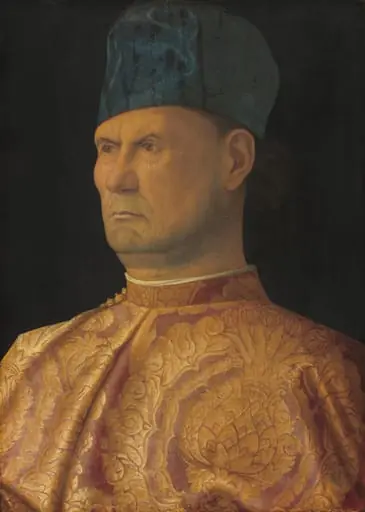
This painting, created around 1460–1470, is generally attributed to the Italian Renaissance artist Andrea Mantegna. It depicts a man with a solemn expression, dressed in elaborate attire and a distinctive hat. The work is currently housed in the National Gallery of Art in Washington, DC, and exemplifies the period's developing approach to individual portraiture.
Own this work as a print
Artist & collection
Artist
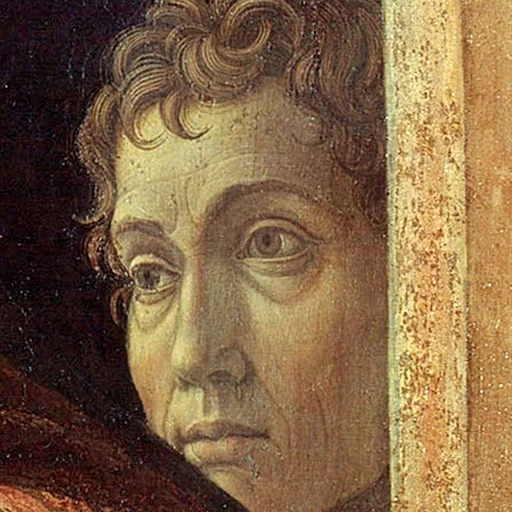
Andrea Mantegna (UK: US:; Italian:; c. 1431 – September 13, 1506) was an Italian Renaissance painter, a student of Roman archaeology, and the son-in-law of Jacopo Bellini. Like other artists of the time, Mantegna…