Artwork
Judith and Maidservant with Head of Holofernes
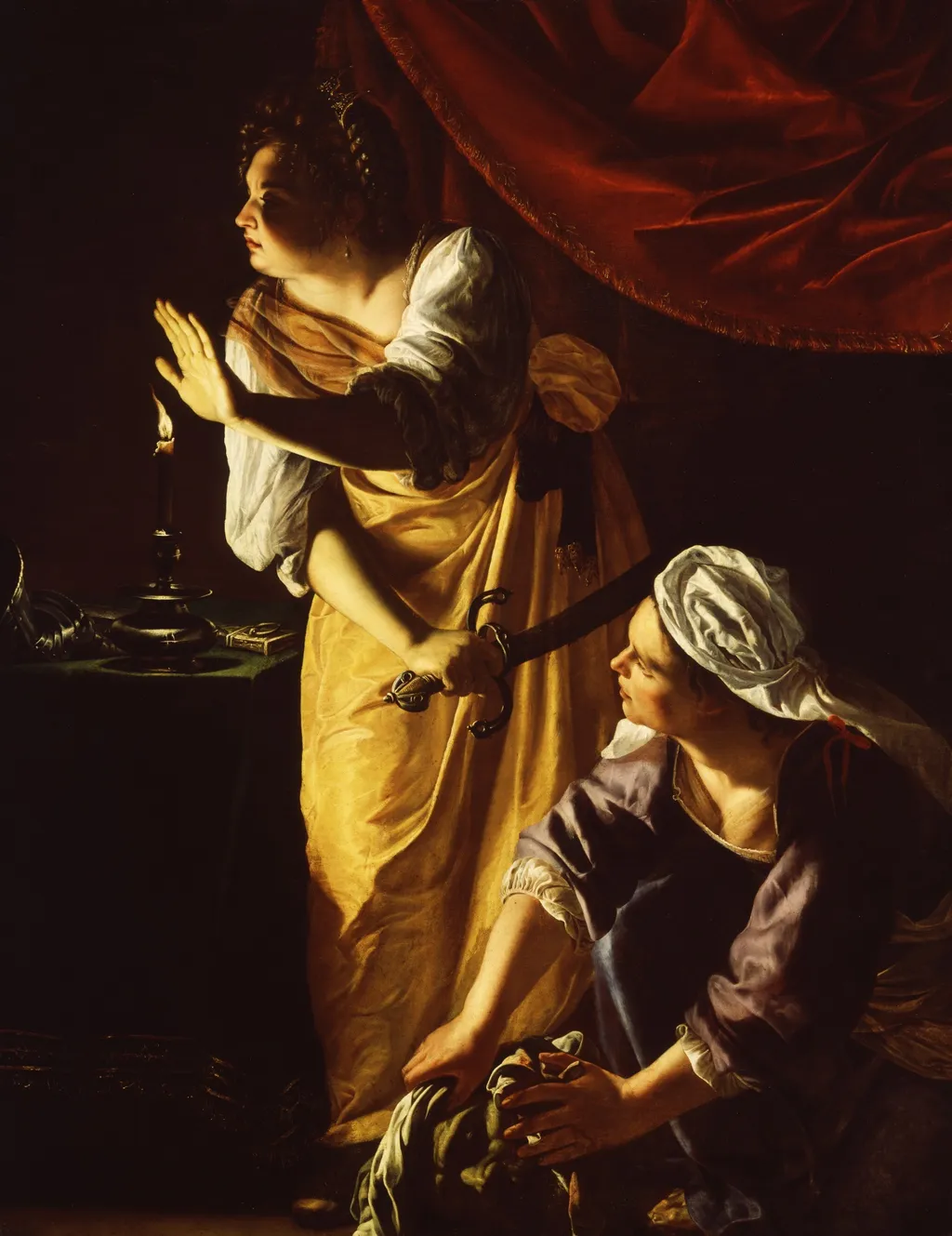
Judith and Maidservant with Head of Holofernes is an oil painting by the Early Baroque Italian artist Artemisia Gentileschi. It dates from 1623 and is held in the collection of the Detroit Institute of Arts.
About this work
Subject & Meaning
Rather than depicting the violent act itself, the composition focuses on Judith and her maidservant Abra preparing to flee the enemy camp.
The painting illustrates a specific episode from the deuterocanonical Book of Judith, capturing the moments immediately following the decapitation of the Assyrian general Holofernes. Rather than depicting the violent act itself, the composition focuses on Judith and her maidservant Abra preparing to flee the enemy camp. The maidservant is shown wrapping the severed head in a cloth with mechanical gestures while averting her gaze, while Judith, dressed in golden silk and jewels, shields her face from a single candle's glow and conceals her weapon.
This iconography emphasizes tension and the psychological weight of the escape rather than the physical struggle. The dramatic chiaroscuro and the crescent-moon shadow cast across Judith's face have been interpreted as symbolic references to Artemis, reinforcing the artist's recurring connection between her female protagonists and lunar deities. Scholars suggest this portrayal communicates an endorsement of female strength and ethical justification, potentially reflecting Gentileschi's own experiences and her focus on powerful women navigating patriarchal constraints.
Technique & Style
Executed in oil on canvas and measuring 187.2 cm high by 142 cm wide, the Detroit work employs strong tenebrism with a single candle as its only light source, casting deep shadows across Judith’s face and hands while isolating the golden silk of her dress and the crimson curtain in vivid local color. The composition is organized around Judith’s half-lit profile and her raised hand shielding the flame, creating a crescent-shaped shadow that echoes the crescent moon symbol associated with Artemis. The maidservant kneels in mechanical concentration, wrapping Holofernes’s head in cloth with averted gaze, her gestures echoing the rhythmic, sculptural folds of the drapery above. A finely wrought sword hilt and discarded gauntlet beside the candlestick attest to Gentileschi’s still-life precision within a Caravaggesque framework. A 2020-2021 cleaning confirmed the integrity of the paint layer and the stability of the ground, revealing the artist’s confident handling of contrasting textures from metal to silk under the dramatic, directional illumination.
History & Provenance
Executed between 1623 and 1625, this oil on canvas depicts the biblical heroine Judith and her maidservant with the severed head of Holofernes. The precise dating remains a subject of debate due to the artist's extensive travels throughout Italy during this period, though some sources suggest a slightly later range of 1625 to 1627 following her return to Rome. During this time, Gentileschi adapted her style to incorporate the tenebristic techniques of Northern painters working in the city, utilizing dramatic candlelight to illuminate the nocturnal scene.
The painting's provenance prior to the mid-20th century is unknown. By 1952, the work was in the possession of Prince Brancaccio and co-owned by Alessandro Morandotti of Rome and Adolph Loewi of New York. Later that same year, Leslie H. Green purchased the canvas and subsequently gifted it to the Detroit Institute of Arts, where it remains in the collection.
The painting is held by the Detroit Institute of Arts, accessioned as 52.5.
It entered the museum’s collection in 1952 after being purchased from Leslie H. Green, who had acquired it that same year from a co-ownership between Alessandro Morandotti of Rome and Adolph Loewi of New York, where it had previously belonged to Prince Brancaccio.
The work was cleaned and restored between 2020 and 2021.
Context
Artemisia Gentileschi’s Judith and Maidservant with Head of Holofernes (c. 1623-25) has been repeatedly singled out by scholars as her masterpiece. A 2001 exhibition catalogue notes that the Detroit version is “generally recognized as Artemisia’s finest work,” while Letizia Treves argues it secures her place among leading Italian Baroque painters. The composition’s technical and emotional intensity, its Caravaggesque tenebrism, sharply modeled forms, and charged narrative, distinguishes it from her other treatments of the subject, including the earlier Florentine and later Neapolitan variants. Scholarship often reads the painting within the artist’s biography, noting how her mastery of dramatic lighting and female agency reflects both her training under her father Orazio and her lived experience. The image’s psychological realism, particularly Judith’s vigilant watchfulness and the maidservant’s mechanical wrapping of the severed head, has been linked to Gentileschi’s identification with the protagonist, a reading tied to her 1612 rape trial against Agostino Tassi. Critics also emphasize her adaptation of Caravaggio’s chiaroscuro while inflecting it with her own palette, golden silks and deep crimson drapery, that heighten the scene’s Baroque intensity.
Legacy
The Detroit version of Judith and Her Maidservant is widely regarded as Artemisia Gentileschi's finest achievement. A 2001 exhibition catalogue explicitly identified it as her best work, a sentiment echoed by art historian Letizia Treves, who argued that the painting secures Gentileschi's status among the leading figures of the Italian Baroque. Contemporary critics and scholars have also praised the artist's technical mastery, with early admirers like Joachim von Sandrart commending the rationality and knowledge evident in her compositions. The work remains a central example of her ability to adapt Caravaggesque tenebrism while infusing scenes with unique dramatic tension and female agency. Its reputation endures through modern exhibitions and restoration efforts, such as the cleaning undertaken between 2020 and 2021, which reaffirmed its significance within her oeuvre.
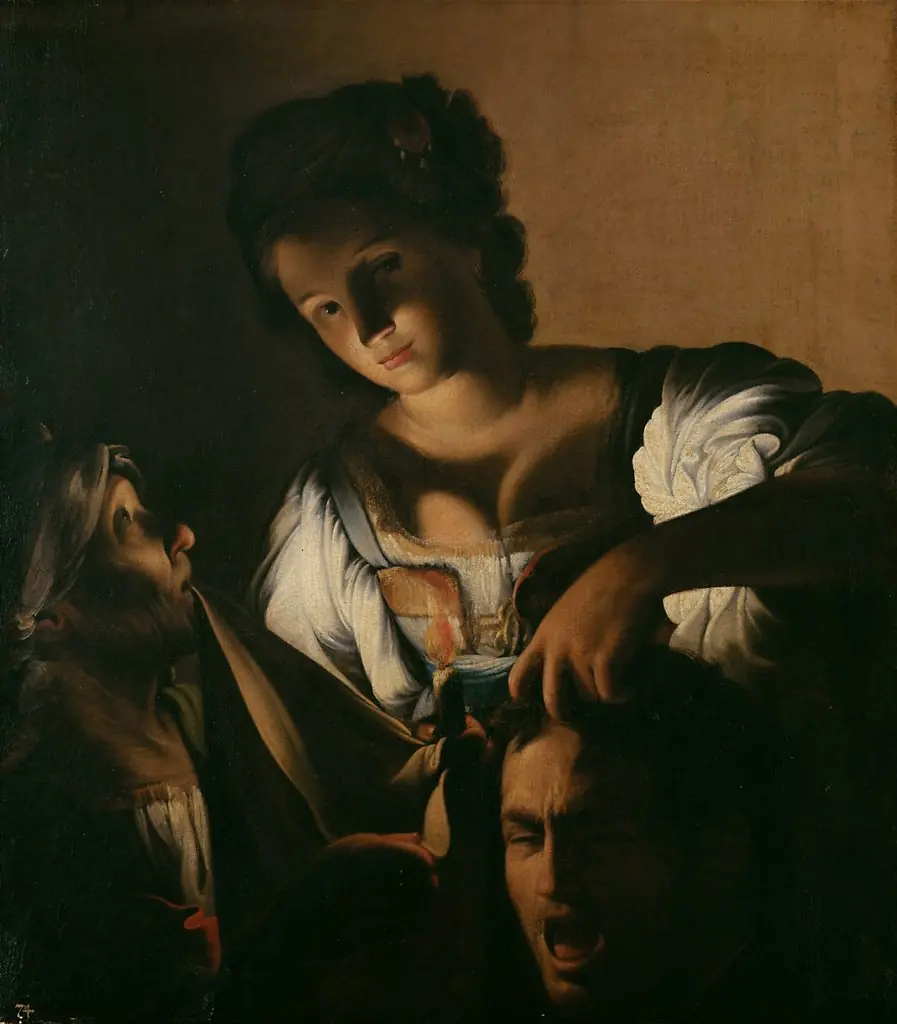
Own this work as a print
Artist & collection
Artist
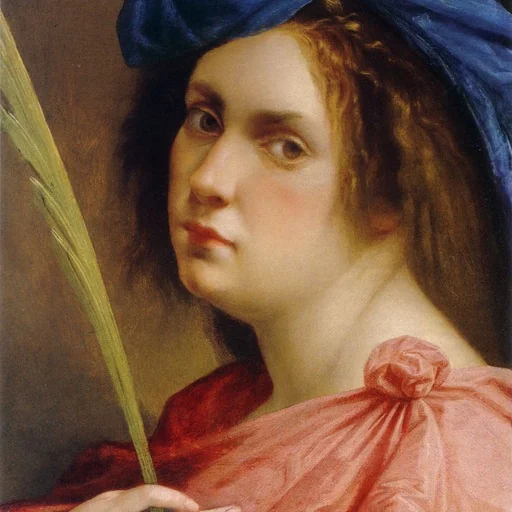
Artemisia Lomi Gentileschi (US: JEN-til-ESK-ee, -teel-; Italian:; 8 July 1593 – after January 1654) was an Italian Baroque painter.

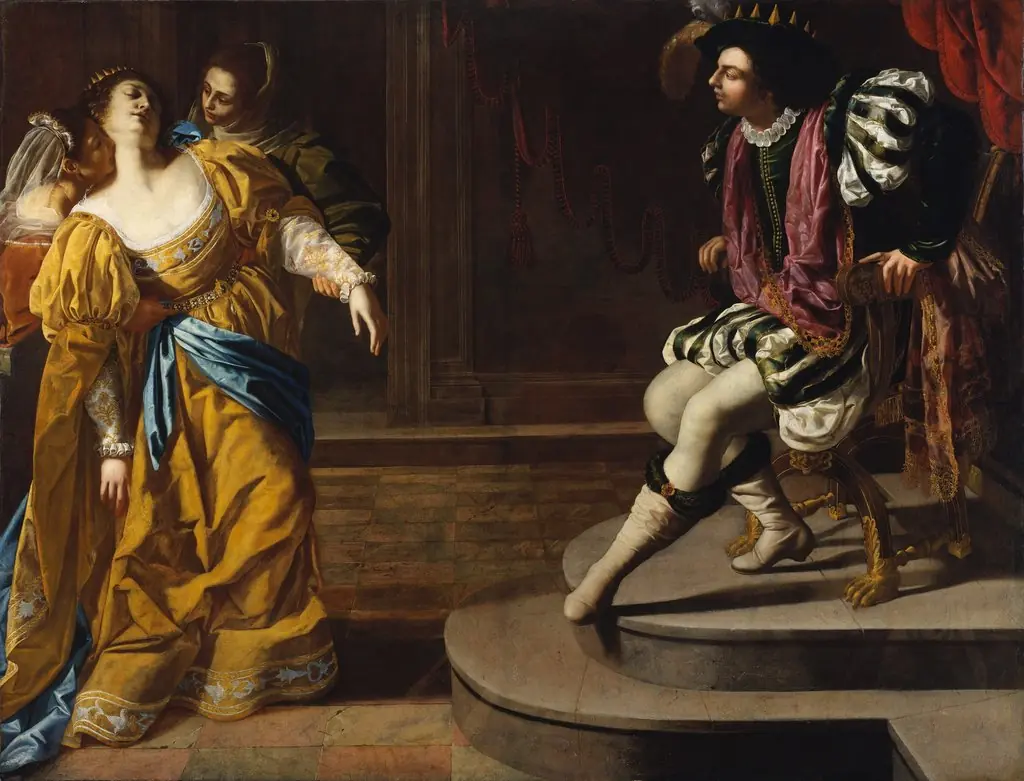

 Studied in the Caravaggio & Baroque course