Artwork
Judith Beheading Holofernes
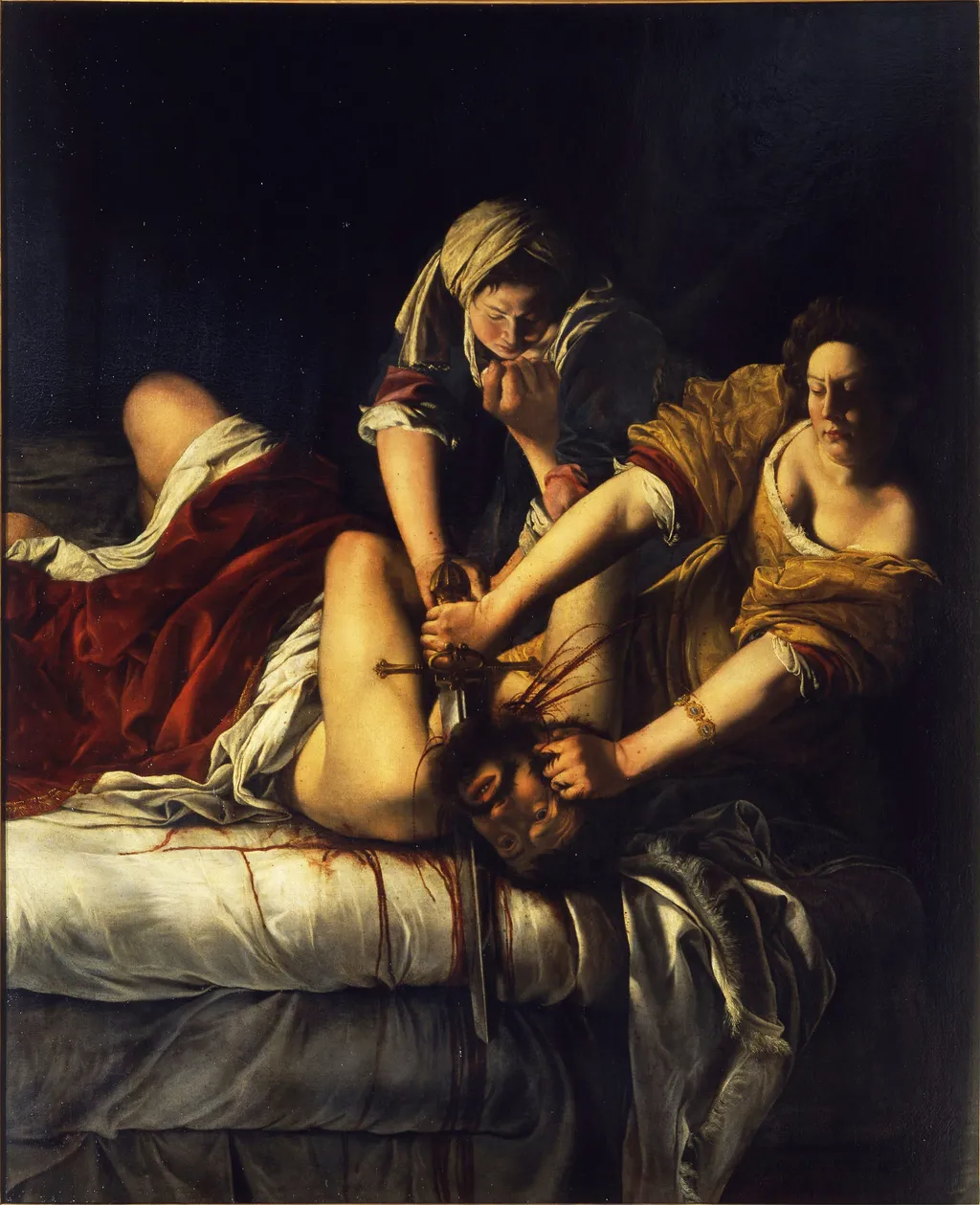
Judith Beheading Holofernes is an oil painting by the Early Baroque Italian artist Artemisia Gentileschi. It dates from 1620 and is held in the collection of the Uffizi Gallery.
About this work
Subject & Meaning
The spouting blood follows parabolic arcs, rendered with brutal realism through dramatic chiaroscuro.
The painting depicts the biblical episode from the deuterocanonical Book of Judith, in which the Jewish widow Judith, accompanied by her handmaiden Abra, infiltrates the Assyrian camp, seduces the enemy general Holofernes, and beheads him to save her besieged people. Gentileschi centers the composition on the physical labor of the killing itself, a departure from more common depictions that show moments before or after the decapitation. Iconographically, Judith wields a vertically positioned sword whose shape alludes to a cross, while she and Abra display rolled sleeves and resolute expressions, suggesting the killing as an unavoidable domestic chore. The women's strong arms and determined faces contrast with Holofernes's helpless struggle. The spouting blood follows parabolic arcs, rendered with brutal realism through dramatic chiaroscuro. Symbolically, Judith's golden-yellow gown, jewelry, and a bracelet bearing ancient cameos, possibly depicting Artemis, the goddess who violently defended her virginity, distinguish her from her blue-clad maidservant and suggest identification between painter and heroine. During the Catholic Reformation, Judith served as a figure of divine virtue opposing heretical tyranny, though the painting's raw violence also invited psychological readings about female vengeance.
Technique & Style
Executed in oil paint on canvas, the Uffizi version measures 199 × 162.5 cm and is rendered with greater care and patience than Gentileschi's earlier Naples interpretation. The three figures are arranged in a deliberate triangular composition, with the torsion of Judith's bust and the rotation of her right arm adding dynamism to the scene. Gentileschi employs a dark, deep, and mysterious background to concentrate focus on the violent act, while the adept use of chiaroscuro produces a drastic contrast between light and dark, both literally and figuratively.
The artist distinguishes Judith from her servant Abra through richer attire: Judith wears a gold-yellow damask gown with precise styling and a gold bracelet set with antique cameos, whereas Abra is dressed in a duller blue, visually subordinated to her mistress. Textiles are built up through multiple glazes and layers, from the folds of the red velvet blanket and the linen sheets to the lace of Judith's chemise and the fringing at the lower left. The painting's brutal realism is heightened by the spurting arc of carotid blood, rendered by flicking red pigment directly from the brush so that droplets scatter across the surface in near-ballistic parabolic curves.
History & Provenance
The Uffizi version of Judith Beheading Holofernes was painted by Artemisia Gentileschi around 1620, as a second, larger treatment of a subject she had first explored in her Naples canvas of c. 1612-1613. It was commissioned by Grand Duke Cosimo II de' Medici, who had presumably seen the earlier Naples version and requested a variation intended for his wife, Maria Magdalena, as part of a broader Pitti Palace collection of biblical heroines. Gentileschi received 50 scudi as payment, an arrangement in which Galileo Galilei, a fellow member of the Florentine Accademia, reportedly interceded on her behalf to secure the agreed compensation. In the late eighteenth century a Grand Duchess, disapproving of the painting's graphic violence, had it relegated to an isolated section of the Uffizi. It was damaged in the 1993 terrorist bombing of the Pitti Palace and, following restoration, was returned to a peripheral location in the gallery, where it remains in the Uffizi's collection.
Context
Artemisia Gentileschi’s 1620 *Judith Beheading Holofernes* stands as a definitive work of the Baroque era, emerging during the Catholic Reformation when religious art served to reaffirm faith through heightened realism. The painting is frequently contextualized within the artist’s biography, specifically her rape trial, though recent scholarship has shifted focus from purely psycho-biographical readings to analyzing her innovative visual rhetoric and technical mastery. Art historians such as Roberto Longhi and Roland Barthes have noted the work’s originality compared to Caravaggio’s earlier treatment of the subject, highlighting its dynamic triangular composition and the dramatic, ballistic trajectory of the blood. The piece was commissioned by Grand Duke Cosimo II de' Medici, who reportedly sought a variation of Gentileschi’s earlier Naples version for his wife. Despite its initial reception as too gruesome, leading to its relegation in the Pitti Palace, the work is now recognized as a masterpiece of violent tension and female agency within the canon of 17th-century art.
Legacy
The Uffizi version is regarded as Artemisia Gentileschi's most celebrated and recognizable work, the painting to which her name is most immediately linked. Its brutal realism, however, initially drew censure: in the late 1700s a Grand Duchess disapproved of the gruesome depiction and had it banished to an isolated section of the Uffizi, where it remained in peripheral display even after restoration following the 1993 terrorist bombing of the Pitti Palace.
The painting has long been interpreted through the lens of Gentileschi's biography, with critics reading it as an expression of female vengeance following her rape by Agostino Tassi. Since 2000, thorough analyses of the 1612 trial records have exposed inconsistencies in that reading, and recent scholarship emphasizes instead the painting's innovative artistic and pictorial achievement. Roberto Longhi addressed the work as early as 1916, and Roland Barthes later used it to clarify its originality even in comparison with Caravaggio's version. Mary D. Garrard's 1991 monograph further cemented its place within Italian Baroque studies.
Own this work as a print
Artist & collection
Artist
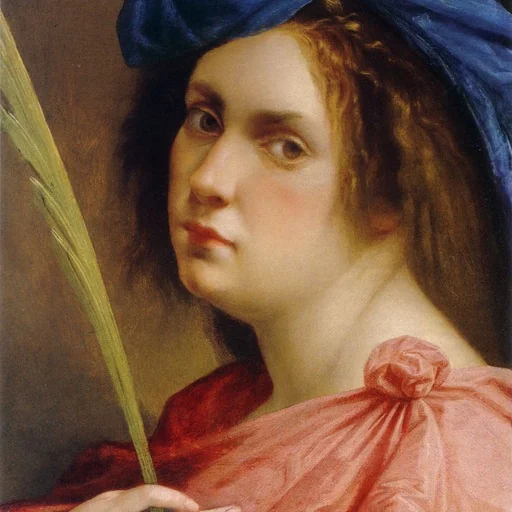
Artemisia Lomi Gentileschi (US: JEN-til-ESK-ee, -teel-; Italian:; 8 July 1593 – after January 1654) was an Italian Baroque painter.


 Studied in the Caravaggio & Baroque course