Artwork
Amor Vincit Omnia
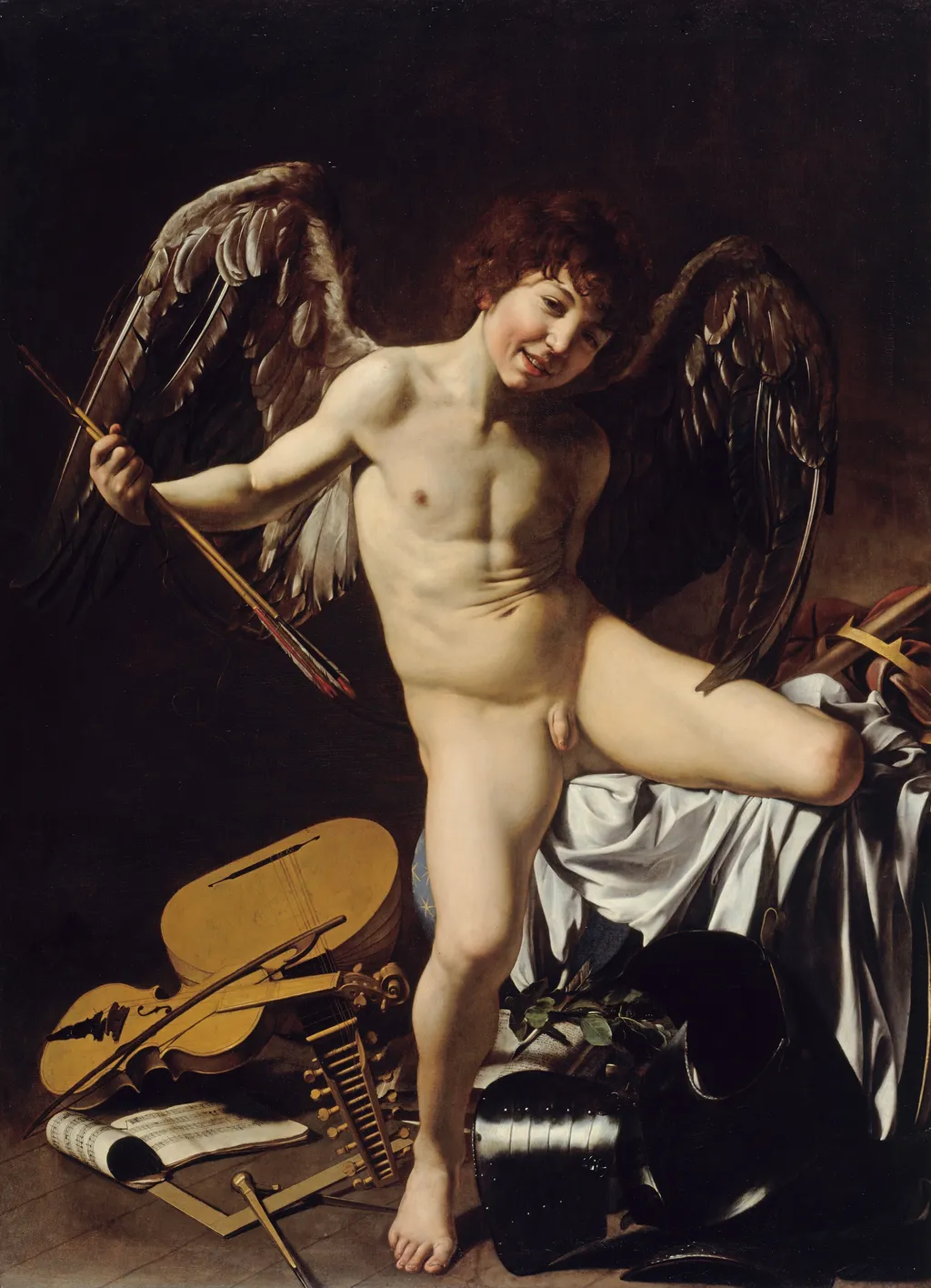
Amor Vincit Omnia is an oil painting by the Baroque artist Caravaggio. It dates from 1601 and is held in the collection of the Gemäldegalerie Berlin.
About this work
Subject & Meaning
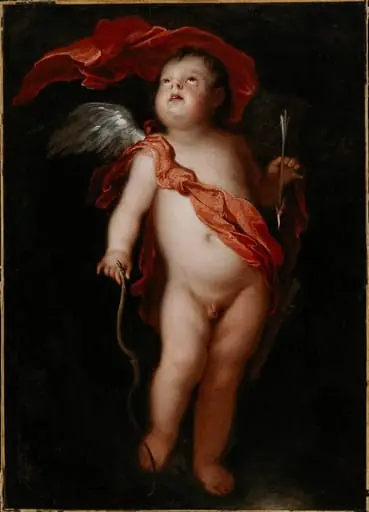
The painting depicts Amor, the Roman Cupid, as a nude adolescent boy with dark eagle wings, seated on a celestial globe and a cloth-draped table.
The painting depicts Amor, the Roman Cupid, as a nude adolescent boy with dark eagle wings, seated on a celestial globe and a cloth-draped table. He holds a bow and two arrows, one red (or golden) to inspire love and one black (leaden) to extinguish it, and the bowstring is broken, signaling that the weapon has already done its work. Scattered beneath his feet are the emblems of worldly power, art, and learning: a violin and lute, a musical manuscript marked with a large "V," armor, a coronet, a compass and square, a pen and book, and a laurel wreath.
The iconography derives from the ancient motif of the triumph of Eros over Pan, in which "Pan" was traditionally read as "all," so that Cupid's victory over these symbols proclaims the omnipotence of love over every human pursuit. The Latin title quotes Virgil's Eclogues (10.69): "Omnia vincit amor; et nos cedamus Amori" ("Love conquers all; let us too yield to Love"). The arrangement of attributes has also been read as an allegorical tribute to the painting's commissioner, Marchese Vincenzo Giustiniani, whose interests in music, science, and the arts the objects collectively evoke.
Technique & Style
Executed in oil on canvas, this work measures approximately 156.5 by 113.3 cm. Caravaggio employed a dramatic chiaroscuro technique, using bundled light to render the figure with strong plasticity and photographic clarity. The palette is dominated by half-colors such as brown, olive, and caput mortuum, accented by red, yellow, and blue. Stylistically, the painting merges allegory with intense realism; the depiction of Cupid as a twelve-year-old boy includes unidealized details like dirty toenails and an unstable, wide-legged pose.
The composition features the nude figure seated on a celestial globe, trampling symbols of human endeavor including musical instruments, armor, and scientific tools. Historical accounts note that the eagle wings used as props were borrowed from the painter Orazio Gentileschi to aid in the direct observation of the model.
History & Provenance
Amor Vincit Omnia was commissioned by Vincenzo Giustiniani, a Roman marquis, and painted by Caravaggio in Rome around 1601-1602. The work remained in the Giustiniani collection until 1812, when it was sold to the art dealer Féréol Bonnemaison and subsequently acquired by Frederick William III of Prussia in 1815 for the Berlin Museums, becoming part of the Gemäldegalerie's holdings. The painting has been displayed in Berlin since its acquisition.
Contemporary records, including Sandrart's 1675 description and Vincenzo Giustiniani's patronage, confirm its immediate success in Roman elite circles and its symbolic reference to the patron's interests in art and science. The work features Cupid as a realistic adolescent male nude with eagle wings, holding a bow with broken string and two arrows (one red, one black), standing on a table partially covered by a cloth, surrounded by emblems of human endeavors. Caravaggio used chiaroscuro to create dramatic three-dimensionality, employing colors such as brown, olive, and caput mortuum.
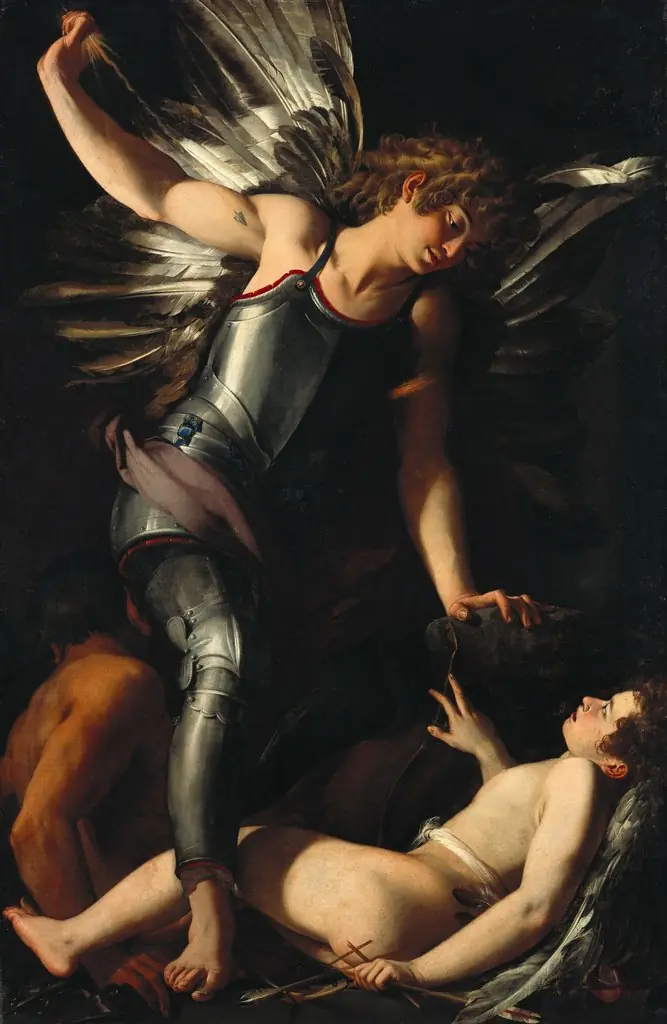
The painting's Latin title derives from Virgil's Eclogues (10,69), and its creation involved props lent by Orazio Gentileschi, allowing precise dating to 1602-03. It was produced in direct response to Vincenzo Giustiniani's commission and later became the subject of artistic rivalry with Giovanni Baglione, who created a contrasting allegorical work for the cardinal brother Benedetto Giustiniani in 1602-03.
Commissioned by Marchese Vincenzo Giustiniani, the painting remained in the Giustiniani collection until its dissolution in the early 19th century. In 1815, King Frederick William III of Prussia purchased the work, along with 156 other pieces from the collection, to establish Berlin as a cultural capital. Since this acquisition, the artwork has been held by the Berlin State Museums and is currently displayed in the Gemäldegalerie, specifically within Room XIV dedicated to 17th and 18th-century Italian, French, and Spanish paintings.
The work's public prominence continued into the modern era, notably during a 2014 controversy where an open letter demanded its removal due to the depicted nudity of the juvenile model. Museum director Bernd Lindemann rejected these calls, citing artistic freedom, and the painting remains on public view.
Context
Completed around 1601–1602 for the Roman collector Vincenzo Giustiniani, this work was immediately celebrated by the city's intellectual elite, inspiring contemporary madrigals and epigrams. The painting's provocative realism and alleged eroticism sparked a fierce rivalry with Giovanni Baglione, who produced a derivative counter-work depicting Divine Love conquering Earthly Love. Baglione later became Caravaggio's first biographer, ensuring their quarrel influenced early scholarship.
While Joachim von Sandrart praised the work's lifelike clarity in the 17th century, modern discourse has occasionally challenged its public display due to the model's youth, though museum directors have defended it as a masterpiece of artistic freedom. The title, derived from Virgil, was formally applied by the critic Giovanni Pietro Bellori in 1672.
Art historically, the piece stands as a rare mythological exception within Caravaggio's predominantly religious Roman output, illustrating his unique fusion of allegory and unidealized naturalism.
Legacy
The painting's legacy is defined by its enduring influence on artistic discourse and its contested interpretations across centuries. Following its acquisition by Frederick William III in 1815, the work remained in the Berlin State Museums' collection, where it became a focal point for debates about artistic merit, eroticism, and historical context. Nineteenth-century scholarship, such as Sandrart's description of its 'life-size Cupid' and precise rendering of 'brown eagle's wings,' highlighted its technical innovation and naturalistic detail, contrasting with idealized contemporaries like Battistello Caracciolo's Sleeping Cupid.
This realism, achieved through Caravaggio's chiaroscuro technique and use of a live model, cemented its reputation as a breakthrough in Baroque art. The painting also sparked a documented rivalry with Giovanni Baglione, who created a derivative work in 1602 as a direct response to Caravaggio's commission, a conflict that later shaped early biographies of the artist. Twentieth-century interpretations amplified its symbolic complexity, with scholars linking its iconography to Vincenzo Giustiniani's identity and alleging erotic subtexts, though these theories were later contested.
Modern critiques, including 2014 controversies over its depiction of a minor, have been met with institutional defense of artistic freedom, underscoring its persistent cultural relevance. The work's journey from Giustiniani's Roman collection to Berlin's Gemäldegalerie, where it remains displayed, reflects its role as a touchstone for discussions on patronage, artistic competition, and the evolving reception of Caravaggio's legacy.
Overview
Created between 1601 and 1602, this oil painting by the Italian Baroque painter Caravaggio bears the Latin title Amor Vincit Omnia, commonly rendered in English as “Love Victorious” or similar variations. The work presents a compact, dramatic scene illuminated by Caravaggio’s characteristic use of light and shadow.
Own this work as a print
Artist & collection
Artist
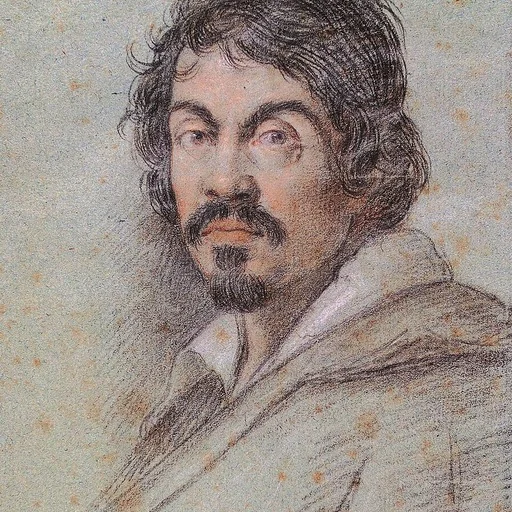
Michelangelo Merisi da Caravaggio (also Michele Angelo Merigi or Amerighi da Caravaggio; 29 September 1571 – 18 July 1610), known mononymously as Caravaggio, was an Italian painter active in Rome for most of his artistic life.