Artwork
Cedar Bluffs
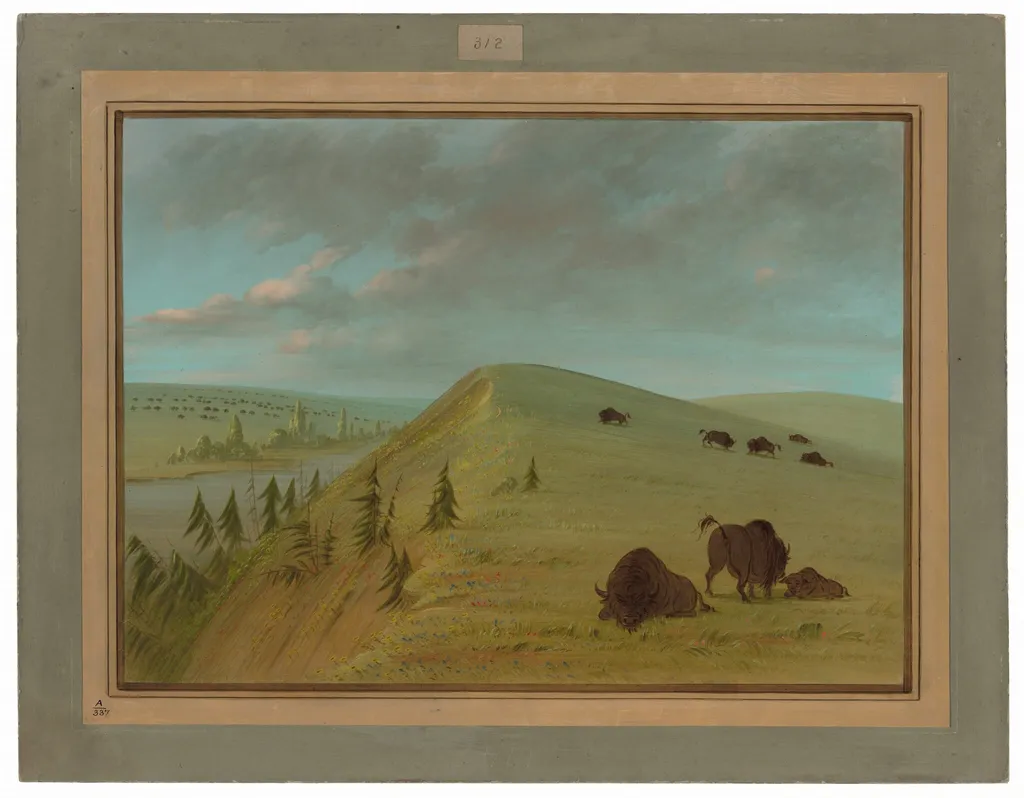
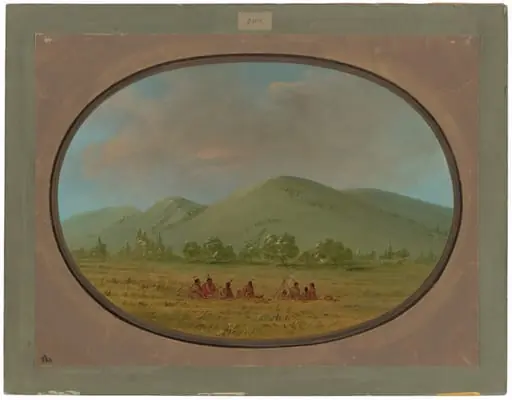
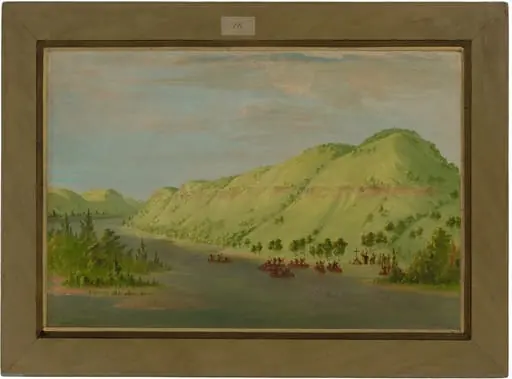
Cedar Bluffs is an oil painting by the Hudson River School artist George Catlin. It dates from 1865 and is held in the collection of the National Gallery of Art.
About this work
Technique & Style
The composition balances naturalistic detail with generalized forms, emphasizing the interplay of light and shadow across the bluffs and river.
The painting is executed in oil on a card support that has been mounted onto paperboard. The handling is fluid, with broad, descriptive brushwork used to render the landscape’s rolling terrain and dense vegetation. The composition balances naturalistic detail with generalized forms, emphasizing the interplay of light and shadow across the bluffs and river.
The condition is stable; no significant losses, abrasions, or deformations are recorded in the source inventory, and the card remains adhered to the paperboard without evident warping.
History & Provenance
Painted in 1865, Cedar Bluffs is a landscape by George Catlin documented to that year.
The work descended from the artist to his daughters, Clara Gregory Catlin, Louise Catlin Kinney, and Elizabeth Wing Catlin, before being purchased in 1912 by the American Museum of Natural History from Elizabeth Wing Catlin. In 1959 it was sold through Kennedy Galleries, New York, to Paul Mellon, Upperville, Virginia, and was subsequently given by Mellon in 1965 to the National Gallery of Art, Washington, D.C.
The painting Cedar Bluffs by George Catlin is currently held in the collection of the National Gallery of Art in Washington, D.C. Its provenance traces from the artist to his daughters, with Elizabeth Wing Catlin selling the work in 1912 to the American Museum of Natural History. The museum sold it in 1959 through Kennedy Galleries to Paul Mellon, who gifted it to the National Gallery of Art in 1965.
The source material does not provide a specific inventory or accession number for the work. Furthermore, the provided texts contain no information regarding the painting's exhibition history.
Context
Cedar Bluffs (1865) by George Catlin entered a notable lineage after its creation, moving from the artist's daughters to the American Museum of Natural History in 1912 before being acquired by Paul Mellon in 1959 and gifted to the National Gallery of Art in 1965. The work remains part of the National Gallery of Art's collection in Washington, D.C., where it is studied within the context of 19th-century American landscape painting and Catlin's broader documentation of frontier subjects.
Legacy
Cedar Bluffs, painted by George Catlin in 1865, entered the collection of the National Gallery of Art in Washington, D.C., where it has been part of the museum's holdings since its acquisition in 1965. The work was previously owned by the artist's descendants before being sold to Paul Mellon in 1959 and subsequently gifted to the museum. Its presence in a major national collection has contributed to ongoing scholarly attention to Catlin's body of work, particularly in assessments of 19th-century American landscape painting.
The painting is frequently referenced in studies of Catlin's role in documenting frontier regions and in surveys of early American art.
Overview
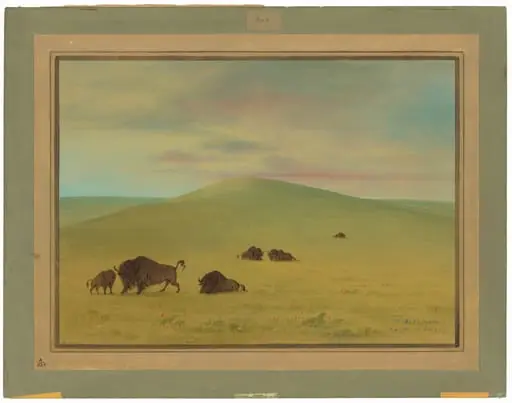
Created in 1865, Cedar Bluffs is an oil painting executed on card that has been mounted on a paperboard support. The composition presents a modest hill punctuated by a few trees, a distant body of water, and a herd of bison, one of which lies down. A cloudy blue sky arches above, lending the scene a tranquil, open‑air atmosphere.
Subject & Meaning
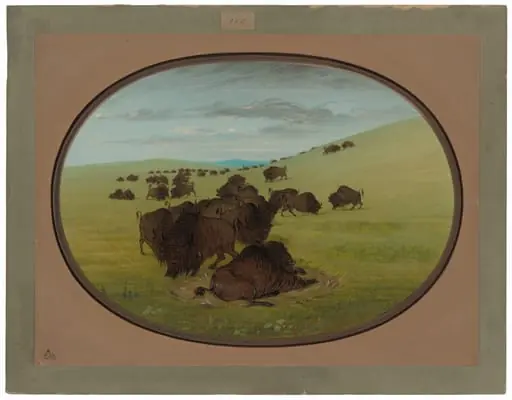
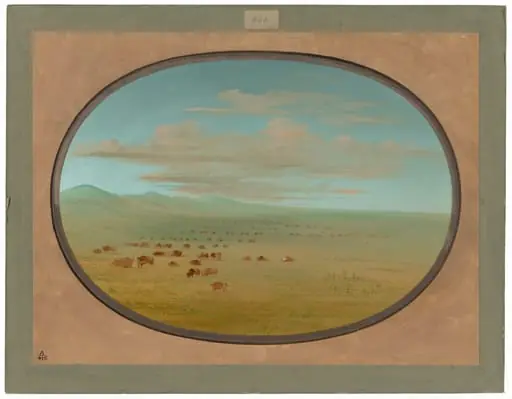
The work depicts a prairie landscape where wildlife and terrain coexist, emphasizing the quiet presence of bison grazing on the hillside. By placing the animals within a gently rolling environment, the painting suggests a harmonious relationship between the land and its native fauna, reflecting a view of the American West as both inhabited and unspoiled.
Own this work as a print
Artist & collection

Artist
George Catlin ( KAT-lin; July 26, 1796 – December 23, 1872) was an American lawyer, painter, author, and traveler, who specialized in portraits of Native Americans in the American frontier.

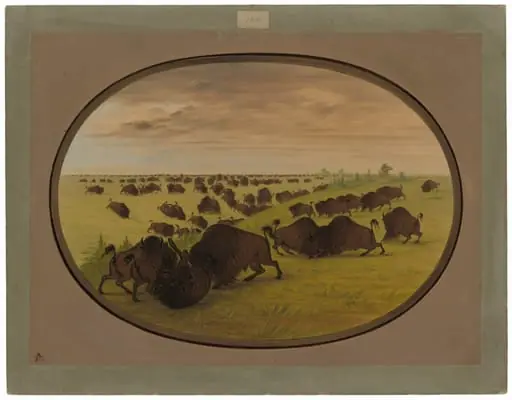 Bulls Fighting
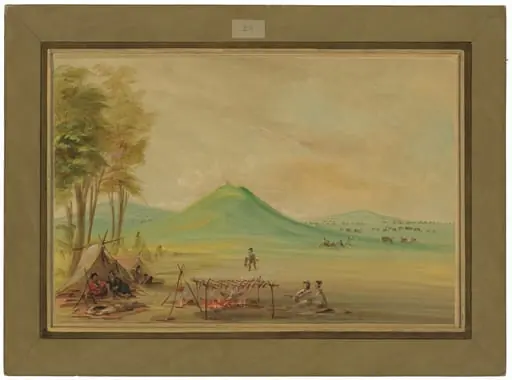 Expedition Encamped on a Texas Prairie. April 1686
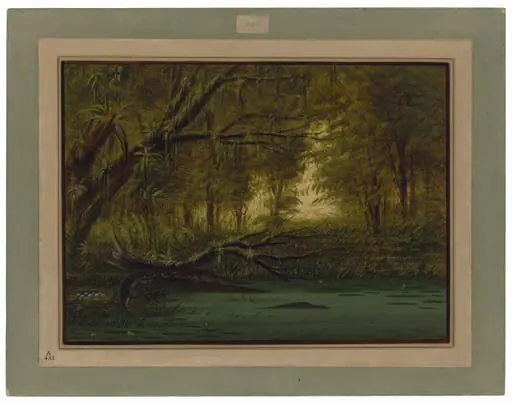 An Alligator's Nest
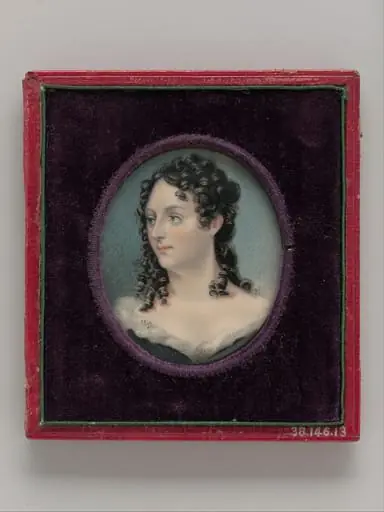 Mrs. George Catlin (Clara Bartlet Gregory)
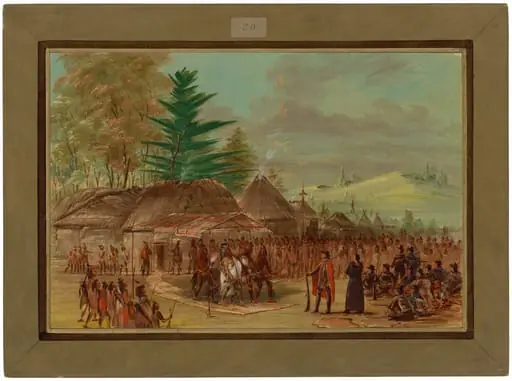 Chief of the Taensa Indians Receiving La Salle. March 20, 1682
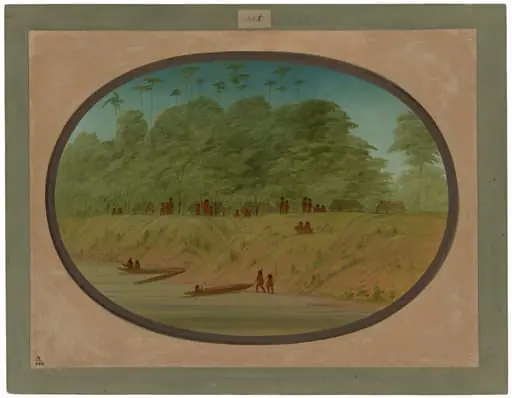 A Small Village - Payaguas Indians
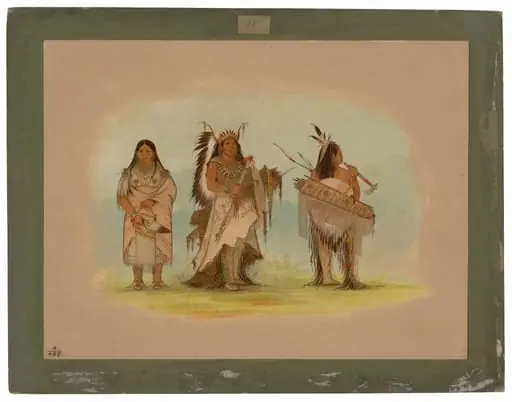 Omaha Chief, His Wife, and a Warrior
 Father Hennepin Leaving the Mississippi to Join La Salle. May 8, 1680