Artwork
Dying Buffalo Bull
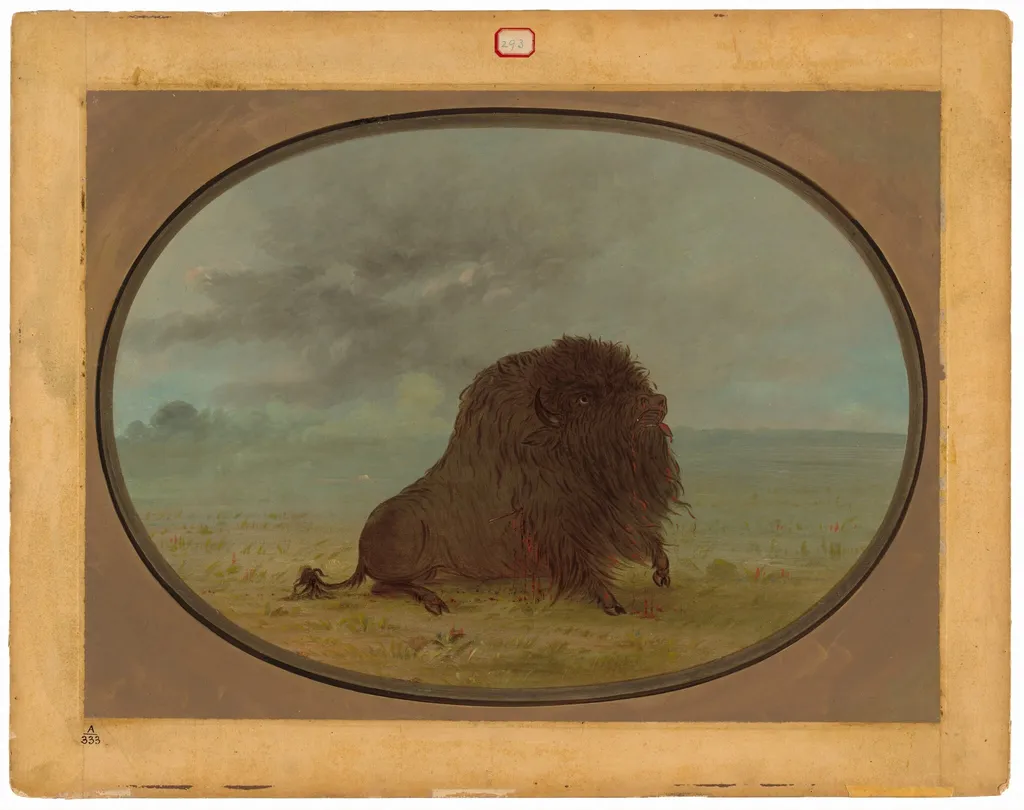
Dying Buffalo Bull is an oil painting by the Impressionist artist George Catlin. It dates from 1865 and is held in the collection of the National Gallery of Art.
About this work
Overview
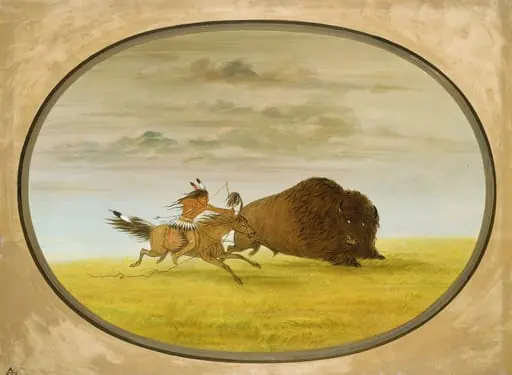
Dying Buffalo Bull is an oil painting by American artist George Catlin, dated 1861, depicting a mortally wounded buffalo bull on the western plains.
Dying Buffalo Bull is an oil painting by American artist George Catlin, dated 1861, depicting a mortally wounded buffalo bull on the western plains. The work, measuring 44.5 by 60.5 centimeters, is executed in oil on card mounted on paperboard and is now held in the collection of the National Gallery of Art in Washington, D.C., under accession number 1965.16.206. It belongs to Catlin's so-called Cartoon Collection, a second major body of work created during the 1850s and 1860s that followed his earlier Indian Gallery of the 1830s. The painting is significant as a document of both western wildlife and the artist's enduring project to record Native American life and the natural world of the American West.
Subject & Meaning
The central subject is a large buffalo bull seated on the ground, its body oriented leftward while its head turns sharply to the right, mouth slightly open with tongue visible. The animal's dark, shaggy coat is marked by numerous red wounds resembling blood on its chest, neck, and forelegs, with additional red spots scattered on the surrounding grass, indicating it has been hunted or attacked. The setting is a flat, expansive plain stretching toward a distant horizon with muted green and yellow vegetation, beneath a sky where heavy, dark gray clouds mass toward the left while lighter, bluish tones appear toward the right. Catlin's 1871 catalog entry for the work identifies the location as the Yellowstone River and dates the original encounter to 1832, though the painting itself was created decades later. The composition conveys the pathos of the dying animal within the vastness of the western landscape, touching on themes of wilderness, mortality, and the vanishing world that Catlin sought to preserve in paint.
Technique & Style
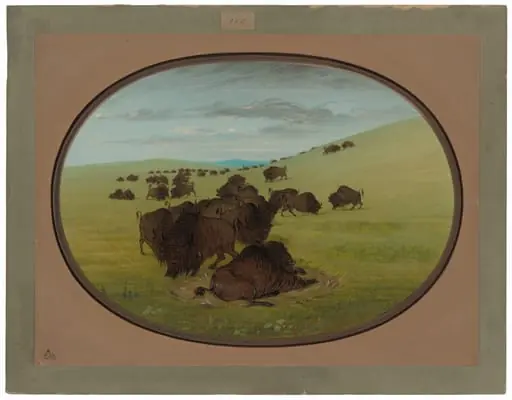
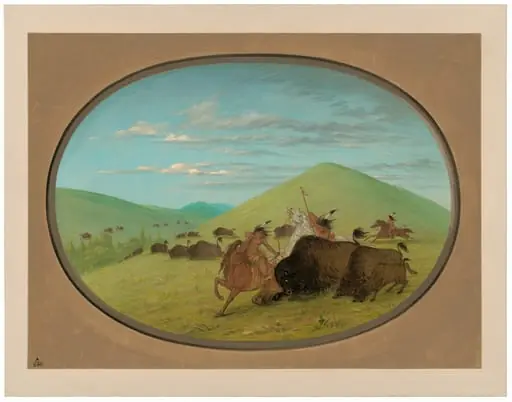
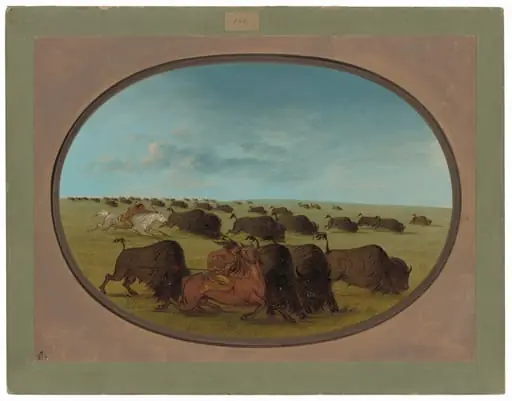
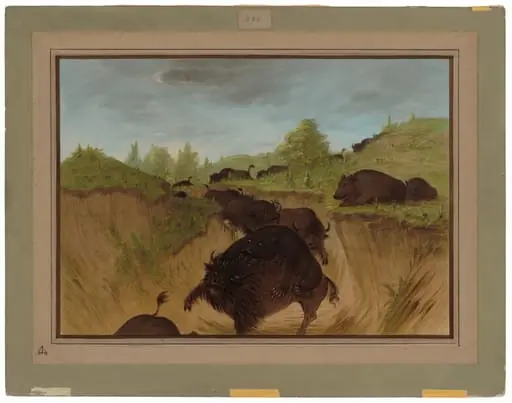
The painting exhibits a smooth, detailed finish in the animal's fur, achieved through dense, textured brushwork that renders the shaggy coat with tactile specificity. This detailed handling contrasts with a more atmospheric, blended treatment in the sky and distant landscape, creating a sense of depth and environmental vastness. The overall palette consists of subdued earth tones, grayed greens, and brownish blacks, with the red of the wounds providing the only vivid chromatic accent. The oval composition, set within a rectangular mat with aged, yellowed borders, reflects the presentation format Catlin employed for works in his Cartoon Collection. The small red octagonal label bearing the number 293 at the top center of the mat and the stamp A 333 at the lower left corner served as cataloging devices for the collection.
History & Provenance
The painting remained in Catlin's possession until his death in 1872, then descended to his daughters: Clara Gregory Catlin, Louise Catlin Kinney, and Elizabeth Wing Catlin. In 1912, the American Museum of Natural History purchased the work from Elizabeth Wing Catlin, acquiring a significant portion of the Cartoon Collection. The museum deaccessioned the work in 1959, selling it through Kennedy Galleries in New York to Paul Mellon of Upperville, Virginia. Mellon, a major collector of American art, gave the painting to the National Gallery of Art in 1965 as part of a larger gift of 351 works from the Cartoon Collection. The work has been exhibited extensively, including a loan to the Whitney Gallery of Western Art at the Buffalo Bill Historical Center in Cody, Wyoming from 1964 to 1974; the exhibition George Catlin: Pioneer Painter of the North American Indian at the Montclair Art Museum in 1985-1986; and The Illusion of the American Frontier at the Museo Thyssen-Bornemisza in Madrid in 2015-2016.
Context
George Catlin (1796-1872) produced two major collections of paintings documenting Native American life and western subjects. The first, his Indian Gallery, comprised more than 500 works completed during the 1830s, with most surviving examples now at the Smithsonian American Art Museum. The second, created during the 1850s and 1860s and numbering more than 600 works, he called his Cartoon Collection. This later group consisted of replicas, variants, and new compositions based on his earlier sketches and memories, produced after Catlin had lost access to his original Indian Gallery. When Catlin exhibited the Cartoon Collection in New York in 1871, he published a catalog listing all works, often including supplementary information about subjects. The entry for this painting, catalog number 293, explicitly linked it to the Yellowstone River and the year 1832, demonstrating how Catlin constructed a documentary framework around works created decades after the purported events. The Cartoon Collection works were acquired by the American Museum of Natural History in 1912, but more than 300 were later deaccessioned and purchased by Paul Mellon, whose 1965 gift to the National Gallery of Art ensured their preservation and public access.
Legacy
Dying Buffalo Bull occupies an important place within the extensive body of work through which Catlin shaped American and European understanding of the West. As part of the Cartoon Collection, it represents the artist's sustained effort to revisit and disseminate his western imagery, even under changed circumstances. The painting's afterlife is inseparable from the institutional history that preserved it: from the American Museum of Natural History's early stewardship to Paul Mellon's decisive collecting and eventual gift to the National Gallery of Art. The work has been cited in successive editions of the National Gallery's American Paintings catalog (1970, 1980, 1992) and has traveled to numerous regional and international venues through the museum's lending program. Its subject, the buffalo, would become an increasingly potent symbol of western loss and conservation in the decades after Catlin's death, though the painting itself predates the near-extinction of the herds in the 1870s and 1880s. The work thus stands as both a specific document of Catlin's artistic practice and a broader emblem of the American West as imagined and transmitted through nineteenth-century painting.
Own this work as a print
Artist & collection

Artist
George Catlin ( KAT-lin; July 26, 1796 – December 23, 1872) was an American lawyer, painter, author, and traveler, who specialized in portraits of Native Americans in the American frontier.

 Bulls Fighting
 Expedition Encamped on a Texas Prairie. April 1686
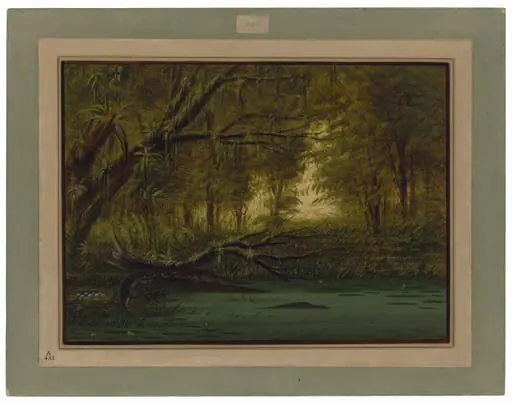 An Alligator's Nest
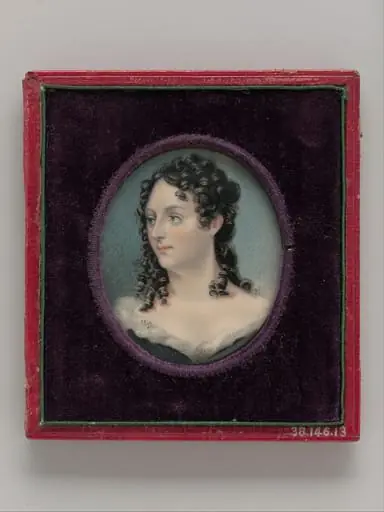 Mrs. George Catlin (Clara Bartlet Gregory)
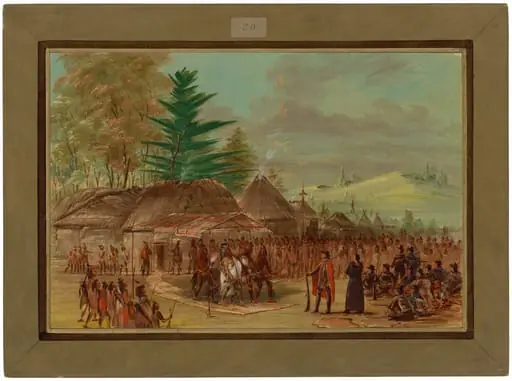 Chief of the Taensa Indians Receiving La Salle. March 20, 1682
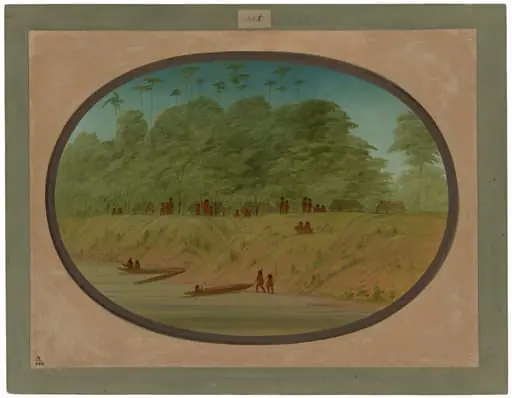 A Small Village - Payaguas Indians
 Omaha Chief, His Wife, and a Warrior
 Father Hennepin Leaving the Mississippi to Join La Salle. May 8, 1680