Artwork
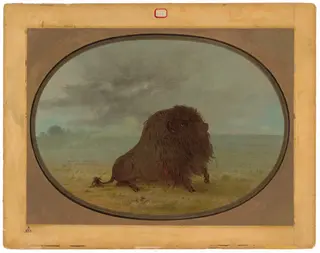
Wounded Buffalo Bull
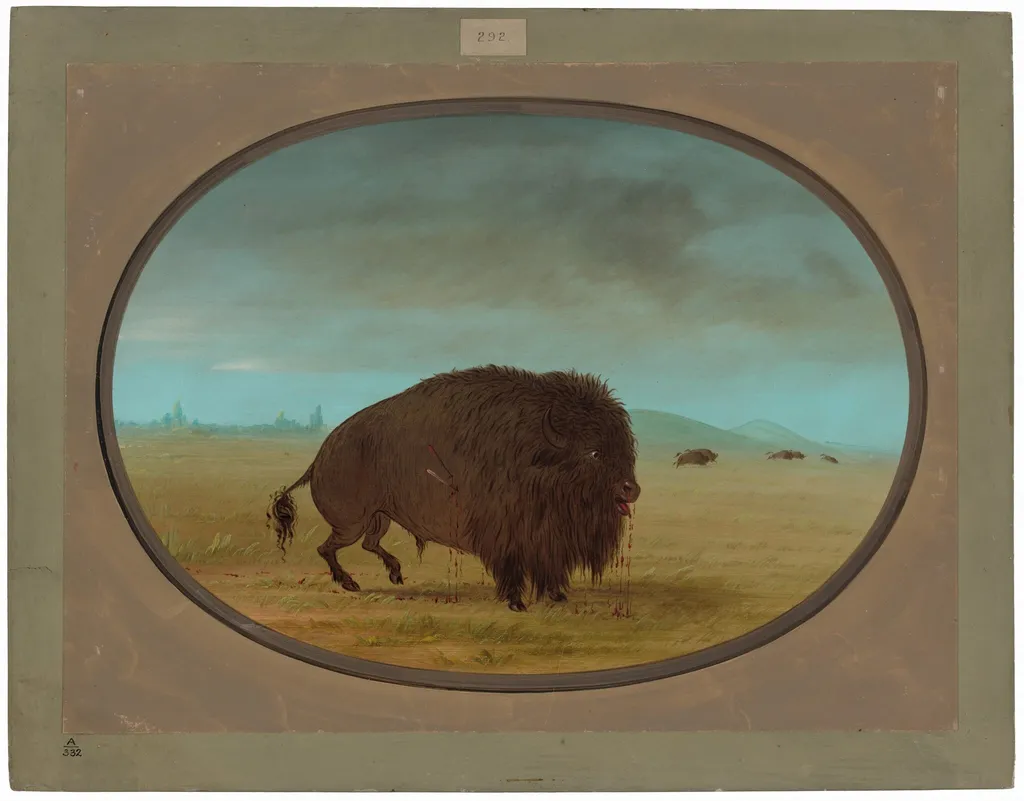
Wounded Buffalo Bull is an oil painting by the Impressionist artist George Catlin. It dates from 1865 and is held in the collection of the National Gallery of Art.
About this work
Overview
5 cm, the work depicts a wounded American bison standing on the prairie, and it is held in the collection of the National Gallery of Art in Washington, D.
Wounded Buffalo Bull is an oil painting on card mounted on paperboard by the American artist George Catlin, dated 1861. Measuring 46.8 by 62.5 cm, the work depicts a wounded American bison standing on the prairie, and it is held in the collection of the National Gallery of Art in Washington, D.C., under accession number 1965.16.205. The painting belongs to Catlin's "Cartoon Collection," a second major body of work created during the 1850s and 1860s that comprised more than 600 paintings, distinct from his earlier "Indian Gallery" of the 1830s. As a document of the American West and its increasingly threatened wildlife, the work exemplifies Catlin's lifelong project of recording Native American life and the western landscape before they disappeared.
Subject & Meaning
The central subject is a wounded buffalo bull standing in a grassy plain, facing right with mouth open and tongue visible. Two broken arrows protrude from the animal's flank, and blood drips from wounds on its side and mouth. The iconography of the wounded bison carries layered meanings: it documents the hunting practices of Plains Indians while simultaneously serving as an elegy for a species and way of life that Catlin recognized as imperiled. The animal's suffering is rendered with explicit detail, yet the composition presents it as a noble figure against the vast prairie. In the background, distant buffalo figures on the horizon suggest the diminishing herds, while faint blue hills and sparse vegetation emphasize the emptiness of the landscape. The sky transitions from pale turquoise near the horizon to deeper blue-gray, creating a somber atmosphere that underscores the pathos of the scene. Catlin's 1871 catalog entry for the painting identifies the subject as "WOUNDED BUFFALO BULL, Platte. 1832," locating the scene geographically and dating the original observation to his early western travels.
Technique & Style
The painting is executed in oil on card mounted on paperboard, a support typical of Catlin's Cartoon Collection works, which were more portable and less formal than his earlier canvases. The paint surface appears smooth, with careful detail lavished on the buffalo's dark brown fur, rendered with textured, shaggy brushwork that becomes longer and more matted beneath the neck and forelegs. The landscape background is handled more loosely, with rolling prairie, distant buffalo, and sparse vegetation indicated with economical means. The palette combines earthy ochres and greens with cool blues, the sky shifting from pale turquoise to blue-gray with scattered clouds. The scene is lit by diffuse daylight without strong shadows, creating an even, documentary clarity. The composition is circular within the rectangular support, with muted olive-green borders; a paper label reading "292" appears at top center, and "A 332" is stamped at lower left, reflecting the cataloging systems applied to the Cartoon Collection.
History & Provenance
The painting remained in Catlin's possession until his death in 1872, then descended to his daughters Clara Gregory Catlin, Louise Catlin Kinney, and Elizabeth Wing Catlin. In 1912, the American Museum of Natural History purchased the work from Elizabeth Wing Catlin, acquiring a significant portion of the Cartoon Collection. The museum deaccessioned many of these works in 1959, and this painting was sold through Kennedy Galleries in New York to Paul Mellon of Upperville, Virginia. Mellon, a major collector of American art, gave the work to the National Gallery of Art in 1965 as part of his gift of 351 paintings from the Cartoon Collection. The painting has been exhibited at the Albrecht Gallery (now Albrecht-Kemper Museum of Art) in St. Joseph, Missouri, in 1969-1970; on extended loan to the U.S. Department of Interior for Secretary Roger C. B. Morton from 1971 to 1975; and at the Montclair Art Museum in New Jersey in 1985-1986 as part of "George Catlin: Pioneer Painter of the North American Indian."
Legacy
The deaccessioning of the Cartoon Collection by the American Museum of Natural History in 1959 and Paul Mellon's subsequent acquisition and gift to the National Gallery of Art proved transformative for Catlin's posthumous reputation. Mellon's donation of 351 works established a critical mass of Catlin's later paintings in a major national collection, enabling comprehensive scholarly study and public access. The work has been reproduced in multiple editions of the National Gallery's catalog of American paintings (1970, 1980, 1992), ensuring its place in the literature on American art. The painting also exists in related print versions, including lithographs produced by Day and Haghe for Catlin's 1844 portfolio and later editions, which disseminated the image to a wider audience. The Birmingham Museum of Art holds a lithograph version (sheet 16 3/4 x 21 3/4 inches), and the Amon Carter Museum of American Art holds another impression, demonstrating the circulation of Catlin's buffalo imagery through reproductive media. These multiple iterations have helped sustain the cultural afterlife of the image as a document of nineteenth-century western expansion and its environmental consequences.
Own this work as a print
Artist & collection

Artist
George Catlin ( KAT-lin; July 26, 1796 – December 23, 1872) was an American lawyer, painter, author, and traveler, who specialized in portraits of Native Americans in the American frontier.

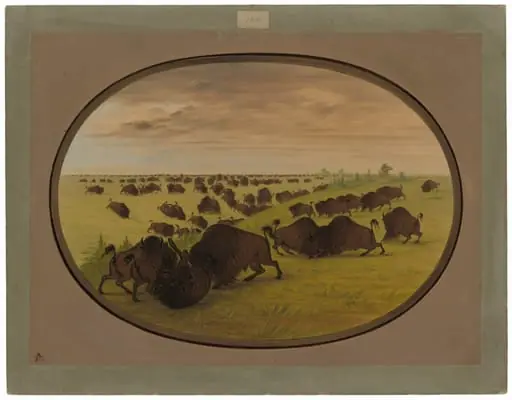 Bulls Fighting
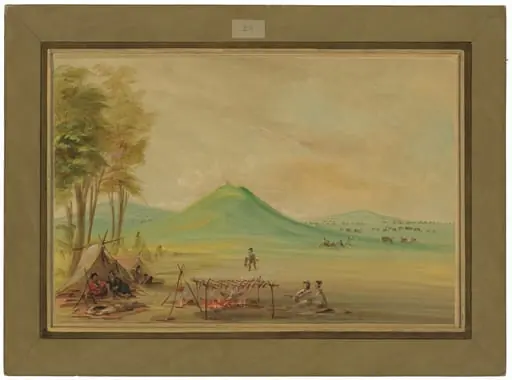 Expedition Encamped on a Texas Prairie. April 1686
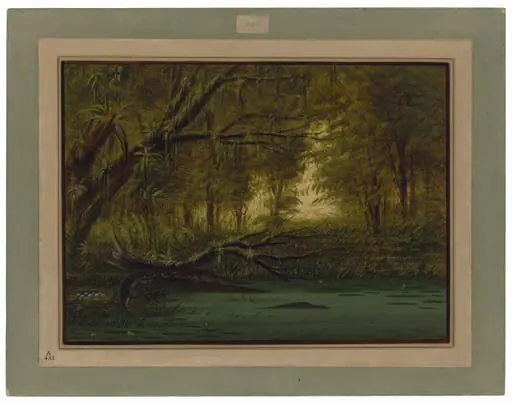 An Alligator's Nest
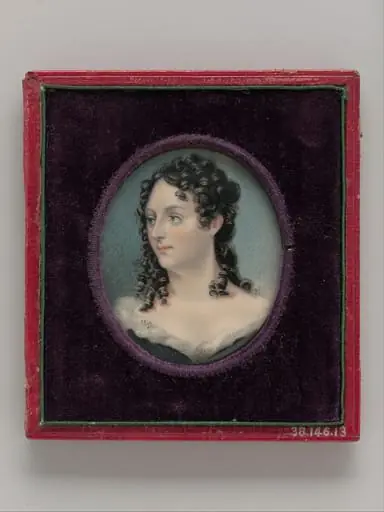 Mrs. George Catlin (Clara Bartlet Gregory)
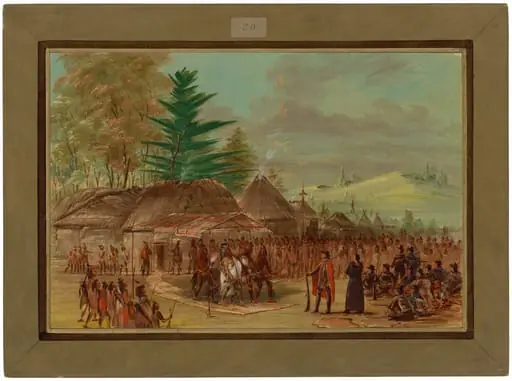 Chief of the Taensa Indians Receiving La Salle. March 20, 1682
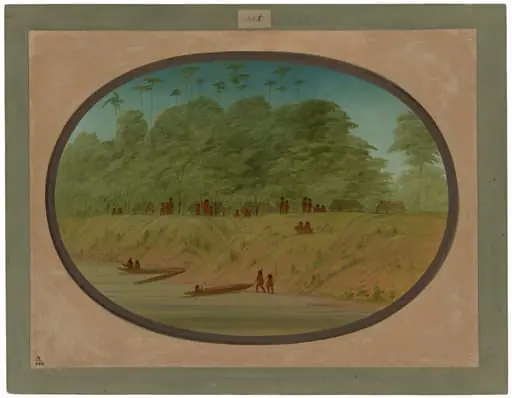 A Small Village - Payaguas Indians
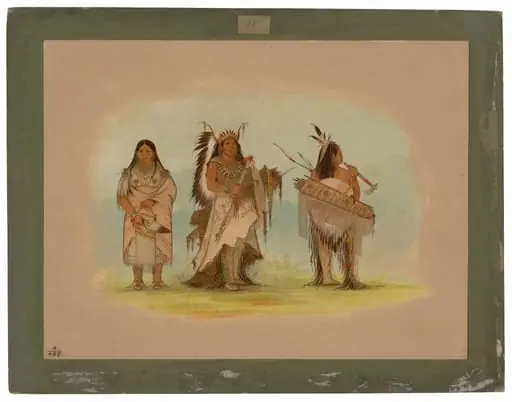 Omaha Chief, His Wife, and a Warrior
 Father Hennepin Leaving the Mississippi to Join La Salle. May 8, 1680