Artwork
Making Flint Arrowheads - Apachees
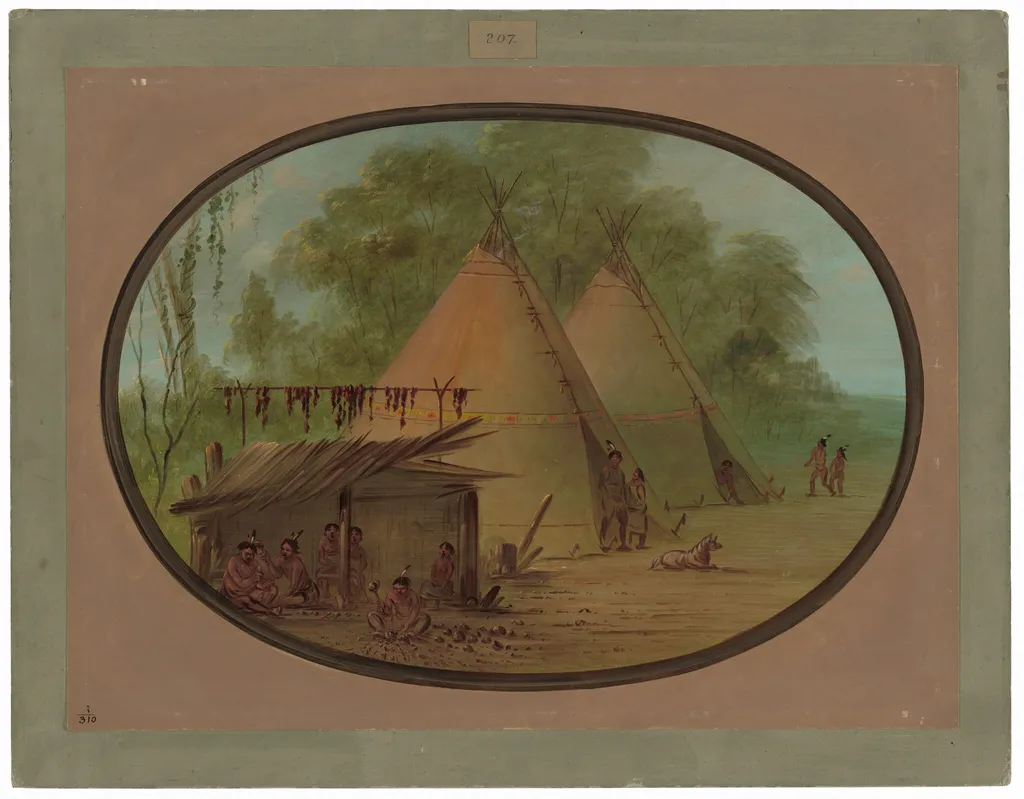
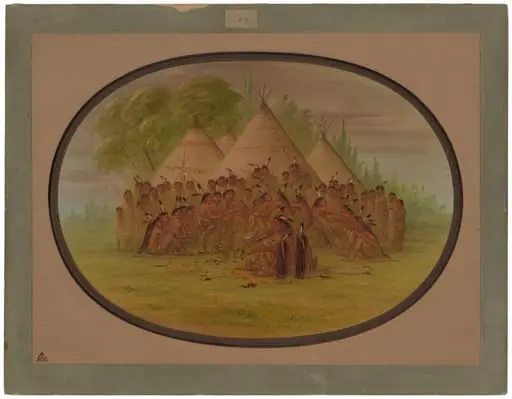
Making Flint Arrowheads - Apachees is an oil painting by the Impressionist artist George Catlin. It dates from 1862 and is held in the collection of the National Gallery of Art.
About this work
George Catlin shows native Apache men outdoors making sharp stone arrowheads. Sunlight picks up the red dirt and their dark clothing. One man kneels over a rock, tapping it with a stone tool.
This was painted in 1855, but Catlin used notes from his 1830s travels. He liked to show native groups at work, not just in battle scenes.
Try looking up Catlin, George next.
Overview
9 by 63 cm (18 7/16 by 24 13/16 inches), the work depicts an Apache encampment scene centered on the communal manufacture of flint arrowheads.
Making Flint Arrowheads - Apachees is an oil painting on card mounted on paperboard by the American artist George Catlin (1796-1872), executed between 1855 and 1869 as part of his second major collection of Native American imagery. Measuring 46.9 by 63 cm (18 7/16 by 24 13/16 inches), the work depicts an Apache encampment scene centered on the communal manufacture of flint arrowheads. It is held in the collection of the National Gallery of Art in Washington, D.C., under accession number 1965.16.187, having been donated by Paul Mellon in 1965. The painting occupies a significant place in the history of American art as both ethnographic documentation and as a focus of critical debate regarding the representation of Indigenous cultures in the nineteenth century.
Technique & Style
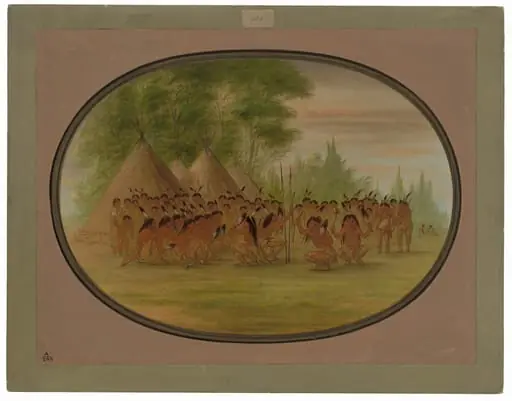
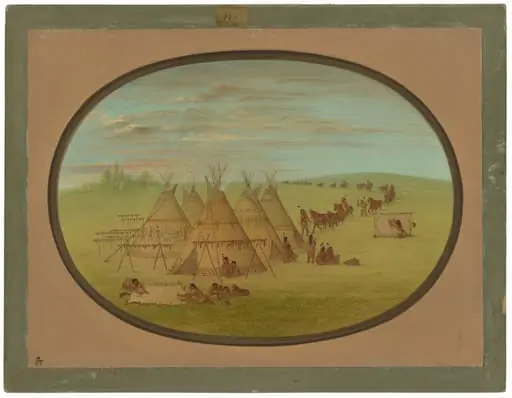
The medium is oil on card mounted on paperboard, a support characteristic of Catlin's Cartoon Collection works, which were designed to be portable and reproducible. The palette consists of earthy browns, muted greens, and soft blue sky, with smooth, descriptive brushwork that pays careful attention to the textures of bark, thatch, and fabric. Light falls evenly across the scene with gentle shadows beneath the structures, creating a clarity that serves documentary purposes while also lending the image a composed, almost stage-like quality. The oval format within a rectangular tan border, marked 207 at top and 310 at lower left, reflects the standardized presentation Catlin employed for the Cartoon Collection. Trees and foliage fill the background with a glimpse of open landscape beyond, framing the human activity within a defined natural setting. The overall effect balances observational specificity with a composed, narrative arrangement of figures and space.
History & Provenance
The painting was created during the 1850s or 1860s as part of Catlin's Cartoon Collection, a second corpus of more than 600 works produced after his earlier Indian Gallery of the 1830s. Catlin exhibited the Cartoon Collection in New York in 1871, publishing a catalog that included this work as Cart. No. 207. Following the artist's death in 1872, the painting descended to his daughters, Clara Gregory Catlin, Louise Catlin Kinney, and Elizabeth Wing Catlin. The American Museum of Natural History purchased it from Elizabeth Wing Catlin in 1912, along with other surviving Cartoon Collection works. In 1959, the museum deaccessioned the work, selling it through Kennedy Galleries in New York to Paul Mellon of Upperville, Virginia. Mellon, who acquired more than 300 paintings from the deaccessioned collection, gave 351 works including this one to the National Gallery of Art in 1965. The painting has been exhibited at the Joslyn Art Museum (1967-1974), the Amon Carter Museum (1981-1982), and in multiple venues through the NGA National Lending Service during the 1990s, including the Delaware Art Museum, Palm Springs Desert Museum, Boise Art Museum, Hofstra Museum, West Bend Gallery of Fine Arts, Lore Degenstein Gallery, and Payne Gallery at Moravian College. It was also on extended loan to Ambassador Otto J. Reich in Caracas, Venezuela (1986-1989), and to Presidents George W. Bush and Barack Obama for display at the White House (2001-2010).
Context
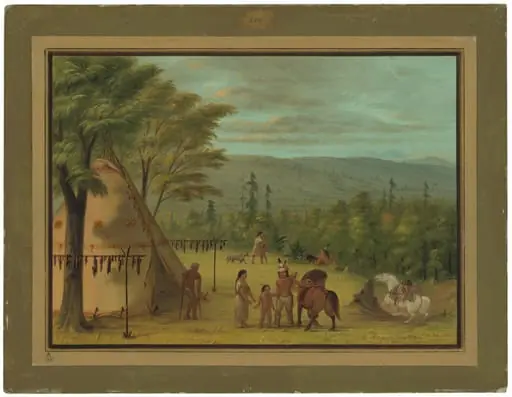
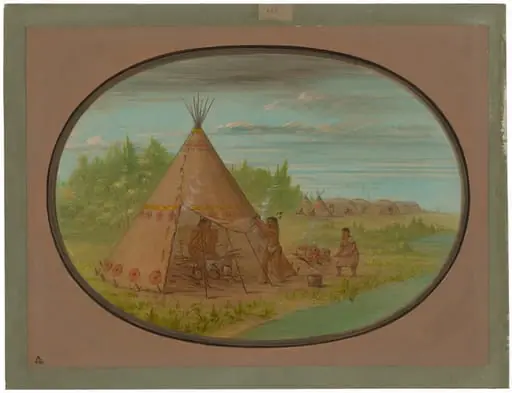
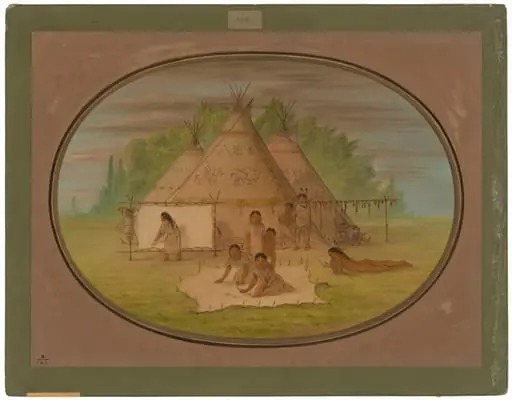
George Catlin occupies a complex position in American art history as both pioneering documentarian and participant in the cultural politics of westward expansion. His first Indian Gallery, comprising more than 500 works from the 1830s, established his reputation; most surviving examples are now at the Smithsonian American Art Museum. The Cartoon Collection, to which Making Flint Arrowheads belongs, represented a second phase of production intended for broader circulation and commercial viability. Catlin's work emerged within a period of intense American interest in Native American cultures, driven by federal removal policies, expanding frontier settlement, and a parallel fascination with Indigenous peoples as subjects of scientific and artistic inquiry. His paintings have prompted sustained scholarly debate regarding the ethics and effects of ethnographic representation. Critics and historians have questioned whether his detailed attention to material culture and social practice constituted genuine documentation or whether the composed, often idealized quality of his scenes served to fix Native Americans within a romanticized past tense, detached from contemporary political reality. The explicit inclusion of female singers in the arrowhead-making process, noted in Catlin's catalog, offers a counterpoint to purely masculine narratives of Native life, yet the overall framing of Apache culture as a coherent, picturesque whole remains subject to critical scrutiny.
Legacy
As a component of one of the largest systematic visual records of Native American life produced in the nineteenth century, Making Flint Arrowheads - Apachees continues to serve as both primary source and object of methodological reflection. Its inclusion in the National Gallery of Art's collection, following Paul Mellon's transformative gift of 351 Catlin works, has ensured its accessibility for research and public engagement. The painting's extended loan to the White House across two presidential administrations (2001-2010) indicates its sustained institutional validation as an image of American heritage, even as this very status invites continued critical examination of whose narratives it advances and whose it simplifies. The work appears in successive NGA catalogues (1970, 1980, 1992), securing its place in the documentary record of American painting. For contemporary viewers and scholars, it functions as a site where questions of artistic intention, ethnographic accuracy, and representational power converge, demanding analysis not only of what Catlin depicted but of the frameworks through which nineteenth-century American audiences, and subsequent generations, have understood Indigenous cultures.
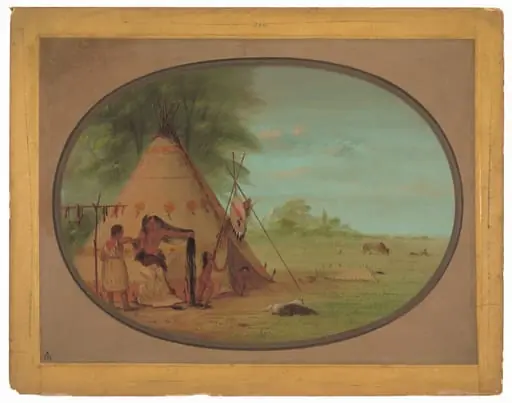
Own this work as a print
Artist & collection

Artist
George Catlin ( KAT-lin; July 26, 1796 – December 23, 1872) was an American lawyer, painter, author, and traveler, who specialized in portraits of Native Americans in the American frontier.

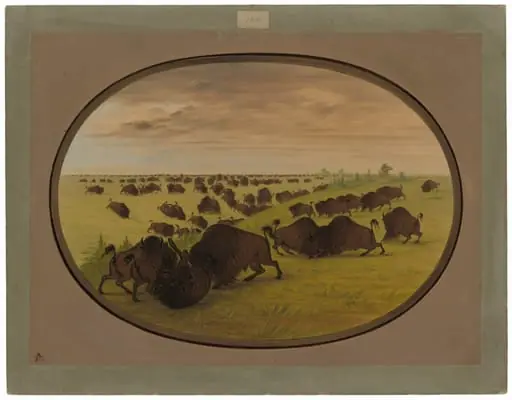 Bulls Fighting
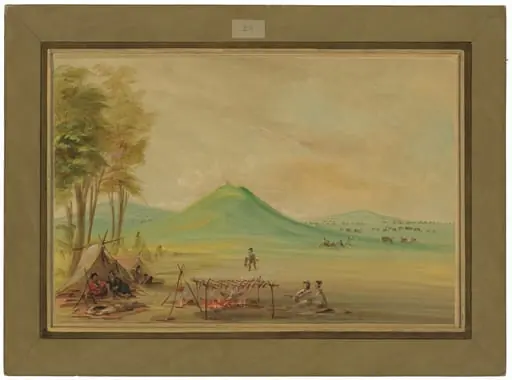 Expedition Encamped on a Texas Prairie. April 1686
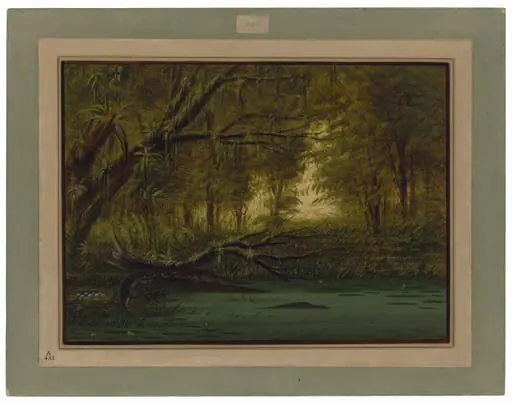 An Alligator's Nest
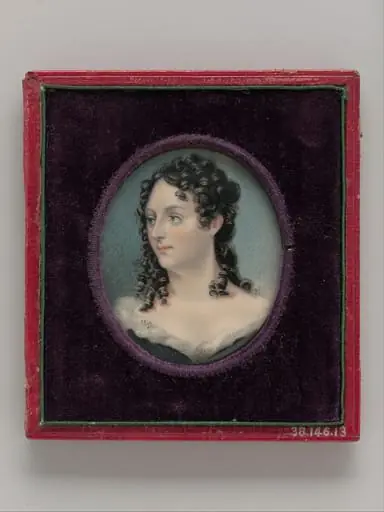 Mrs. George Catlin (Clara Bartlet Gregory)
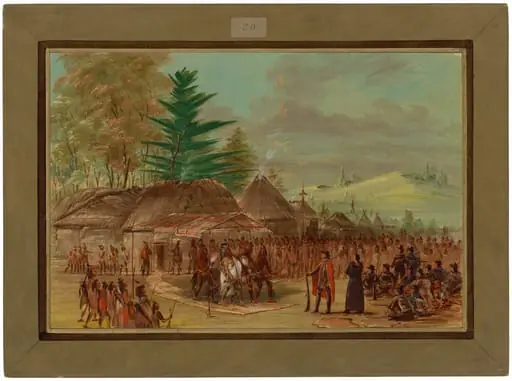 Chief of the Taensa Indians Receiving La Salle. March 20, 1682
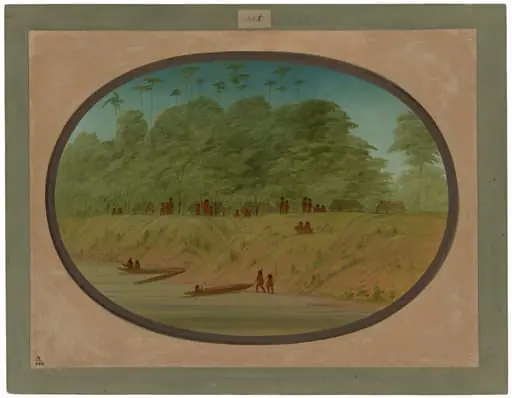 A Small Village - Payaguas Indians
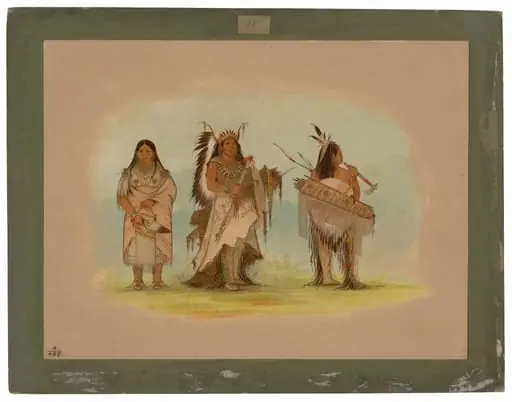 Omaha Chief, His Wife, and a Warrior
 Father Hennepin Leaving the Mississippi to Join La Salle. May 8, 1680