Artwork
Nayas Village - Indians Bathing
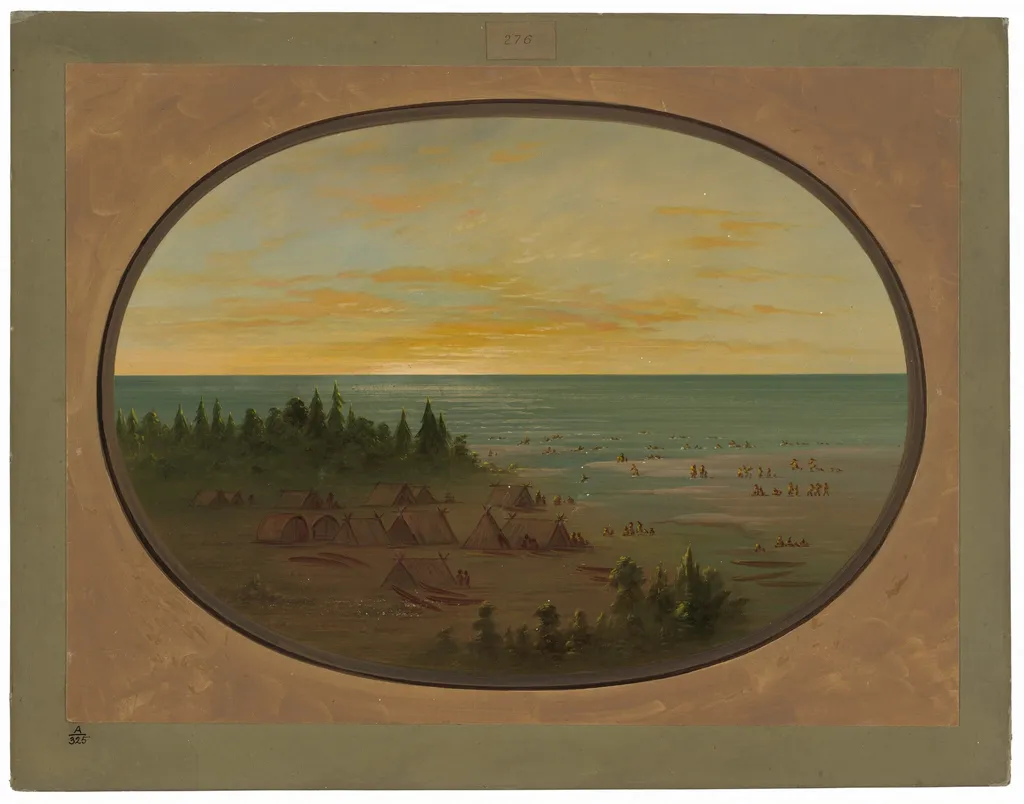
Nayas Village - Indians Bathing is an oil painting by the American Folk Art artist George Catlin. It dates from 1862 and is held in the collection of the National Gallery of Art. Created in 1862, Nayas Village – Indians Bathing is an oil painting executed on card that has been mounted on paperboard.
About this work
Technique & Style
Its handling aligns with Catlin’s characteristic smooth, descriptive brushwork used to render figures and setting with careful detail.
The painting is executed in oil on a card support that has been mounted onto paperboard. Its handling aligns with Catlin’s characteristic smooth, descriptive brushwork used to render figures and setting with careful detail. Stylistically, the composition belongs to Catlin’s late genre scenes, combining topographical accuracy with anecdotal narrative, evident in the orderly portrayal of the bathing figures and the delineated Nayas village backdrop.
Dimensions are 46.2 cm in height by 62.6 cm in width.
History & Provenance
The painting Nayas Village - Indians Bathing by George Catlin was created in 1862. The work originated with the artist, who held it until his death in 1872. It subsequently passed by descent to his daughters: Clara Gregory Catlin, Louise Catlin Kinney, and Elizabeth Wing Catlin.
In 1912, the American Museum of Natural History purchased the piece from Elizabeth Wing Catlin. The museum later sold the painting in 1959 through Kennedy Galleries in New York to Paul Mellon of Upperville, Virginia. Mellon eventually gifted the work to the National Gallery of Art in 1965, where it remains part of the collection.
The painting is held in the collection of the National Gallery of Art in Washington, D.C. Its accession number is not explicitly stated in the provided sources, but it entered the collection through a gift in 1965 from Paul Mellon. The work was previously owned by George Catlin and descended through his daughters before being sold by Kennedy Galleries in 1959 and acquired by the National Gallery of Art in 1965.
Context
Painted in 1862, George Catlin's Nayas Village - Indians Bathing portrays a specific Delaware settlement along the Kansas River, reflecting his documented anthropological interest in Plains Indian communities during westward expansion. The work entered the National Gallery of Art's collection in 1965 after passing through the holdings of George Catlin's descendants and the American Museum of Natural History, establishing a clear provenance tied to early 20th-century American cultural institutions. Its placement within the NGA's American paintings wing situates it among Catlin's broader body of work focused on indigenous life, contributing to ongoing scholarly discussions about 19th-century representations of Native American cultures and the intersection of art and ethnographic documentation.
Overview
Created in 1862, Nayas Village – Indians Bathing is an oil painting executed on card that has been mounted on paperboard. The work portrays a shoreline settlement where temporary tents line the water’s edge and figures are shown wading or standing in the surf. The composition is bathed in a soft, warm sky, while dark, tall trees rise behind the camp.
Subject & Meaning
The scene captures a moment of everyday life among Plains peoples, focusing on communal bathing and the social rhythms of a riverside encampment. By depicting ordinary activities rather than ceremonial or martial subjects, the painting emphasizes the humanity and routine of the community, offering a glimpse into the domestic sphere of Native American life in the mid‑nineteenth century.
Own this work as a print
Artist & collection

Artist
George Catlin ( KAT-lin; July 26, 1796 – December 23, 1872) was an American lawyer, painter, author, and traveler, who specialized in portraits of Native Americans in the American frontier.

 Bulls Fighting
 Expedition Encamped on a Texas Prairie. April 1686
 An Alligator's Nest
 Mrs. George Catlin (Clara Bartlet Gregory)
 Chief of the Taensa Indians Receiving La Salle. March 20, 1682
 A Small Village - Payaguas Indians
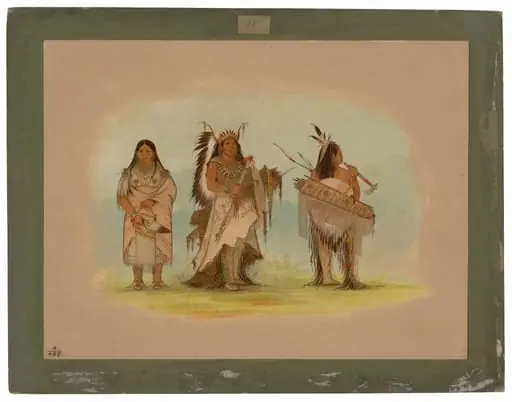 Omaha Chief, His Wife, and a Warrior
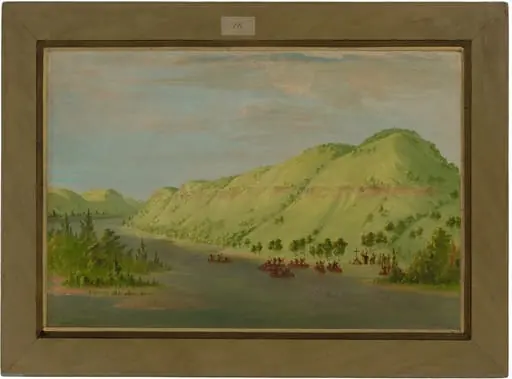 Father Hennepin Leaving the Mississippi to Join La Salle. May 8, 1680
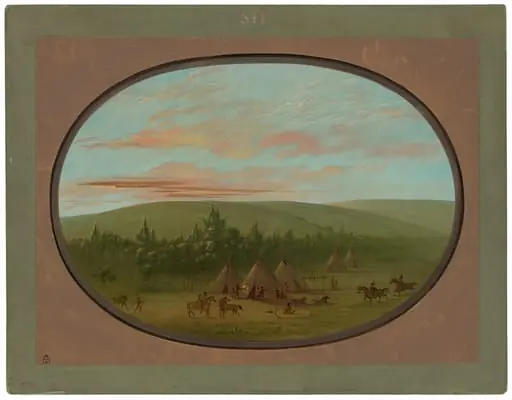 A Sioux Village
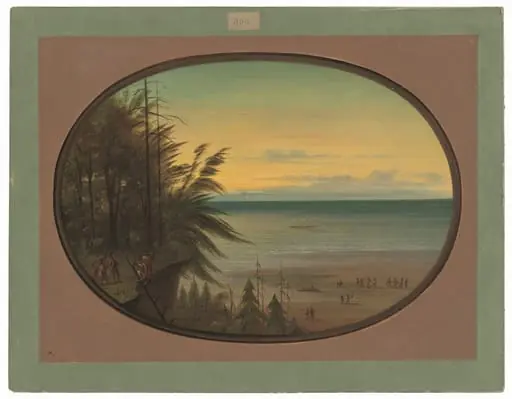 An Indian Ladder - Nayas Indians
 Gathering Wild Rice - Winnebago
 An Indian Encampment at Sunset
 First Sailing of the Griffin on Lake Erie. August 7, 1679
 La Salle and Party Arrive at the Village of the Illinois. January 1, 1680
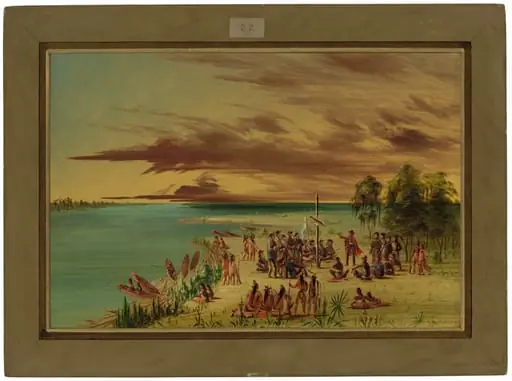 La Salle Claiming Louisiana for France. April 9, 1682
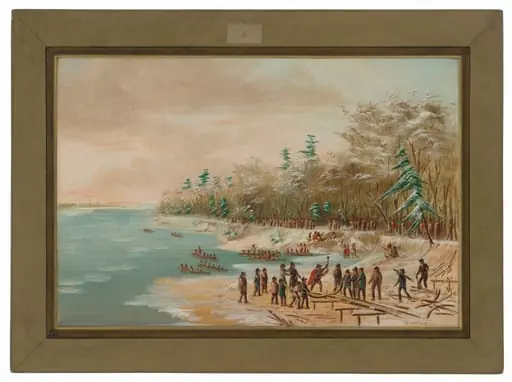 La Salle Driving the First Bolt for the Griffin. January 26, 1679
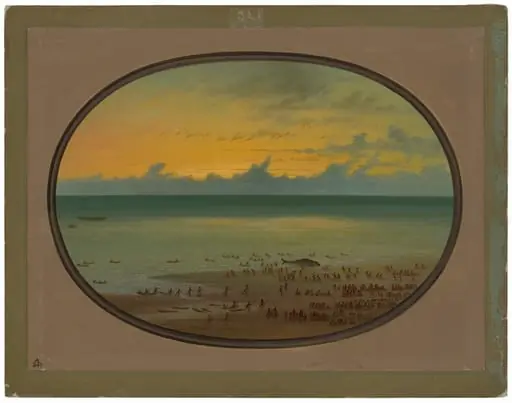 A Whale Ashore - Klahoquat