Artwork
Salmon River Mountains
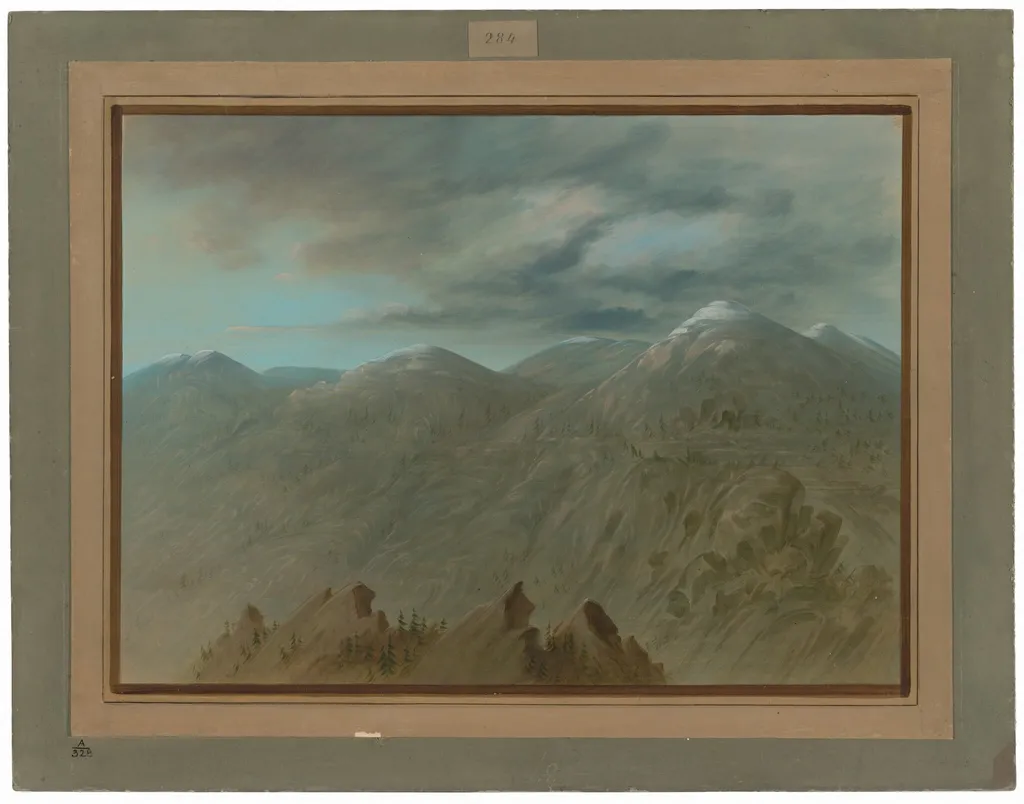
Salmon River Mountains is an oil painting by the Impressionist artist George Catlin. It dates from 1862 and is held in the collection of the National Gallery of Art.
About this work
Overview
The painting depicts a sweeping western wilderness landscape without human presence, representing the remote mountain terrain west of the Rocky Mountains.
Salmon River Mountains is an oil painting on card mounted on paperboard by the American artist George Catlin, dated 1862 and measuring 47.5 by 62.1 centimeters. The work is held in the collection of the National Gallery of Art in Washington, D.C., as part of the Paul Mellon Collection, under accession number 1965.16.201. It belongs to Catlin's so-called Cartoon Collection, a second major body of work comprising more than 600 paintings created during the 1850s and 1860s, which followed his earlier Indian Gallery of the 1830s. The painting depicts a sweeping western wilderness landscape without human presence, representing the remote mountain terrain west of the Rocky Mountains. As a document of Catlin's continued engagement with the American West and as a surviving example from a pivotal phase of his career, the work holds significance for understanding both the artist's practice and nineteenth-century American visual culture.
Subject & Meaning
The painting presents a vast horizontal panorama of the Salmon River Mountains, a range located west of the Rocky Mountains. The composition is dominated by layered mountain ridges that recede into atmospheric distance, with light-colored, possibly snow-capped summits visible on the distant peaks. The middle ground consists of rolling, densely forested slopes rendered in muted greens and browns, while the foreground is anchored by rocky outcrops with scattered evergreen trees. The upper half of the canvas is occupied by a broad sky filled with streaked clouds in varying shades of gray and blue, with patches of lighter blue sky breaking through toward the left. No human figures or animals appear in the scene. Catlin's own catalog entry for the 1871 exhibition of the Cartoon Collection described the subject simply as Salmon River Mountains, west of the Rocky Mountains, with a date of 1855. The absence of human presence distinguishes this work from related compositions by Catlin that include Crow villages or skin tents in the foreground, suggesting that this particular canvas was conceived as a pure landscape study emphasizing the sublime scale and remoteness of the western wilderness. The subdued palette of cool blues, grays, olive greens, and earthy browns reinforces the impression of an untouched, expansive terrain.
Technique & Style
The medium is oil on card mounted on paperboard, a support characteristic of Catlin's Cartoon Collection works, which were typically more modest in scale and material than his earlier Indian Gallery paintings. The brushwork appears smooth and blended, creating soft atmospheric transitions between the successive layers of mountain ridges. This handling produces a sense of depth through tonal gradation rather than sharp linear perspective. The palette is restrained and cool, relying on subtle shifts between blues, grays, and earth tones to model form and suggest aerial perspective. The painting is mounted within multiple borders: a thin brown inner line, a wider tan mat, and an outer gray-green support. A small rectangular label bearing the number 284 appears at the top center of the outer border, and a mark reading A 328 is visible in the lower left corner. These markings correspond to Catlin's cataloging system for the Cartoon Collection. The overall effect is one of controlled naturalism tempered by romantic sensibility, typical of mid-nineteenth-century American landscape painting, with particular attention to atmospheric conditions and the vast scale of western topography.
History & Provenance
The painting was created in 1862, though Catlin dated the subject to 1855 in his 1871 catalog. It remained in the artist's possession until his death in 1872, then descended to his daughters: Clara Gregory Catlin, Louise Catlin Kinney, and Elizabeth Wing Catlin. In 1912, the American Museum of Natural History in New York purchased the work from Elizabeth Wing Catlin, acquiring a substantial portion of the surviving Cartoon Collection. The museum deaccessioned the work in 1959, selling it through Kennedy Galleries in New York to Mr. Paul Mellon of Upperville, Virginia. Mellon, a major collector of American art, subsequently gave the painting to the National Gallery of Art in 1965 as part of a larger gift of 351 works from the Cartoon Collection. The painting has been exhibited publicly on several occasions: at the Allentown Art Museum in Pennsylvania in 1970 for an exhibition of George Catlin paintings, and from 1972 to 1997 it was on extended loan for display in Chief Justice Rehnquist's chambers. It has also been reproduced in the National Gallery of Art's catalogues of American paintings in 1970, 1980, and 1992.
Context
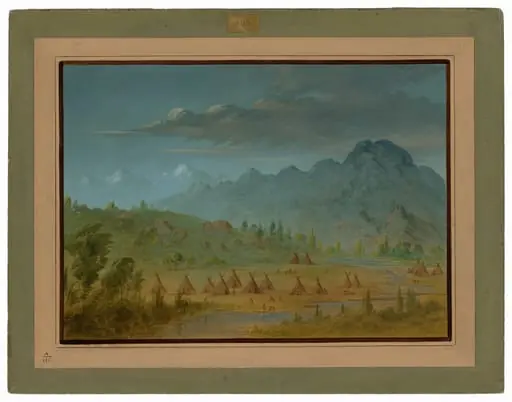
George Catlin is best known for his Indian Gallery of the 1830s, comprising more than 500 portraits and scenes of Native American life that now reside principally at the Smithsonian American Art Museum. However, during the 1850s and 1860s he produced a second major collection of over 600 works, the Cartoon Collection, which included western landscapes alongside continued portraits and genre scenes. The Salmon River Mountains belongs to this later phase, when Catlin was working in a more portable format and with greater speed, perhaps responding to changed circumstances after the financial failure of his Indian Gallery exhibitions and his subsequent years in Europe. The work must be understood in relation to a closely related composition, A Crow Village and the Salmon River Mountains, which shares the same mountain backdrop but adds a Crow village in the foreground. That related work, cataloged as Cart. No. 397, was dated 1855 by Catlin, the same year he assigned to the mountain landscape alone. The existence of multiple variants suggests Catlin treated the mountain view as a reusable compositional element, adapting it with or without human settlement to suit different purposes. Scholarly attention to the Cartoon Collection has historically been overshadowed by interest in the Indian Gallery, though the National Gallery of Art's acquisition of 351 works from this later collection in 1965 significantly improved their visibility and preservation.
Legacy
The Salmon River Mountains occupies a notable position within the institutional history of American art collecting. Paul Mellon's acquisition of more than 300 paintings from the Cartoon Collection when they were deaccessioned by the American Museum of Natural History, and his subsequent gift of 351 works to the National Gallery of Art in 1965, represented a crucial act of preservation for a body of work that might otherwise have been dispersed or lost. The painting's extended loan to Chief Justice Rehnquist's chambers from 1972 to 1997 indicates its status as a representative American landscape within official Washington. More broadly, the work contributes to understanding of how Catlin's artistic project evolved across decades, from the documentary ambitions of the Indian Gallery to the more repetitive, commercially oriented production of the Cartoon Collection. The painting's afterlife in reproduction, including its availability through commercial print outlets, attests to its continued circulation as an image of the American West. Within Catlin's oeuvre, it exemplifies the persistent tension between ethnographic documentation and landscape romanticism that characterizes much of his western imagery.
Own this work as a print
Artist & collection

Artist
George Catlin ( KAT-lin; July 26, 1796 – December 23, 1872) was an American lawyer, painter, author, and traveler, who specialized in portraits of Native Americans in the American frontier.

 Bulls Fighting
 Expedition Encamped on a Texas Prairie. April 1686
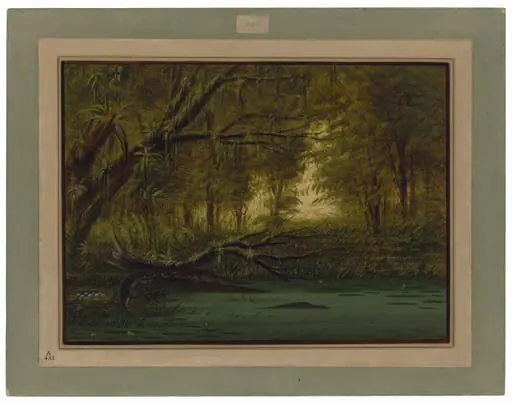 An Alligator's Nest
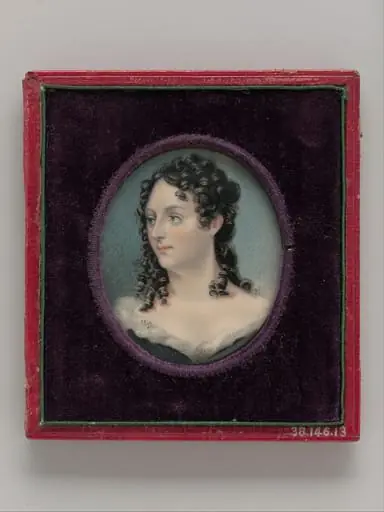 Mrs. George Catlin (Clara Bartlet Gregory)
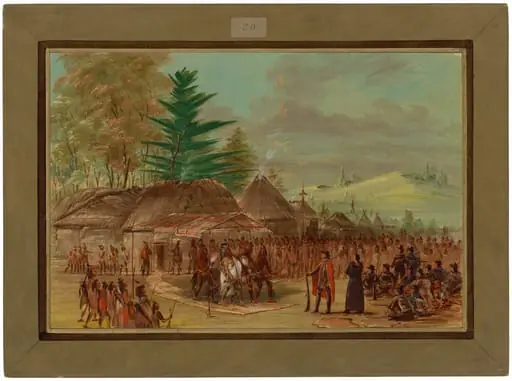 Chief of the Taensa Indians Receiving La Salle. March 20, 1682
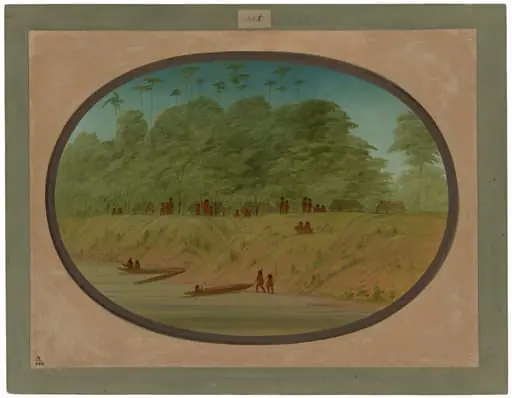 A Small Village - Payaguas Indians
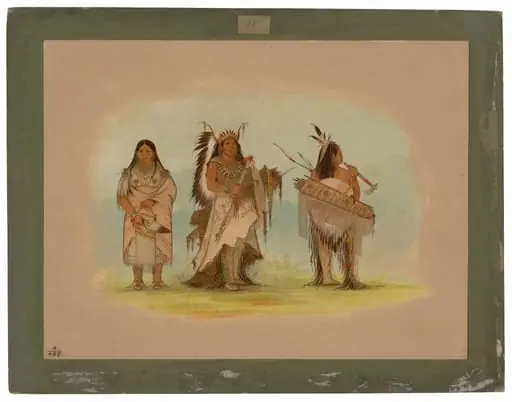 Omaha Chief, His Wife, and a Warrior
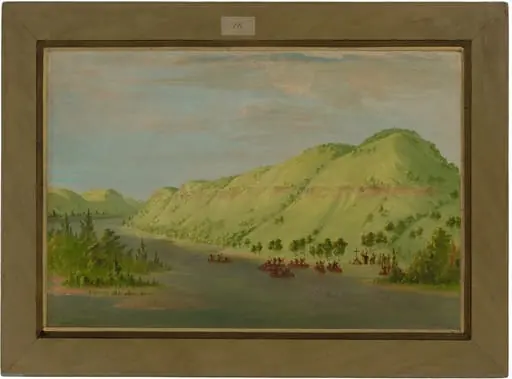 Father Hennepin Leaving the Mississippi to Join La Salle. May 8, 1680
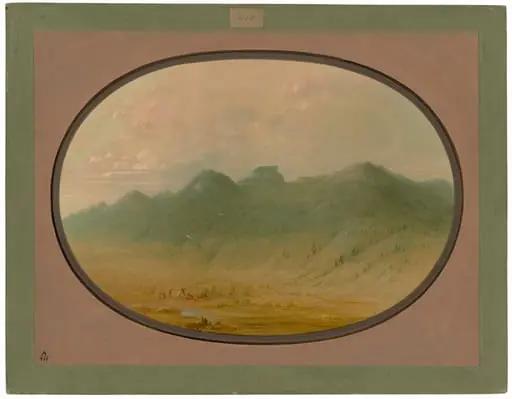 View of the Crystal Mountains, Brazil
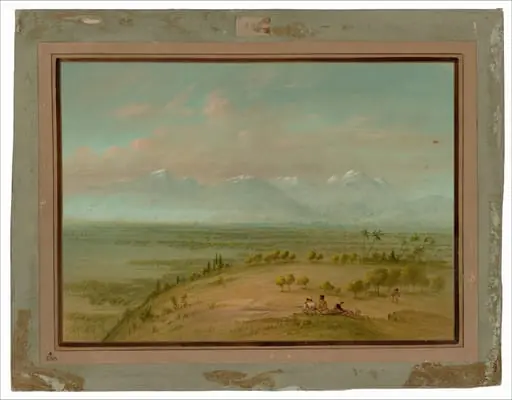 View of the Pampa del Sacramento
 Grassy Bluffs, Upper Missouri
 Chain of Mont Blanc
 Bjerglandskab ved Civitella
 Valley with winding streams, a range of mountains in the background, and a village on the left
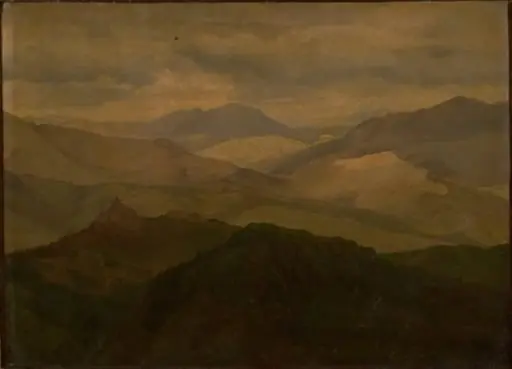 Bjerglandskab ved Civitella
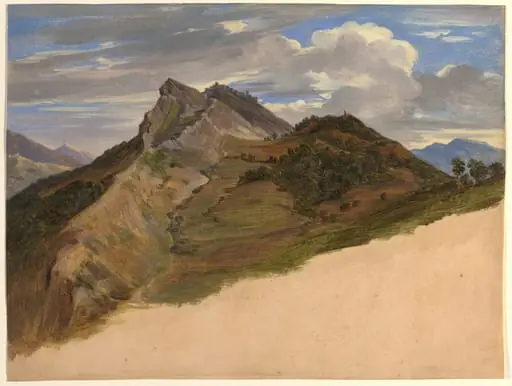 Civitella Seen from the North
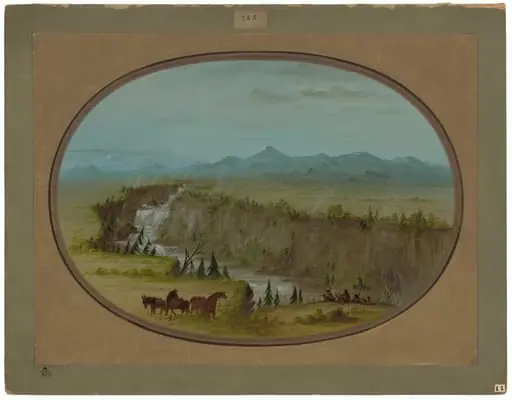 Falls of the Snake River
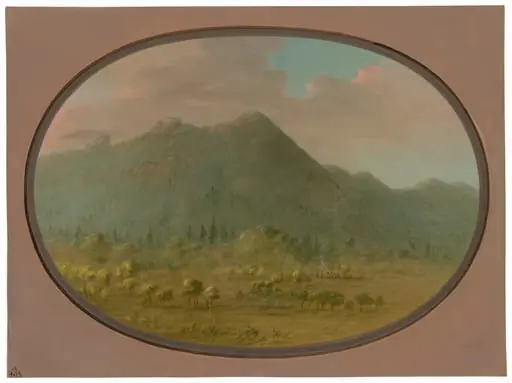 View in the Crystal Mountains
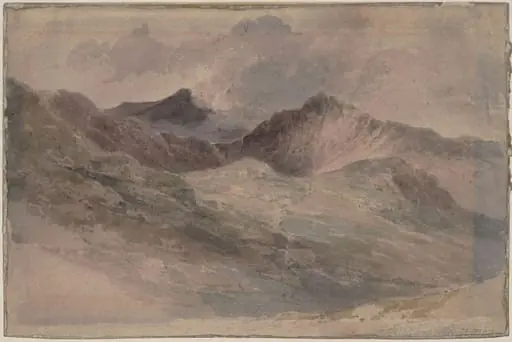 Snowdon and the Vale of Llanberis
- A Crow Village and the Salmon River Mountains