Artwork
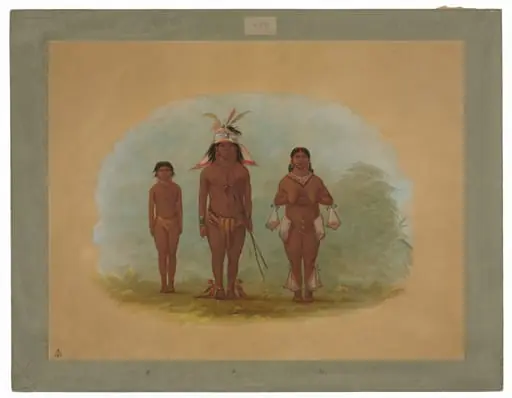
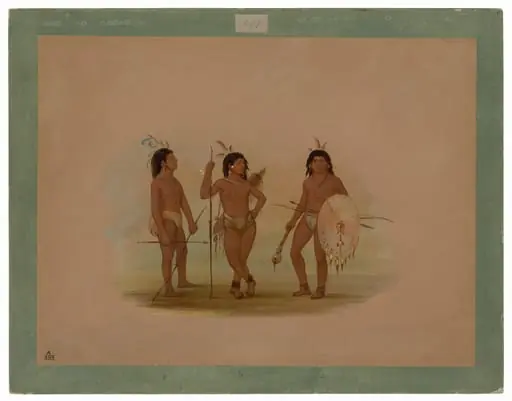
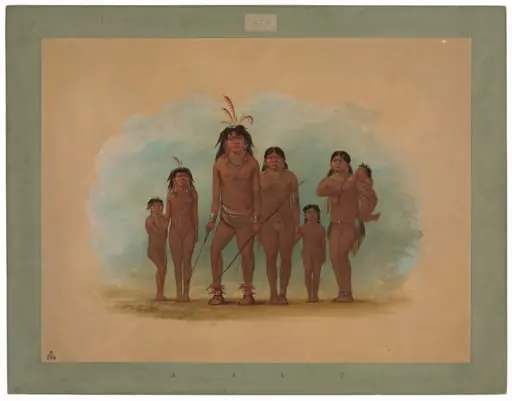
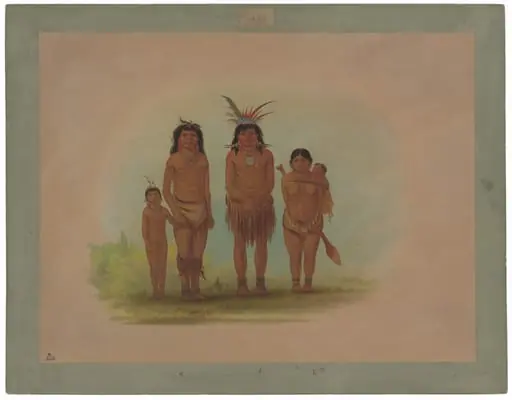
Three Auca Children
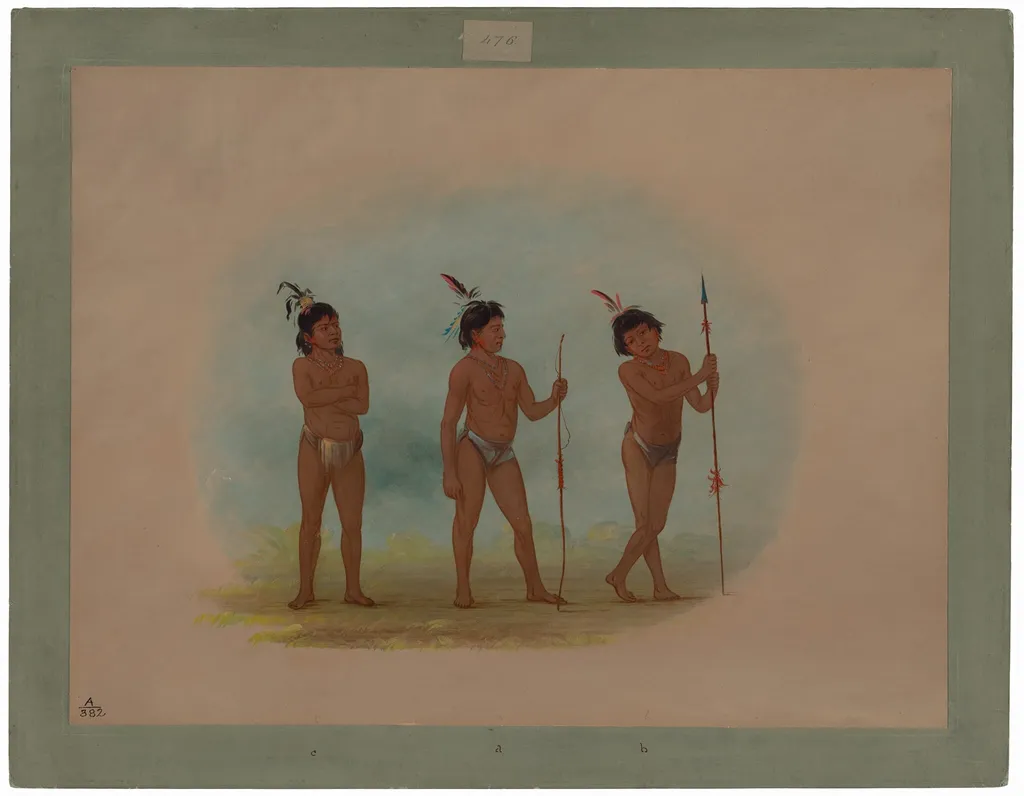
Three Auca Children is an oil painting by the American Folk Art artist George Catlin. It dates from 1862 and is held in the collection of the National Gallery of Art.
About this work
Technique & Style
Three Auca Children is an oil painting executed on card mounted on paperboard, a support choice consistent with Catlin's field-portrait practice of working on lightweight, portable surfaces during his travels. The work measures 46.4 cm in height by 62 cm in width. Classified as a portrait, it is rendered in oil, a medium that allowed Catlin to build up the flesh tones and textile details of his three young Indigenous sitters while retaining the matte, somewhat dry surface characteristic of paint applied to a rigid card ground rather than canvas.
The composition is arranged in a horizontal format suited to a group portrait, with the figures placed against a plain ground that focuses attention on their features and dress.
The mounting of the card onto paperboard provides structural stability, helping to preserve the work given its modest scale and the inherent fragility of oil paint on a thin card support.
History & Provenance
The painting is held in the collection of the National Gallery of Art in Washington, D.
Three Auca Children is an 1863 oil on card painting by George Catlin, originally held by the artist and subsequently passed to his daughters Clara Gregory Catlin, Louise Catlin Kinney, and Elizabeth Wing Catlin. The work entered the American Museum of Natural History in 1912 through purchase from Elizabeth Wing Catlin, was sold in 1959 via Kennedy Galleries to Paul Mellon, and was gifted to the National Gallery of Art in 1965.
The painting is held in the collection of the National Gallery of Art in Washington, D.C. It was acquired in 1965 as a gift to the institution. Its provenance traces back through the artist's daughters to George Catlin, then to a 1912 purchase by the American Museum of Natural History, followed by a 1959 sale through Kennedy Galleries to Paul Mellon, after which it was gifted to the National Gallery of Art.
Context
Three Auca Children (1863) occupies a distinctive position in George Catlin's oeuvre as a portrait that documents Indigenous subjects during a period of heightened colonial expansion in the American West. Contemporary scholarship has examined Catlin's dual role as artist and ethnographer, situating this work within his broader mission to preserve Native American cultures amid westward settlement. The painting's journey from Catlin's personal collection to the National Gallery of Art reflects evolving institutional approaches to American art history, having passed through the artist's daughters and into the hands of Paul Mellon before acquisition in 1965.
Its formal qualities, oil on card mounted on paperboard measuring 46.4 cm by 62 cm, align with mid-19th century portrait conventions while diverging in subject matter through its focus on South American Indigenous children.
Scholarly attention has highlighted Catlin's documentation of Native American life as both valuable ethnographic record and artistic intervention, though interpretations of his work have shifted with changing perspectives on colonial narratives. The painting's presence in a major natural history museum before transfer to an art institution underscores interdisciplinary collecting practices of the early 20th century, while its 1959 sale through Kennedy Galleries illustrates the commercial pathways through which significant American works entered private and public collections.
Legacy
The painting Three Auca Children has become emblematic of George Catlin's ethnographic approach, cited by scholars examining 19th‑century representations of Indigenous peoples and influencing later artists who engage with cross‑cultural portraiture. Its presence in the National Gallery of Art's collection ensures continued scholarly attention and public interpretation of Catlin's work. The work's provenance, descended through Catlin's daughters, sold to Paul Mellon, and gifted to the National Gallery in 1965, underscores its institutional significance.
Overview
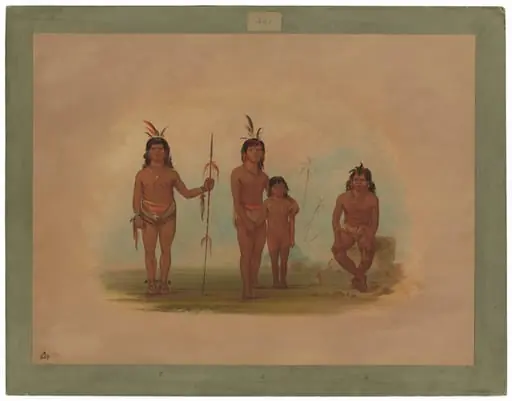
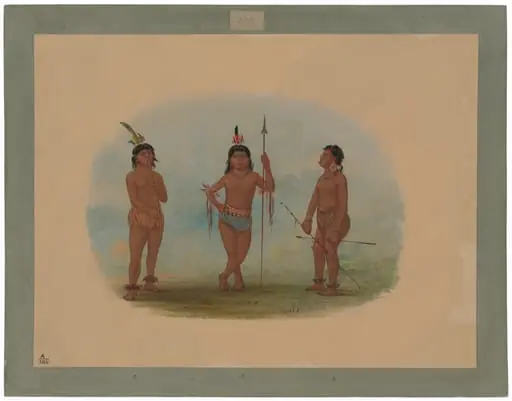
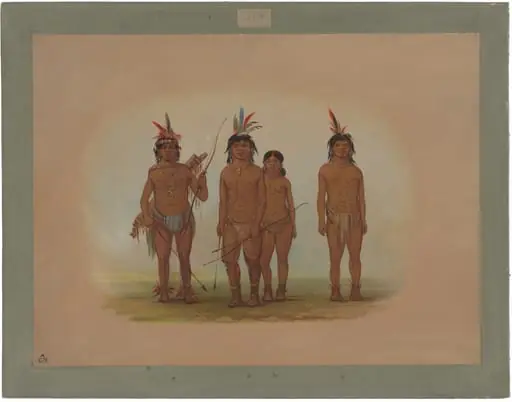
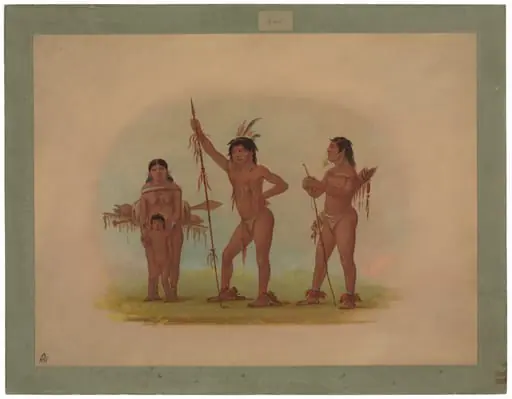
Created in 1862, Three Auca Children is an oil painting executed on card that has been mounted on a paperboard support. The work depicts three adolescent figures from the Auca (Hidatsa) tribe, rendered in a straightforward, folk‑art manner typical of George Catlin’s extensive visual record of Native peoples.
Subject & Meaning
The three youths stand side by side, bare‑chested and clad only in loincloths, their hair adorned with feathers and their necks encircled by necklaces. Two of the figures grip spears, suggesting a ceremonial or martial context, while the composition emphasizes their individuality within a collective cultural identity.
Own this work as a print
Artist & collection

Artist
George Catlin ( KAT-lin; July 26, 1796 – December 23, 1872) was an American lawyer, painter, author, and traveler, who specialized in portraits of Native Americans in the American frontier.

 Bulls Fighting
 Expedition Encamped on a Texas Prairie. April 1686
 An Alligator's Nest
 Mrs. George Catlin (Clara Bartlet Gregory)
 Chief of the Taensa Indians Receiving La Salle. March 20, 1682
 A Small Village - Payaguas Indians
 Omaha Chief, His Wife, and a Warrior
 Father Hennepin Leaving the Mississippi to Join La Salle. May 8, 1680