Artwork
Three Esquimaux
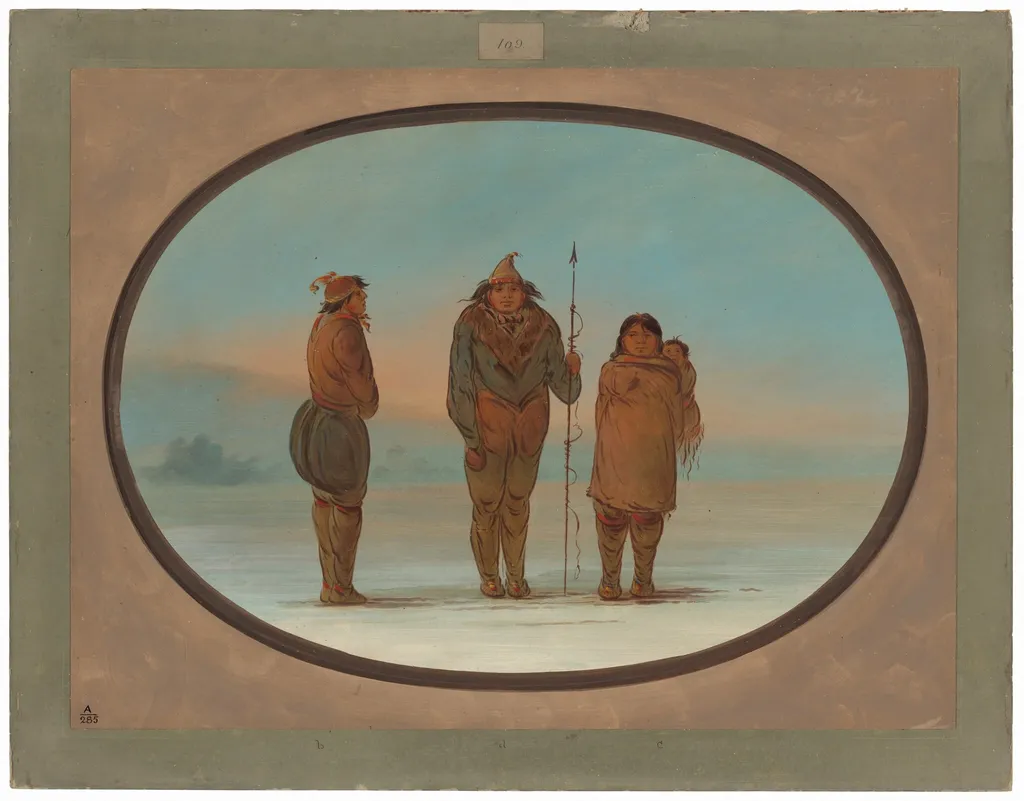
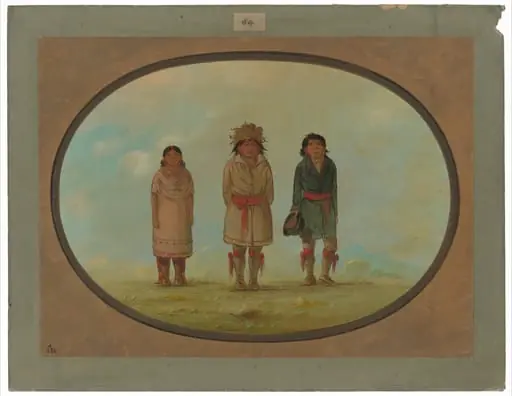
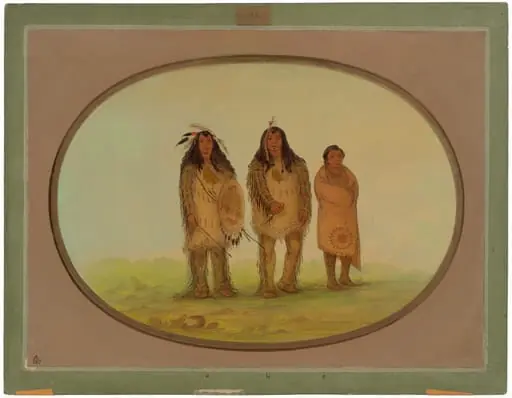
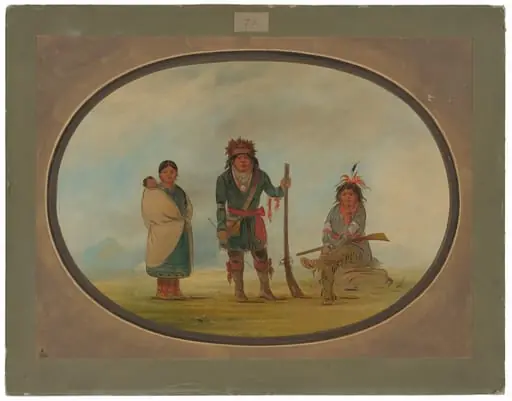
Three Esquimaux is an oil painting by the Impressionist artist George Catlin. It dates from 1862 and is held in the collection of the National Gallery of Art.
About this work
Overview
), the painting is executed in oil on card mounted on paperboard and is held in the collection of the National Gallery of Art in Washington, D.
Three Esquimaux is an oil painting by American artist George Catlin, dated to 1855 or 1862 depending on the source, though the National Gallery of Art gives a broader range of 1855/1869. The work belongs to Catlin's second major collection, known as the "Cartoon Collection," which he assembled during the 1850s and 1860s after his earlier "Indian Gallery" of the 1830s. Measuring 46.3 by 62.2 cm (18 1/4 by 24 1/2 in.), the painting is executed in oil on card mounted on paperboard and is held in the collection of the National Gallery of Art in Washington, D.C., where it entered in 1965 as part of the Paul Mellon Collection. The work matters as a document of Catlin's sustained project of recording Indigenous peoples of North America, in this case Inuit figures from the Labrador coast, and as a representative example of the reproductive, catalog-driven nature of his later Cartoon Collection.
Subject & Meaning
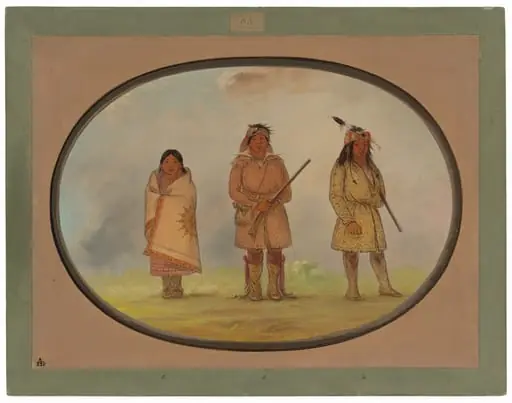
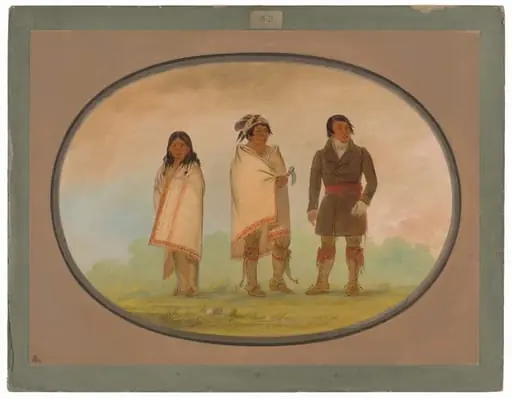
The painting depicts three Inuit figures in a circular tondo format. The central standing figure, identified by Catlin as Mole-hule-be-áu-be (The Rising Sun), holds a tall spear with a line attached and wears a pointed hat with a red band, a fur-trimmed coat, and fitted trousers. To the left stands Pet-ti-áu-be (The Black Day), shown in profile wearing a rounded cap with a feather, a rust-colored jacket, and full breeches. To the right, a shorter figure carries a small child on their back, wrapped in a large tan blanket or robe; this figure is identified only as an unnamed Esquimaux woman. All three wear similar foot coverings with red accents. Catlin's 1871 catalog entry for the work, when he exhibited the Cartoon Collection in New York, identified the subjects as members of "a numerous tribe, coast of Labrador" and dated the original encounter to 1855. The child, visible in the composition, adds a domestic dimension to what might otherwise read as a purely ethnographic record of male hunters. The iconography reflects Catlin's documentary impulse, presenting his subjects with individualized names and attributes while framing them within a composed, staged arrangement that served his didactic purposes.
Technique & Style
The medium is oil on card mounted on paperboard, a support characteristic of the Cartoon Collection, which Catlin produced in large quantities for exhibition and reproduction purposes. The palette consists of muted earth tones, blues, and warm browns, with the pale blue sky and soft rose and gray clouds above a flat, icy landscape providing atmospheric context. The brushwork appears smooth and detailed, with careful attention to costume and facial features. Shadows fall directly beneath the figures, suggesting even overhead light that flattens the pictorial space rather than creating dramatic depth. The circular image is surrounded by a wide painted border in olive green and tan, with small inscribed labels reading "109" at top center and "A 285" at lower left, indicating its place within Catlin's systematic cataloging of the collection. The tondo format and the decorative border suggest the work was conceived as a finished presentation piece rather than a mere sketch, despite the "cartoon" designation that Catlin applied to the entire group.
History & Provenance
The painting originated with George Catlin (1796-1872) and descended to his daughters, Clara Gregory Catlin, Louise Catlin Kinney, and Elizabeth Wing Catlin. In 1912, the American Museum of Natural History purchased the work from Elizabeth Wing Catlin, acquiring a substantial portion of the Cartoon Collection. The museum deaccessioned the work in 1959, selling it through Kennedy Galleries in New York to Paul Mellon of Upperville, Virginia. Mellon, a major collector of American art, purchased more than 300 paintings from the deaccessioned Cartoon Collection. He gave 351 works from this collection to the National Gallery of Art in 1965, including this painting, which bears the accession number 1965.16.168. The work has been exhibited in several notable venues: it was lent to the U.S. Consulate in Leningrad, U.S.S.R., from 1973 to 1978; shown in "American Indian Life: Paintings by George Catlin" at the National Gallery of Art in 1980; and lent to The White House from 1982 to 1989.
Context
George Catlin's career was defined by two ambitious projects of picturing North American Indigenous peoples. His first, the "Indian Gallery" of the 1830s, comprised more than 500 works now largely at the Smithsonian American Art Museum. The second, the Cartoon Collection of the 1850s and 1860s, numbered more than 600 works and was acquired by the American Museum of Natural History in 1912. The National Gallery of Art's holding of 351 works from this second collection, made possible by Paul Mellon's gift, represents the largest surviving group. Catlin's approach to the Inuit subjects of Three Esquimaux fits within his broader practice of naming, cataloging, and exhibiting his Indigenous subjects as types and individuals simultaneously. The work has been reproduced in successive editions of the National Gallery's American paintings catalog (1970, 1980, and 1992), indicating its established place within the museum's permanent collection documentation. Critical reception of Catlin has long grappled with the tension between his genuine documentary ambition and the aesthetic and ethnographic conventions of his time, which shaped how he presented non-Western subjects to European and American audiences.
Legacy
Three Esquimaux occupies a modest but representative position within the large corpus of Catlin's work that survives at the National Gallery of Art. Its value lies less in any singular artistic innovation than in its exemplification of the Cartoon Collection's methods: the standardized format, the catalog numbering, the combination of individual naming with typological presentation, and the reproductive function that allowed Catlin to circulate his images widely. The painting's presence in two extended loans to prominent governmental settings, the U.S. Consulate in Leningrad and The White House, testifies to its perceived utility as cultural diplomacy, representing American artistic engagement with Indigenous subject matter. The work's afterlife in commercial reproduction, as evidenced by its appearance in print catalogs, extends its reach beyond the museum context. Within Catlin scholarship, the Cartoon Collection has received less attention than the earlier Indian Gallery, but the National Gallery's substantial holding ensures that works like Three Esquimaux remain accessible for study of the artist's later methods and of mid-19th-century American visual culture more broadly.
Own this work as a print
Artist & collection

Artist
George Catlin ( KAT-lin; July 26, 1796 – December 23, 1872) was an American lawyer, painter, author, and traveler, who specialized in portraits of Native Americans in the American frontier.

 Bulls Fighting
 Expedition Encamped on a Texas Prairie. April 1686
 An Alligator's Nest
 Mrs. George Catlin (Clara Bartlet Gregory)
 Chief of the Taensa Indians Receiving La Salle. March 20, 1682
 A Small Village - Payaguas Indians
 Omaha Chief, His Wife, and a Warrior
 Father Hennepin Leaving the Mississippi to Join La Salle. May 8, 1680