Artwork
Two Blackfoot Warriors and a Woman
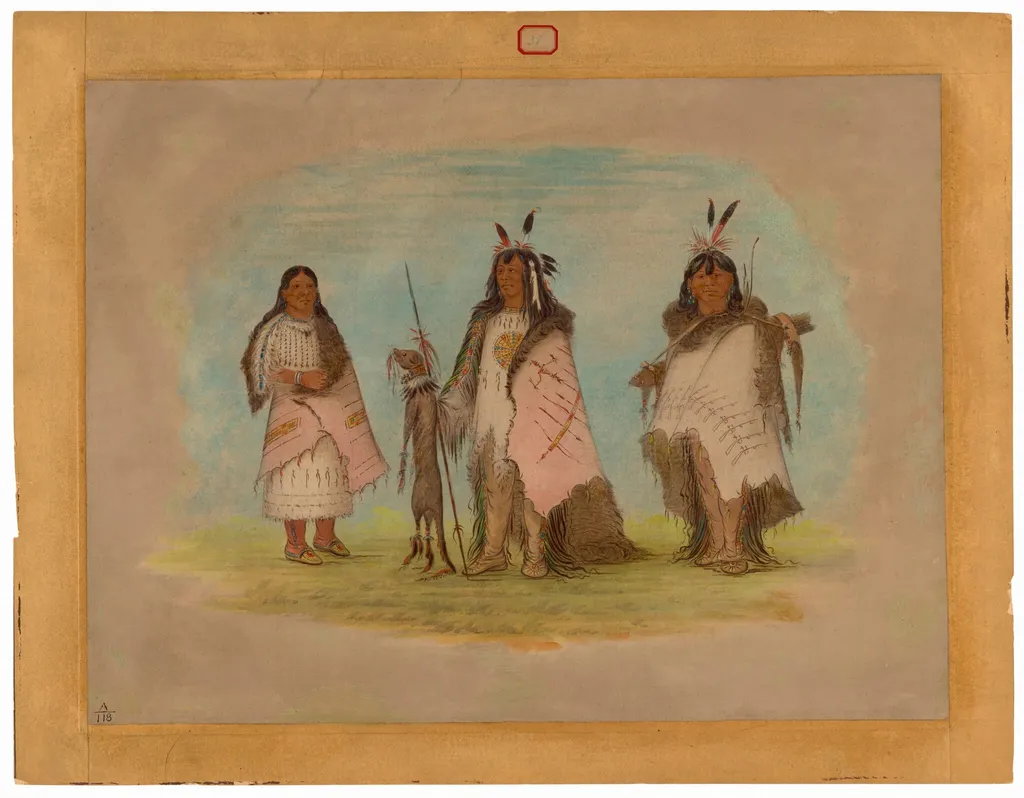
Two Blackfoot Warriors and a Woman is an oil painting by the Impressionist artist George Catlin. It dates from 1865 and is held in the collection of the National Gallery of Art.
About this work
Overview
Two Blackfoot Warriors and a Woman is an oil painting by American artist George Catlin, dated 1861, measuring 46.
Two Blackfoot Warriors and a Woman is an oil painting by American artist George Catlin, dated 1861, measuring 46.7 by 61.5 centimeters. The work belongs to Catlin's second major series, the "Cartoon Collection," comprising more than 600 works created during the 1850s and 1860s as reimagined versions of subjects he had first painted in the 1830s. Now held by the National Gallery of Art in Washington, D.C., where it entered in 1965 as part of a landmark gift of 351 works from Paul Mellon, the painting exemplifies Catlin's lifelong project of documenting Native American peoples and cultures during a period of rapid transformation.
Subject & Meaning
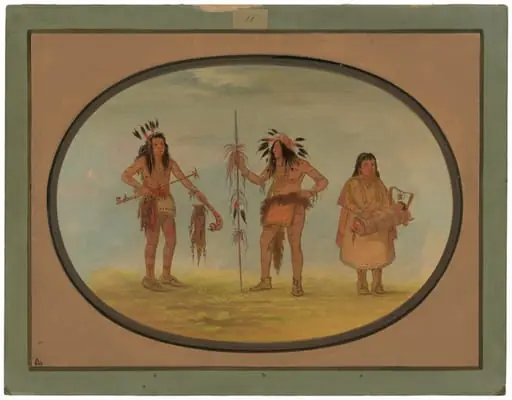
The painting depicts three Blackfoot figures standing in a row on a grassy ground line against a pale blue sky. The central warrior, identified by Catlin's 1871 catalog as Mix-ke-móte-skin-na (The Iron Horn), holds a spear and a staff topped with a small animal pelt, his white garment bearing a circular yellow and red chest emblem, pink draped fabric, and a feathered headdress with two upright feathers. To his right stands In-ne-ó-cose (The Buffalo's Child), similarly attired with a bow and quiver, wearing a white and pink wrapped garment with fur collar and feathered headdress. The woman at left, Ah-kay-e-péx-en (The Woman Who Strikes), wife of one of the warriors, stands with hands clasped, wearing a white dress with pink decorative panels and fur trim. All three wear moccasins and garments with fringe and fur details. Catlin's catalog specifies that the two men are "warriors of distinction, richly dressed," and notes the date 1832, when he presumably encountered these individuals during his western travels. The arrangement presents the figures with formal dignity, the woman slightly separated in pose yet integrated through the unified color scheme of white, pink, and fur tones.
Technique & Style
The medium is oil on card mounted on paperboard, a support characteristic of the Cartoon Collection works. The painting exhibits a soft, sketchy quality with visible paper texture and muted watercolor-like washes, despite being executed in oil. This distinctive handling, looser than the more finished works of the Indian Gallery, reflects the working method Catlin employed for this second series. The tan border surrounding the image, the small red octagonal stamp at top center, and the inscription "A/118" at lower left are consistent features of the Cartoon Collection's presentation format. The relatively small scale, 46.7 by 61.5 centimeters, and the portable card support suggest these works were conceived as a coherent portable archive rather than individual gallery paintings.
History & Provenance
The painting remained in Catlin's possession until his death in 1872, then descended to his daughters Clara Gregory Catlin, Louise Catlin Kinney, and Elizabeth Wing Catlin. In 1912, the American Museum of Natural History purchased the work from Elizabeth Wing Catlin, acquiring the bulk of the surviving Cartoon Collection. When the museum deaccessioned these works, Paul Mellon of Upperville, Virginia, purchased this painting in 1959 through Kennedy Galleries, New York. Mellon gave it to the National Gallery of Art in 1965, where it bears accession number 1965.16.27. The work was exhibited at the Whitney Gallery of Western Art, Buffalo Bill Historical Center in Cody, Wyoming, from 1964 to 1974, and from 1981 to 2017 was on extended loan for use by Justice Sandra Day O'Connor at the Supreme Court of the United States, with temporary returns to the NGA.
Context
Catlin's two collections represent distinct phases of his documentary enterprise. The Indian Gallery, more than 500 works from the 1830s, was painted from direct observation during his western travels; most surviving examples are now at the Smithsonian American Art Museum. The Cartoon Collection, created in the 1850s and 1860s largely in Europe and the eastern United States, comprised more than 600 works that revisited earlier subjects, often from memory, sketches, and earlier paintings. When Catlin exhibited the Cartoon Collection in New York in 1871, he published a catalog with descriptive entries for each work, providing the identifications and narrative details that survive for this painting. The National Gallery of Art's holding of 351 Cartoon Collection works, acquired through Paul Mellon's 1965 gift, constitutes the largest repository of this second series and enables scholarly assessment of Catlin's later working methods.
Legacy
The painting's extended display at the Supreme Court from 1981 to 2017, in the chambers of Justice Sandra Day O'Connor, the first woman to serve on that body, lent it a public visibility beyond typical museum exhibition. This placement reflected both the work's portable scale and its symbolic resonance as a document of American cultural encounter. Within Catlin scholarship, the Cartoon Collection has historically been evaluated against the Indian Gallery, with debates about the relative authority of firsthand versus remembered observation. The work has been reproduced in successive National Gallery catalogues in 1970, 1980, and 1992, ensuring its place in the institutional record of American painting. As part of the Mellon gift, it contributes to one of the most significant concentrations of Catlin's later production available for study.
Own this work as a print
Artist & collection

Artist
George Catlin ( KAT-lin; July 26, 1796 – December 23, 1872) was an American lawyer, painter, author, and traveler, who specialized in portraits of Native Americans in the American frontier.

 Bulls Fighting
 Expedition Encamped on a Texas Prairie. April 1686
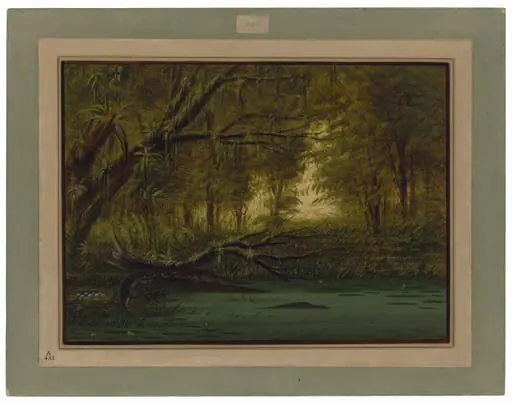 An Alligator's Nest
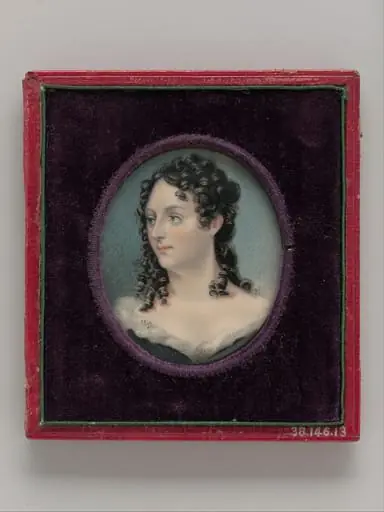 Mrs. George Catlin (Clara Bartlet Gregory)
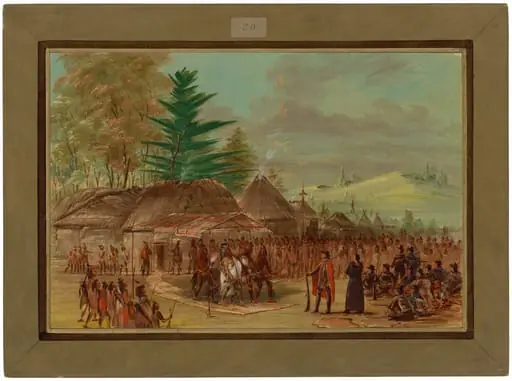 Chief of the Taensa Indians Receiving La Salle. March 20, 1682
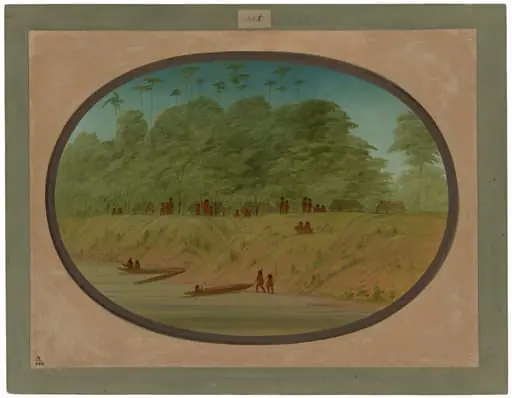 A Small Village - Payaguas Indians
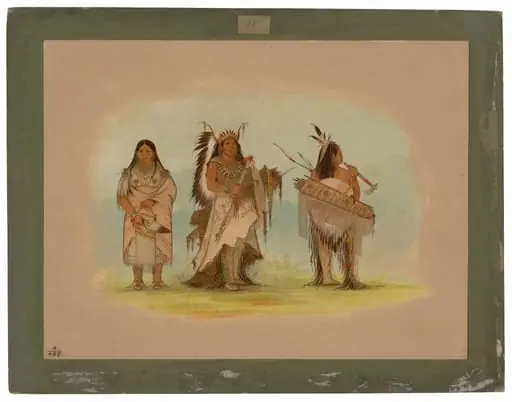 Omaha Chief, His Wife, and a Warrior
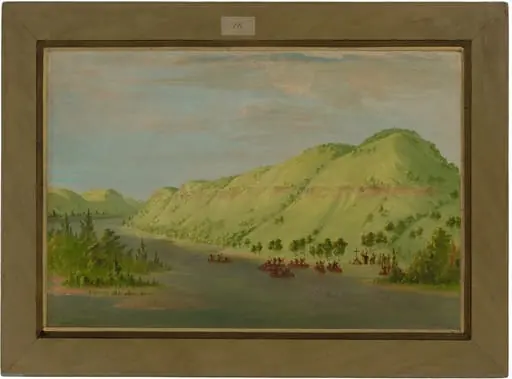 Father Hennepin Leaving the Mississippi to Join La Salle. May 8, 1680
- A Blackfoot Chief, His Wife, and a Medicine Man
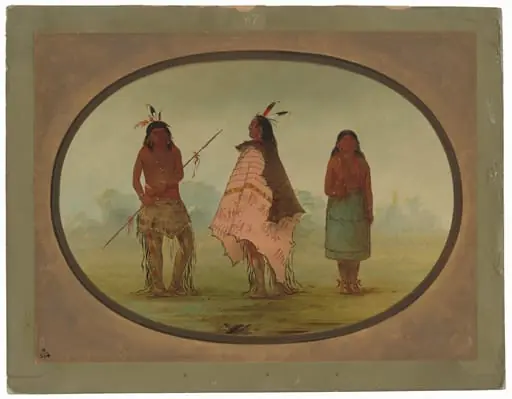 Two Apachee Warriors and a Woman
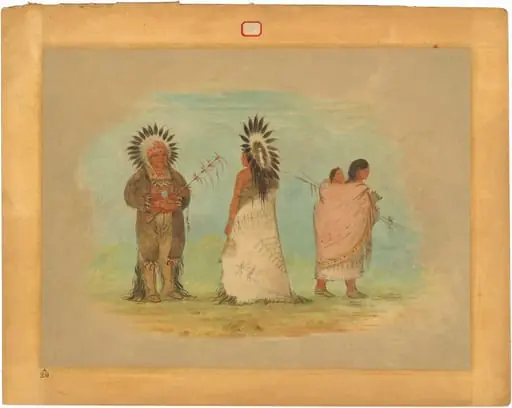 Two Ottoe Chiefs and a Woman
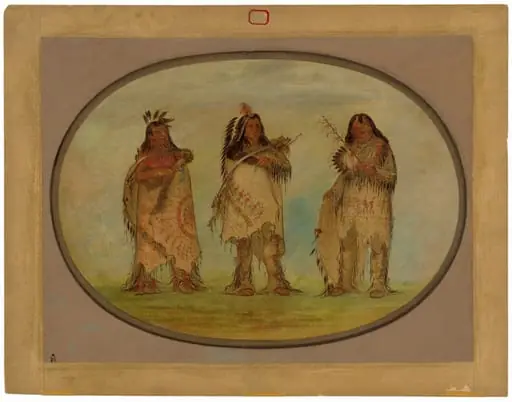 Three Distinguished Warriors of the Sioux Tribe
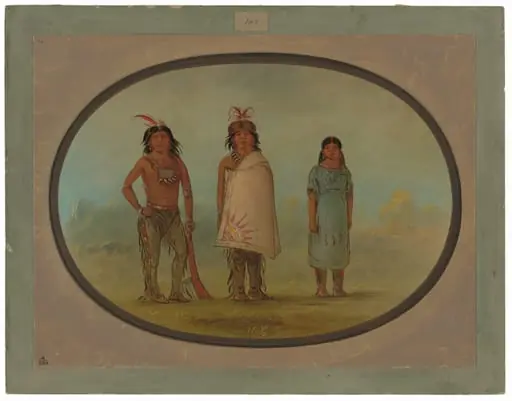 Two Chippewyan Warriors and a Woman
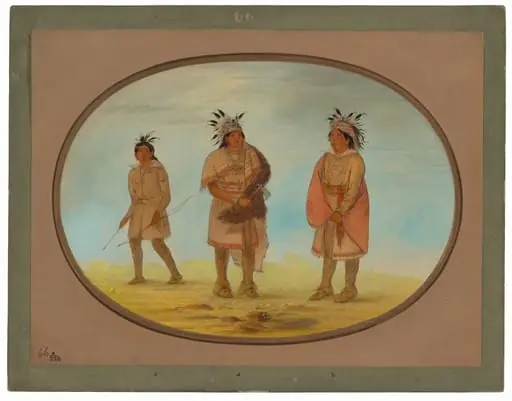 Two Weeah Warriors and a Woman
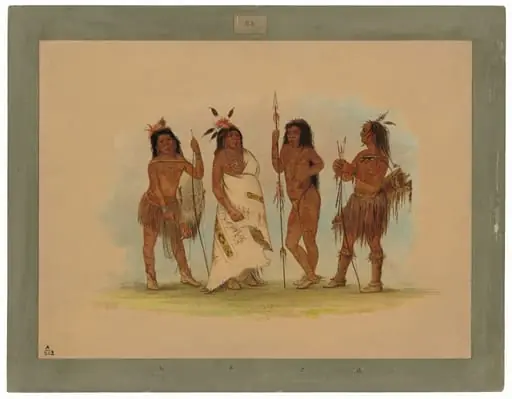 Apachee Chief and Three Warriors
 Two Ojibbeway Warriors and a Woman
 Three Shoshonee Warriors
 Yntah Medicine Man, a Warrior, and a Woman