Artwork
The Doge's Palace Seen from San Giorgio Maggiore
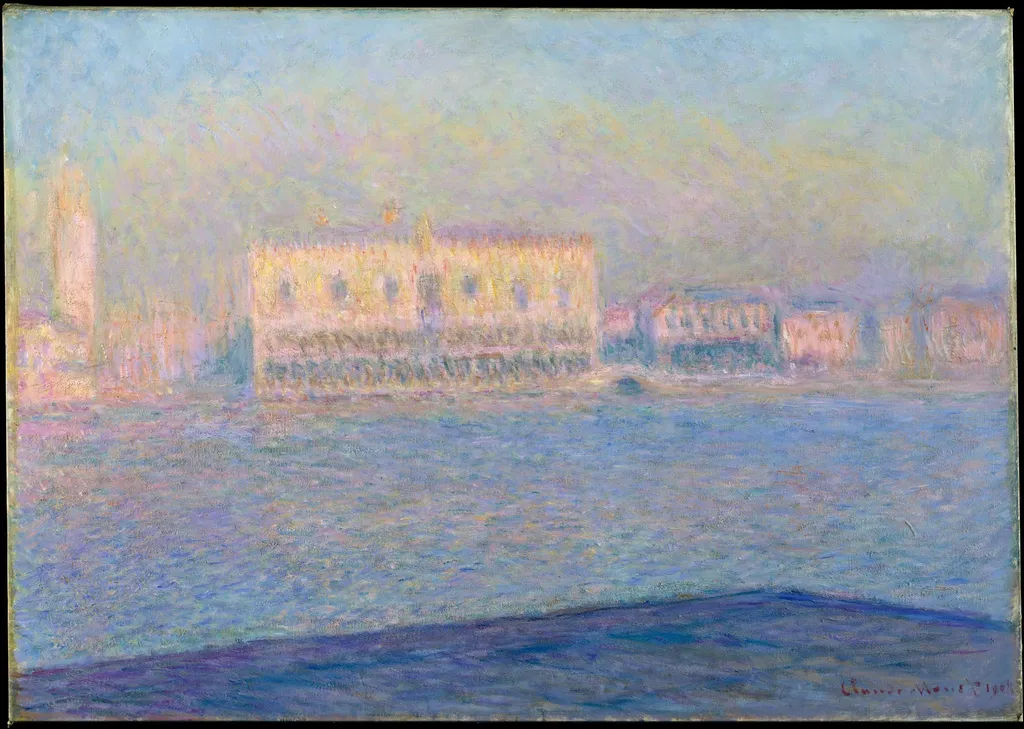
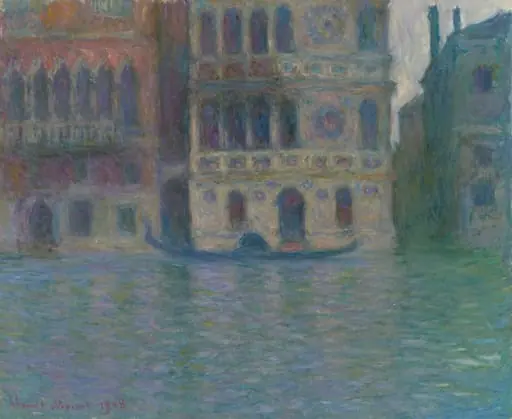
The Doge's Palace Seen from San Giorgio Maggiore is an oil painting by the Impressionist artist Claude Monet. It dates from 1908 and is held in the collection of the Metropolitan Museum of Art.
About this work
Subject & Meaning
The scene includes the Riva degli Schiavoni waterfront and is framed by the perspective of Palladio's abbey church.
The work depicts the Doge's Palace, a historic seat of government for the Republic of Venice and an iconic landmark, viewed from the island of San Giorgio Maggiore across the Bacino di San Marco canal. The scene includes the Riva degli Schiavoni waterfront and is framed by the perspective of Palladio's abbey church. Monet created this painting as part of a series of six versions designed to capture the varied lighting effects throughout the day, a practice rooted in his interest in changing light and en plein air techniques.
Although executed late in his career, the piece reflects his signature style and the influence of Venetian sunsets. For contemporary critic Guillaume Apollinaire, these views represented a form of realism that stripped away the city's traditional mystery to reveal the raw reality of a typical day in Venice.
Technique & Style
The Doge's Palace Seen from San Giorgio Maggiore is an oil‑on‑canvas work measuring 65.4 cm by 92.7 cm. Monet applied oil paint to a stretched canvas, a support typical of his later impressionistic practice, and built the image through layered brushwork that captures the shifting reflections on the lagoon. The painting belongs to a series of six canvases executed in 1908 that explore varying daylight conditions; Monet produced multiple versions of the same vista, a method he adopted during his early plein‑air experiments. The composition is framed from the island of San Giorgio Maggiore, presenting the Doge's Palace and the surrounding waterfront in a balanced, atmospheric arrangement that emphasizes luminous color and subtle tonal modulation.
History & Provenance
Monet painted the work in late 1908 during a brief stay in Venice, executing six versions of the same view to capture changing daylight conditions. He returned to France with many canvases unfinished and spent several years preparing 29 paintings for exhibition. In 1912 Monet presented the Venetian series, including this composition, at the Bernheim-Jeune gallery in Paris.
The Doge’s Palace Seen from San Giorgio Maggiore was later acquired by the Metropolitan Museum of Art, where it has remained in the permanent collection.
The Doge's Palace Seen from San Giorgio Maggiore is held in the permanent collection of the Metropolitan Museum of Art in New York. While the specific inventory or accession number is not provided in the sources, the work is catalogued as W1755 in the Wildenstein catalogue raisonné. The painting was first exhibited in Paris in 1912 as part of the successful show Claude Monet Venise at the Bernheim-Jeune gallery, where it was displayed alongside twenty-eight other Venetian views.
Following this exhibition, the work traveled internationally before being acquired by the Metropolitan Museum of Art, where it remains today.
Context
Created during a brief 1908 sojourn in Venice, this work belongs to a series of six views capturing varying light conditions, a hallmark of Monet's serial approach developed earlier in his career. Although executed late in his life after his style was firmly established, some scholarship suggests the series was less successful than his earlier works because Monet was forced to complete many canvases from memory in Paris rather than on site. Despite these constraints, the Venice paintings are now regarded as masterpieces that encapsulate his signature impressionist style and the unique atmosphere of the city.
Contemporary critic Guillaume Apollinaire praised the works for their realism, arguing that Monet stripped away the city's mystique to reveal the ordinary reality of its morning mists. The series debuted to acclaim in 1912 at the Bernheim-Jeune gallery in Paris before entering the collection of the Metropolitan Museum of Art.
Legacy
Although Claude Monet spent only a brief period in Venice, works initiated there, including this depiction of the Doge's Palace, are regarded as some of his most highly regarded masterpieces. These paintings are celebrated for capturing his signature style and the influence of the effervescent Venetian sunset. Following its debut at the successful 1912 exhibition in Paris, the work traveled internationally before finding its permanent home at the Metropolitan Museum of Art in New York.
While some contemporary critics like Guillaume Apollinaire praised the series for its realism in depicting morning mist, other assessments suggest the specific Doge's Palace versions were less successful because Monet was forced to complete the series from memory after returning to France.
Overview
Claude Monet's 1908 oil painting, The Doge's Palace Seen from San Giorgio Maggiore, captures a specific Venetian vista. It is part of a larger group of works depicting this same subject, a characteristic approach for the artist. This particular rendition, catalogued W1755 in the Wildenstein catalogue raisonné, is housed within the Metropolitan Museum of Art's collection.
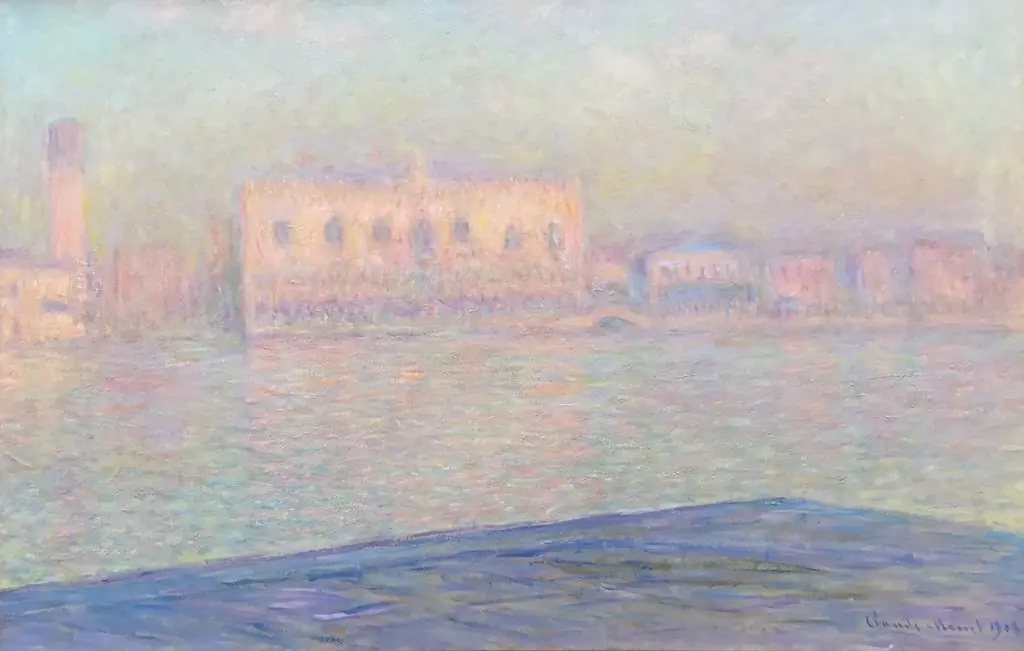
Own this work as a print
Artist & collection
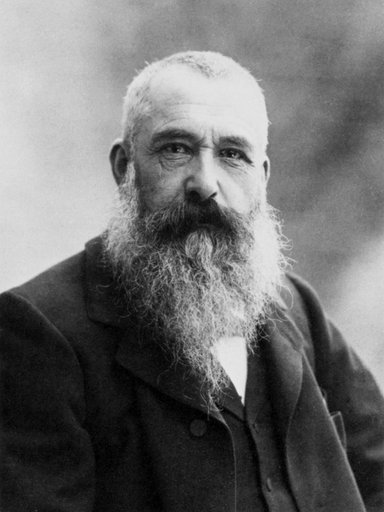
Artist
Oscar-Claude Monet was a French painter and founder of Impressionism who is seen as a key precursor to modernism, especially in his attempts to paint nature as he perceived it.