Artwork
The Entrance to the Port of Le Havre
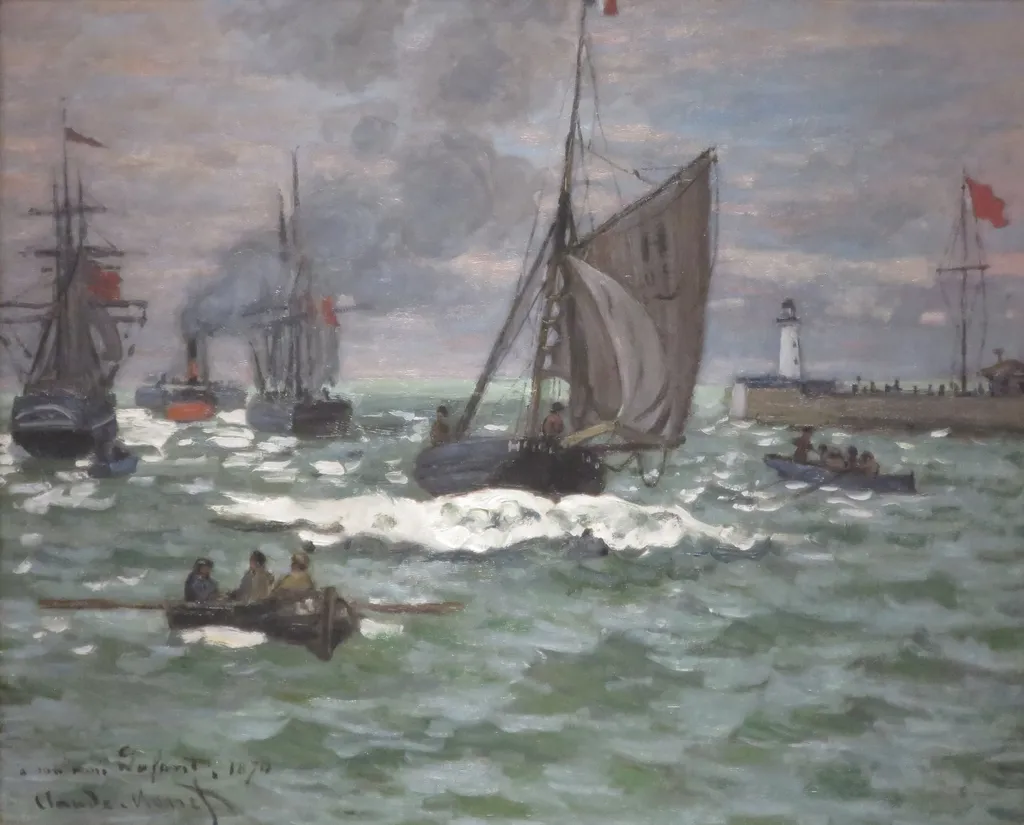
The Entrance to the Port of Le Havre is an oil painting by the Impressionist artist Claude Monet. It dates from 1867 and is held in the collection of the Norton Simon Museum.
About this work
Overview
Executed in oil paint, the work demonstrates Monet's early mastery of light and atmosphere, characteristic of his developing Impressionist style.
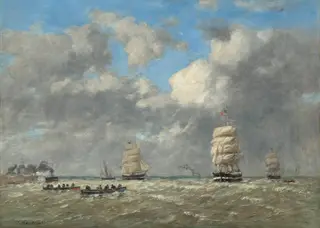
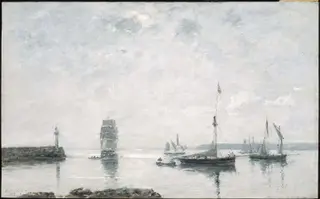
Claude Monet's 'The Entrance to the Port of Le Havre,' painted in 1867, captures a dynamic maritime scene at the artist's hometown harbor. The composition centers on a large vessel with a white sail and dark hull, navigating through a busy waterway crowded with smaller boats, some flying red flags or emitting smoke from their stacks. In the background, a lighthouse anchors the horizon, providing a vertical counterpoint to the horizontal expanse of the sea and sky.
Executed in oil paint, the work demonstrates Monet's early mastery of light and atmosphere, characteristic of his developing Impressionist style. The painting reflects the industrial vitality of Le Havre while showcasing Monet's interest in capturing transient effects of light on water and the interplay between natural and man-made elements. Created during a pivotal period in Monet's career, just before his groundbreaking 'Impression, Sunrise' of 1872, this work illustrates his evolving approach to modern life and landscape, bridging traditional marine painting with the innovative techniques that would define Impressionism.
Subject & Meaning
The composition centers on a large vessel with a white sail and dark hull, surrounded by smaller boats bearing red flags and emitting smoke from their funnels. A lighthouse rises on the right, while modest shoreline buildings frame the view. The cloudy, gray sky broken by patches of blue underscores the bustling activity of a working port.
Technique & Style
Monet employs his early plein‑air approach, using loose brushwork to suggest movement in water and sky. The palette balances muted grays with occasional bright accents, red flags, white sails, and the lighthouse’s glow, creating a sense of atmospheric depth without detailed rendering.
History & Provenance
Painted shortly after Monet’s move to Le Havre, the work reflects his interest in maritime subjects. After changing hands among private collectors, it entered the Norton Simon Museum’s holdings in the mid‑20th century, where it remains on view as an example of Monet’s formative years.
Own this work as a print
Artist & collection
Artist
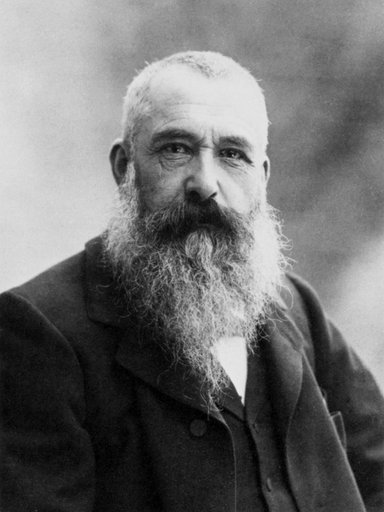
Oscar-Claude Monet was a French painter and founder of Impressionism who is seen as a key precursor to modernism, especially in his attempts to paint nature as he perceived it.