Artwork
Corot's Studio: Woman Seated Before an Easel, a Mandolin in her Hand
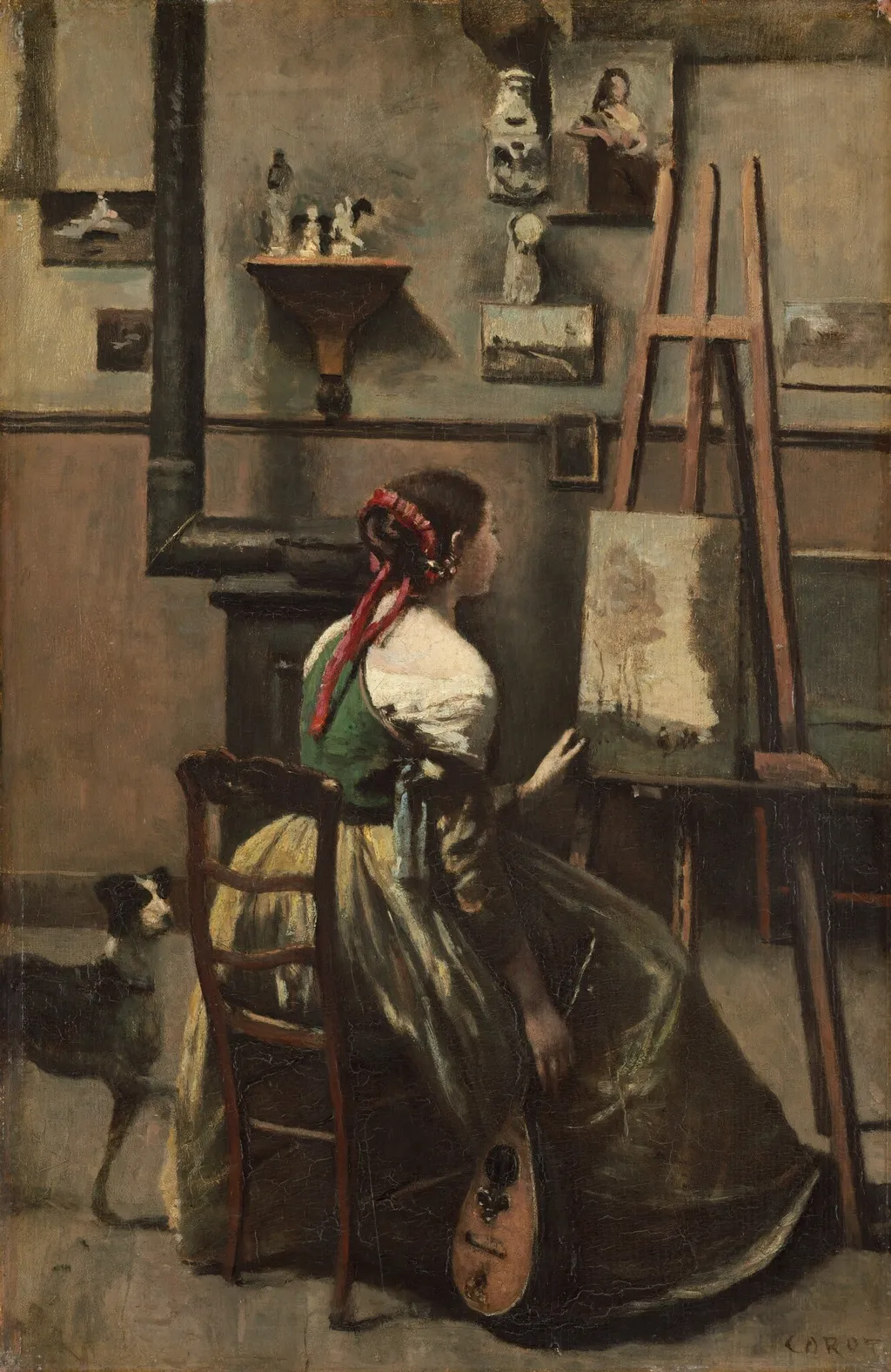
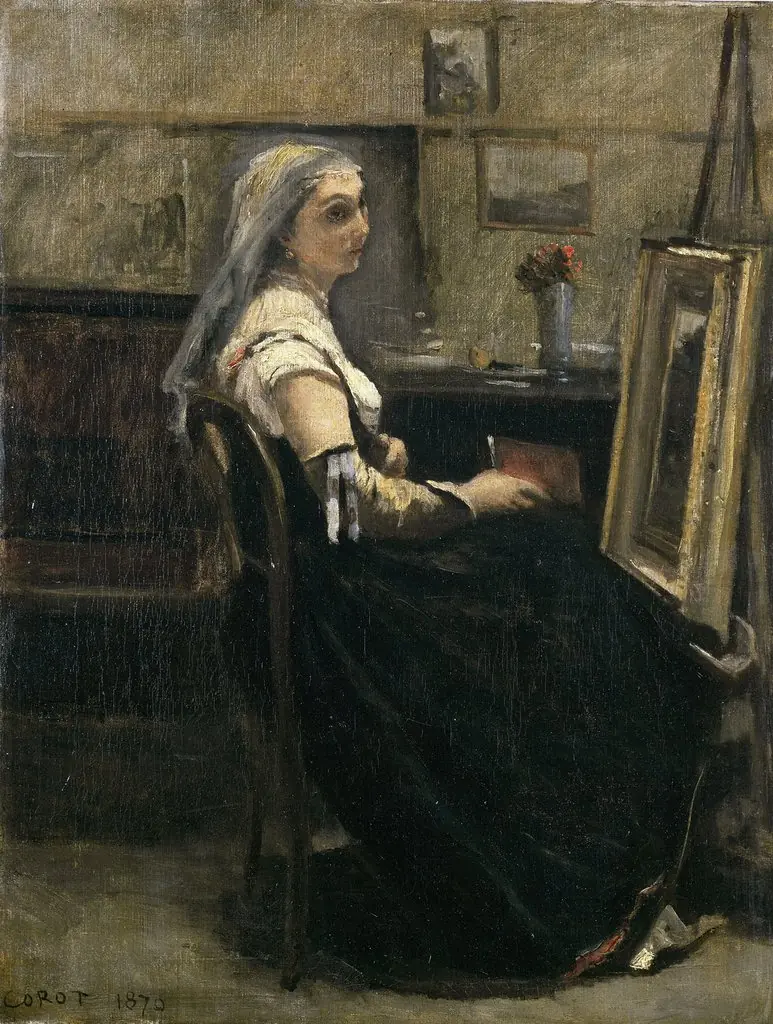
Corot's Studio: Woman Seated Before an Easel, a Mandolin in her Hand is an oil painting by the Impressionist artist Jean Baptiste Camille Corot. It dates from 1868 and is held in the collection of the National Gallery of Art. Created circa 1868, this oil on wood painting by Jean‑Baptiste‑Camille Corot portrays a quiet interior scene.
- Inscription
- Inscribed:lower right: COROT
About this work
Technique & Style
Its condition appears stable, retaining original pigment integrity and showing no significant craquelure or flaking in available documentation.
The painting is executed in oil on wood panel, a support typical of Corot's smaller studio works from the 1860s. Brushwork is characteristically soft and atmospheric, with blended tonal transitions that emphasize overall mood over linear precision. The composition relies on subtle chiaroscuro and a restrained palette of earth tones punctuated by delicate highlights, reflecting the artist's mature approach to plein-air sensibility within the confines of the studio.
These formal qualities align with Corot's broader stylistic emphasis on poetic realism and the lyrical rendering of light and space.
The work's handling demonstrates careful attention to surface texture, with thinly layered glazes that enhance depth without sacrificing the intimate scale of the piece. Its condition appears stable, retaining original pigment integrity and showing no significant craquelure or flaking in available documentation.
History & Provenance
Corot painted this oil on wood in 1868, retaining it in his own possession until his death in 1875. The work then entered the posthumous sale of the artist at the Hôtel Drouot in Paris on 26 May 1875 (lot 134), where it was acquired by Hector Brame of Paris. It subsequently passed to Jules Paton in Paris, resurfacing at Paton's own sale at the Hôtel Drouot on 24 April 1883 (lot 35), where Bernheim-Jeune purchased it.
The Paris dealers kept the painting through at least 1889, lending it that year to the Exposition centennale de l'art français at the Exposition universelle in Paris (no. 163).
After further ownership by figures recorded as "Duz." and "Van den Eynde," the painting was handled by Durand-Ruel et Cie in Paris. In 1892 it was sold to Peter A.B. Widener of Lynnewood Hall, Elkins Park, Pennsylvania. It passed by inheritance and power of appointment to Joseph E. Widener, also at Elkins Park, who gifted it in 1942 to the National Gallery of Art.
The painting is held in the collection of the National Gallery of Art in Washington, D.C., having been gifted to the institution in 1942 by Joseph E. Widener as part of the inheritance from the estate of his father, Peter A.B. Widener. Prior to entering the museum, the work passed through several private hands and dealers, including Hector Brame, Jules Paton, and Bernheim-Jeune, before being sold to Peter A.B. Widener in 1892.
Regarding its exhibition history, the work was lent by Bernheim-Jeune to the Exposition centennale de l'art français at the Exposition universelle in Paris in 1889. It has also been featured in later surveys dedicated to the artist, including exhibitions titled "Corot 1796-1875" and "Corot. The Painter and his Models."
Overview
Created circa 1868, this oil on wood painting by Jean‑Baptiste‑Camille Corot portrays a quiet interior scene. A woman seated before an easel holds a mandolin, while a partially finished canvas rests on the easel. The composition is set within a modest studio, its walls lined with small sculptures, framed works, and a dog curled on the floor, evoking the everyday atmosphere of an artist’s workspace.
Subject & Meaning
The central figure, a woman wrapped in a green shawl with a red ribbon in her hair, suggests a domestic or musical presence within the creative environment. By juxtaposing the mandolin with the tools of painting, Corot hints at the harmony between visual and auditory arts, while the modest surroundings emphasize the ordinary, unglamorous aspects of artistic practice.
Context
The piece emerges from the broader Realist movement of the mid‑19th century, a period when artists turned to everyday life and domestic interiors for subject matter. Corot’s interest in natural light and unidealized scenes anticipates the concerns of the Impressionists who would follow, positioning this studio scene as a transitional example of evolving French art.
Own this work as a print
Artist & collection
Artist
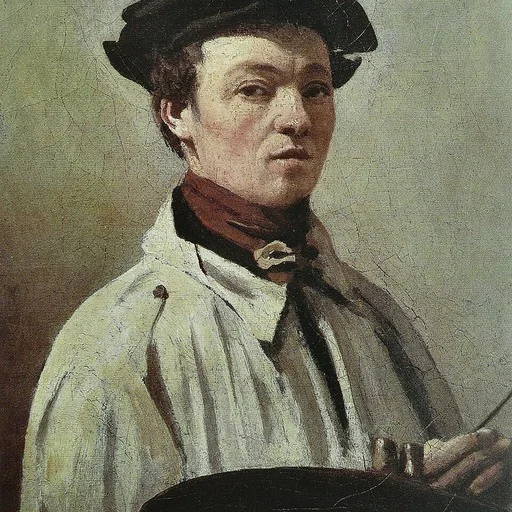
Jean-Baptiste-Camille Corot (UK: KORR-oh, US: kə-ROH, kor-OH; French:; 16 July 1796 – 22 February 1875), or simply Camille Corot, was a French landscape and portrait painter as well as a printmaker in etching.