Artwork
The Angel with the Key to the Bottomless Pit
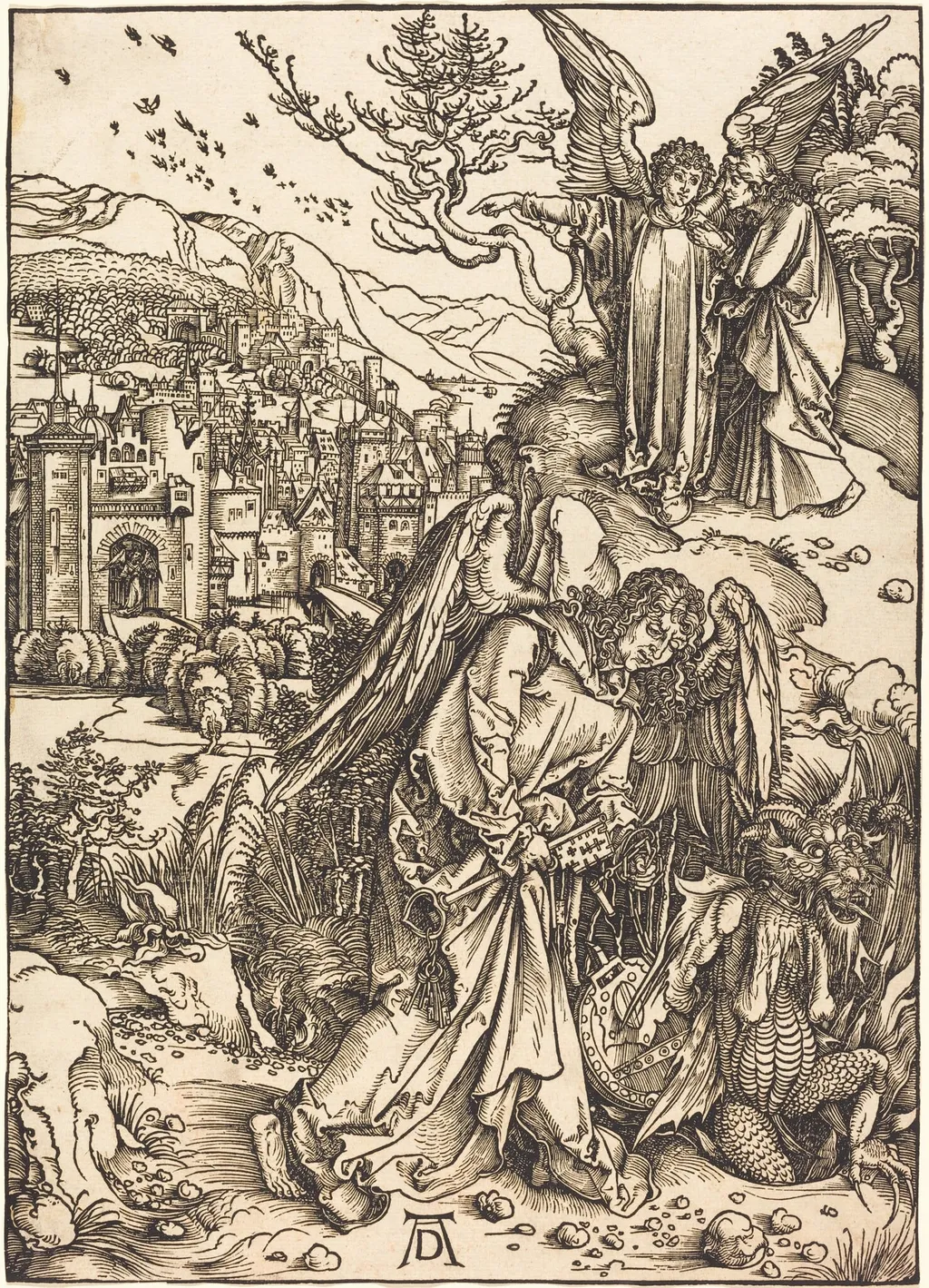
The Angel with the Key to the Bottomless Pit is an ink print by the Northern Renaissance artist Albrecht Dürer. It dates from 1497 and is held in the collection of the Metropolitan Museum of Art.
- Inscription
- Inscribed:verso, lower left, in graphite by a later hand: 303
About this work
Subject & Meaning
The woodcut depicts an angel and John the Evangelist, the visionary of the Book of Revelation to whom the apocalyptic vision is attributed.
The woodcut depicts an angel and John the Evangelist, the visionary of the Book of Revelation to whom the apocalyptic vision is attributed. The work belongs to Dürer's Apocalypse series and illustrates passages from Revelation 20 and 21, the biblical chapters that describe an angel holding the key to the bottomless pit and the chaining of the dragon. The pairing of the angel with the Evangelist situates the scene within the tradition of apocalyptic imagery, in which John witnesses and records the end-time events revealed to him.
As a religious print from the German Renaissance, the image conveys the theological weight of Revelation's vision of cosmic judgment, using the angel as the agent who seals the abyss and John as the seer through whom the revelation is mediated.
Technique & Style
The Angel with the Key to the Bottomless Pit is a woodcut print executed on laid paper, measuring 39.3 by 28.3 cm. As part of Dürer's Apocalypse series, the image exemplifies the technical precision and expressive power of German Renaissance printmaking. The medium of woodcut, with its bold contrasts between black and white, allows for dramatic linear patterns and densely worked areas that heighten the visionary intensity of the biblical subject. The composition draws directly on Revelation 20 and 21, channelling the narrative drama through stark tonal contrasts and meticulous control of the carved line.
Dürer's handling demonstrates a masterful balance between ornamental detail and dynamic movement, hallmarks of his graphic style in the 1490s.
History & Provenance
The Angel with the Key to the Bottomless Pit is a woodcut by Albrecht Dürer produced in Nuremberg in 1496, as part of his Apocalypse series. The print was created on laid paper and depicts an angel associated with John the Evangelist, drawing on passages from Revelation chapters 20 and 21.
Beyond its creation, the work entered several major European and American print collections. It is held by the Prints department of the National Gallery of Art in Washington, D.C., as part of the Rosenwald Collection, and impressions are also associated with the Chester Beatty Library, the Städel Museum, the Staatliche Kunsthalle Karlsruhe, the Cleveland Museum of Art, the Metropolitan Museum of Art, the Baltimore Museum of Art, the Kupferstichkabinett Berlin, and the Kupferstich-Kabinett Dresden. No details of an individual commission or successive ownership chain are recorded in the available sources.
The Angel with the Key to the Bottomless Pit, a 1496 woodcut by Albrecht Dürer, is held in the Prints collection of the National Gallery of Art in Washington, D.C., as part of the Rosenwald Collection. Beyond the National Gallery of Art, impressions of the print are also held by the Chester Beatty Library, the Städel Museum, the Staatliche Kunsthalle Karlsruhe, the Cleveland Museum of Art, the Metropolitan Museum of Art, the Baltimore Museum of Art, the Kupferstichkabinett Berlin, and the Kupferstich-Kabinett Dresden.
No specific accession number, acquisition date, or exhibition history is documented in the available sources for this impression.
Overview
Albrecht Dürer’s woodcut, titled The Angel with the Key to the Bottomless Pit, dates from around 1497. Executed in the late‑15th‑century German print tradition, the image presents a celestial figure holding a massive key, standing upon a swirling cloud while a diminutive John the Evangelist kneels at the angel’s feet.
Context
The late 1400s saw a surge in devotional prints that catered to a growing literate public seeking visual access to scriptural narratives. Dürer’s engagement with such subjects aligns with contemporary reformist currents that emphasized personal contemplation of biblical themes.
Own this work as a print
Artist & collection
Artist
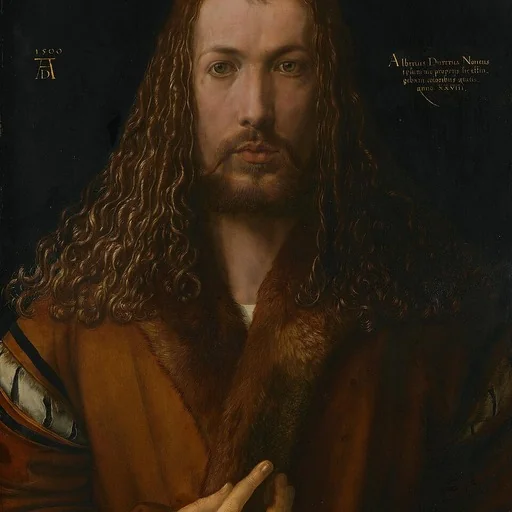
Albrecht Dürer spent his life in Nuremberg, a busy German city where artists traded prints like currency.

![Madonna and Child [obverse], by Albrecht Dürer](https://artifactworldgallery.com/img/albrecht-durer--madonna-and-child-obverse--d7b8ebf05d22ebe5-w320.webp)
![Lot and His Daughters [reverse], by Albrecht Dürer](https://artifactworldgallery.com/img/albrecht-durer--lot-and-his-daughters-reverse--b4ebf9b282faa17a-w320.webp)
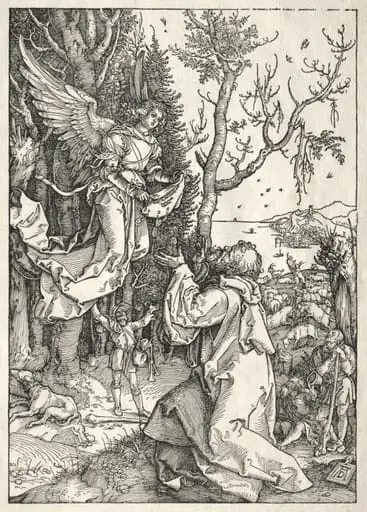 Life of the Virgin: Joachim and the Angel
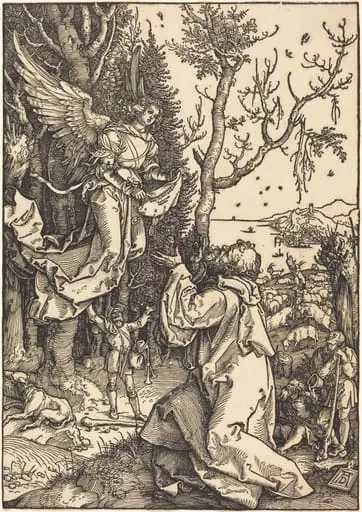 Joachim and the Angel
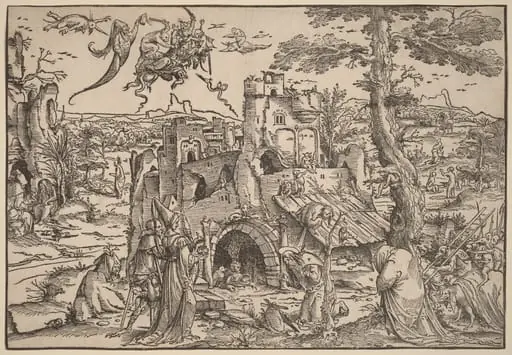 The Temptation of Saint Anthony
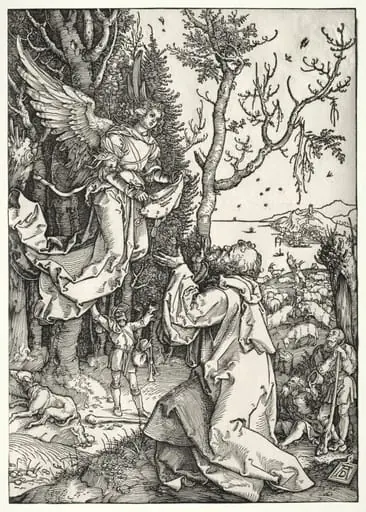 Joachim and the Angel
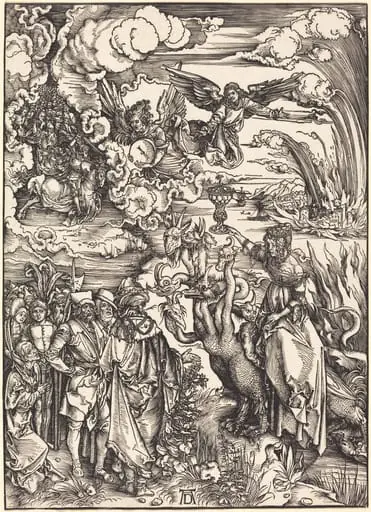 The Babylonian Whore
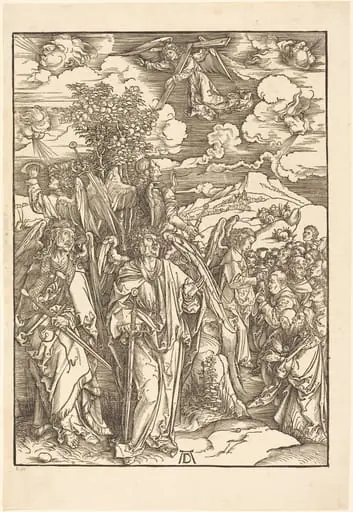 The Four Angels Holding the Winds
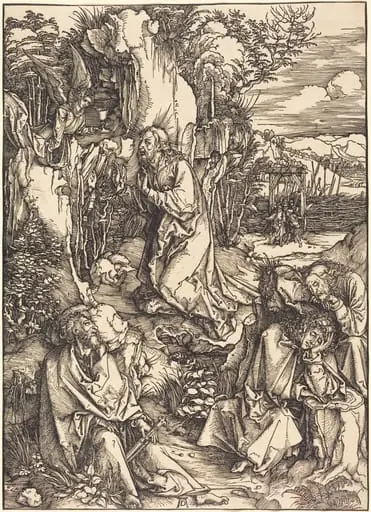 Christ on the Mount of Olives
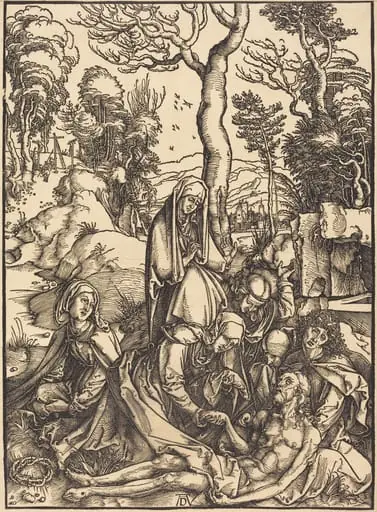 The Lamentation
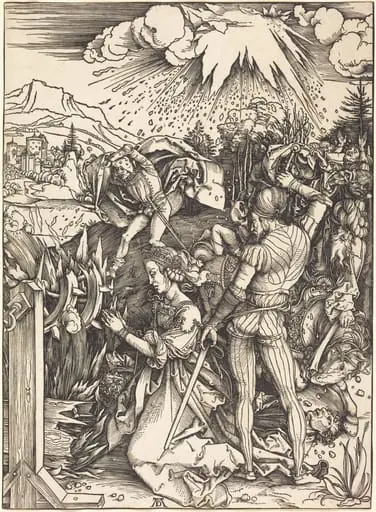 The Martyrdom of Saint Catherine
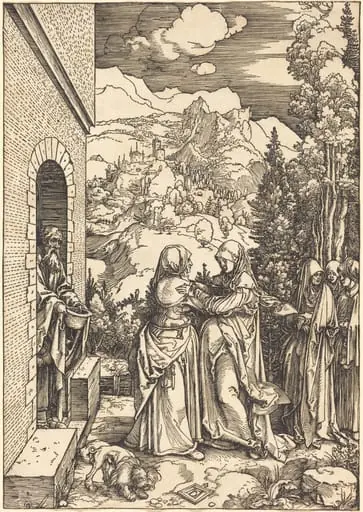 The Visitation
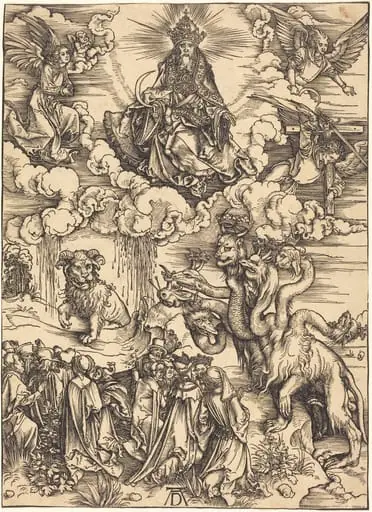 The Beast with Two Horns like a Lamb
- Revelation of St. John: Angel with the Key of the Bottomless Pit