Artwork
11 heures du matin
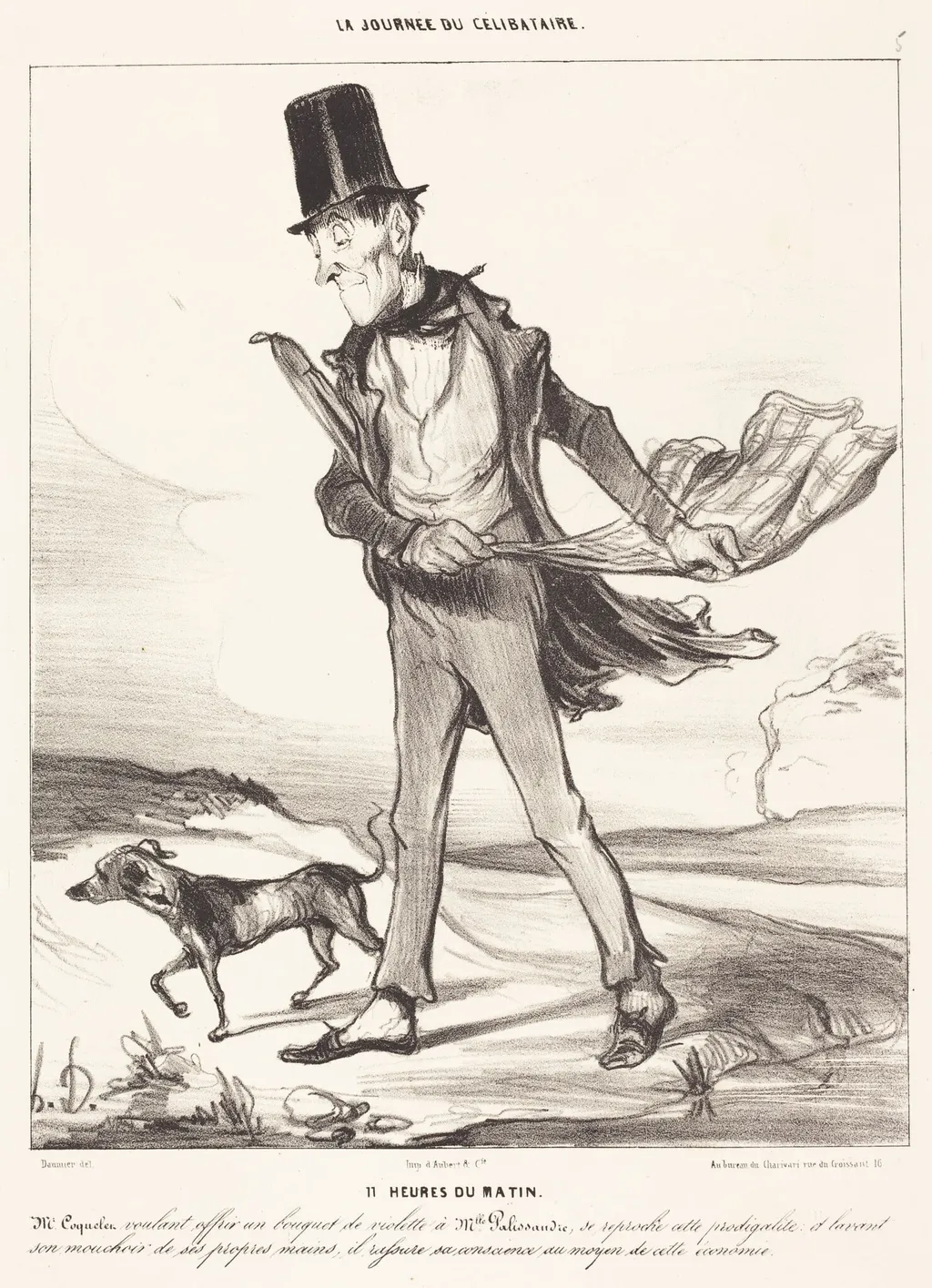
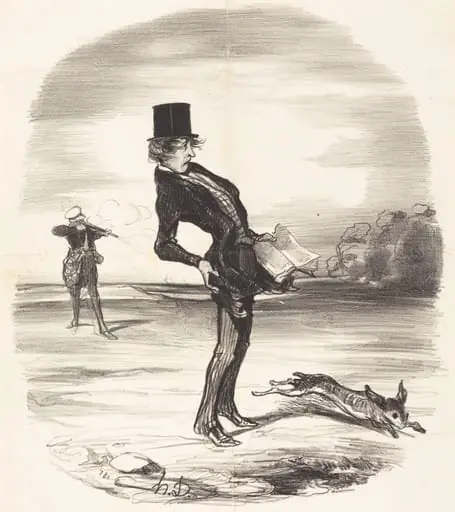
11 heures du matin is a crayon print by the Romanticist artist Honoré Daumier. It dates from 1839 and is held in the collection of the National Gallery of Art.
- Inscription
- Inscribed:upper center in plate: LA JOURNEE DU CELIBATAIRE.; upper right in plate: 5; lower left in image in plate: h.D.; lower left below image in plate: Daumier del.; lower center below image in plate: Imp. d'Aubert & Cie.; lower right below image in plate: Au bureau du Charivari rue du Croissant 16; across bottom in plate: 11 HEURES DU MATIN / Mr Coquelet voulant offrir un bouquet de violette à Mlle Palissandie, se reproche cette prodigalite: et lavant / son mouchoir de ses propres mains, il rassure sa conscience au moyen de cette économie.; by later hand, lower left to lower center in graphite: L.D. 611 HD 2002; by later hand, lower right in graphite: F / 21785; by later hand, lower right verso in graphite: os 14 Set of 12
About this work
Overview
Created in 1839, 11 heures du matin is a black crayon lithograph on wove paper by Honoré Daumier. The work belongs to the artist’s prolific output of socially charged prints produced during the July Monarchy, a period marked by political tension and rapid urban change in France.
Subject & Meaning
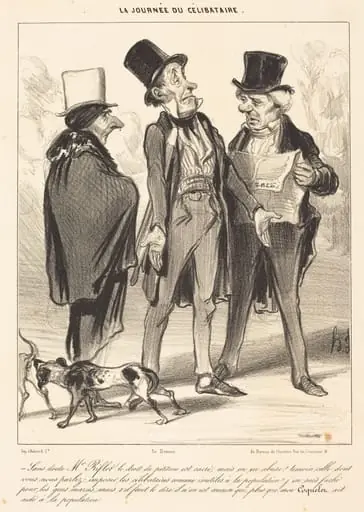
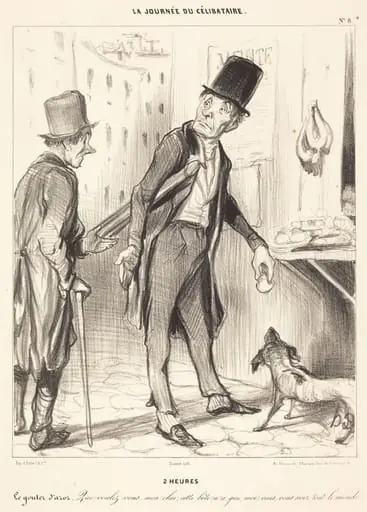
The image captures a well‑dressed gentleman in a top hat and long coat, strolling with a leashed dog. He clutches a sheet of paper or cloth, while his coat billows open, suggesting movement. The accompanying title, La Journée du Célibataire (The Bachelor’s Day), hints at a humorous observation of solitary urban life and the rituals of the middle class.
Technique & Style
Daumier employed crayon lithography, a process that allows rapid, gestural drawing directly onto the lithographic stone. The resulting lines are loose and sketch‑like, conveying immediacy. The use of wove paper provides a smooth surface that accentuates the fine black strokes, characteristic of Daumier’s satirical prints.
History & Provenance
The print was produced for circulation in popular periodicals such as La Caricature and Le Charivari, venues through which Daumier disseminated his political and social commentary. Like many of his works, it was widely distributed in the 19th‑century French print market, reaching a broad audience beyond elite patrons.
Context
During the July Monarchy (1830‑1848), Daumier turned his attention to the everyday scenes of Parisian life, using humor to critique the emerging bourgeoisie and the lingering influence of the aristocracy and clergy. This lithograph exemplifies his focus on ordinary moments as a mirror for broader societal attitudes.
Legacy
11 heures du matin illustrates Daumier’s mastery of the lithographic medium as a tool for rapid, mass‑produced commentary. The work continues to be studied for its blend of spontaneous drawing and incisive social observation, influencing later generations of caricaturists and printmakers.
Own this work as a print
Artist & collection
Artist
Honoré-Victorin Daumier (French: ; 26 February 1808 – 10 or 11 February 1879) was a French painter, sculptor, and printmaker, whose many works offer commentary on the social and political life in France, from the…