Artwork
Le mari du bas-bleu...
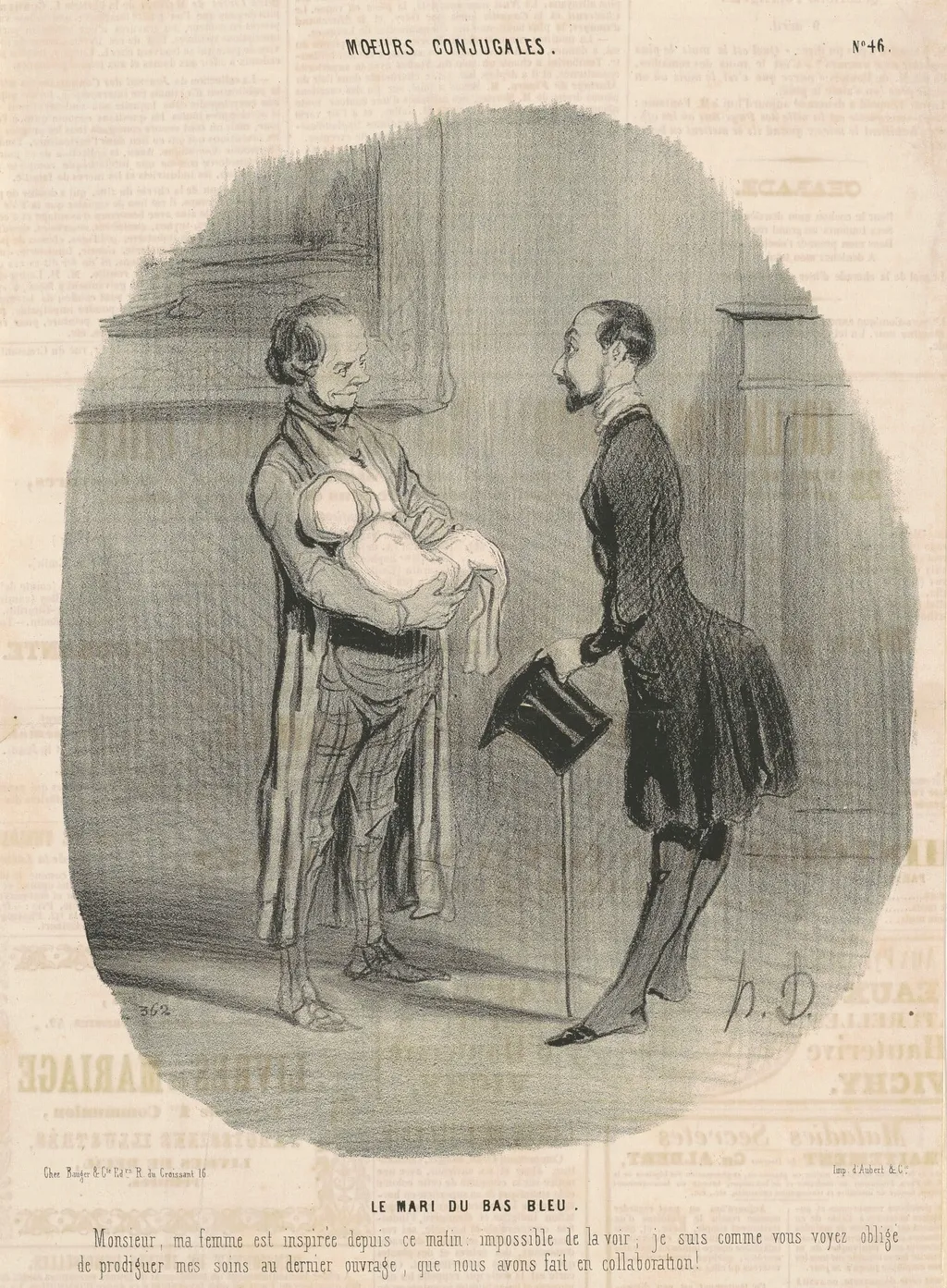
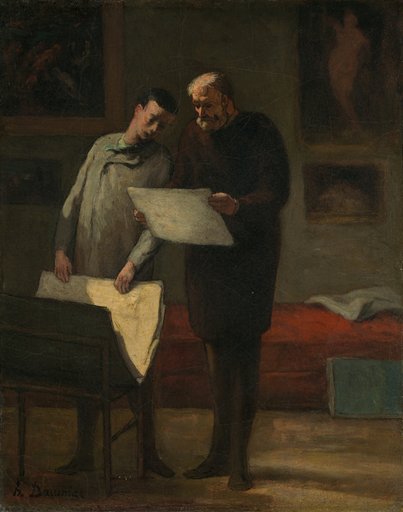
Le mari du bas-bleu... is an ink print by the Romanticist artist Honoré Daumier. It dates from 1842 and is held in the collection of the National Gallery of Art.
About this work
Honoré Daumier’s 1842 lithograph shows two men in a bare room. One holds a wrapped baby while the other talks. Their clothes look rumpled, like they’ve been up all night.
Daumier wasn’t painting pretty scenes. He mocked the pretensions of the middle class. This image pokes fun at men forced into awkward fatherhood roles.
It’s a quick sketch with sharp edges. Check out how he used lithography.
Overview
Created in 1842, this lithograph by Honoré Daumier depicts two men in a sparse interior, one cradling an infant while the other engages in conversation. Rendered with minimal detail and bold lines, the scene captures an unidealized moment of domestic life. Daumier employed lithography to produce a work that feels immediate, almost sketchlike, emphasizing gesture over polish.
Subject & Meaning
One man, visibly exhausted, tends to the baby while the other appears detached yet engaged in talk, suggesting an awkward, improvised childcare arrangement.
The image satirizes the disruption of traditional gender roles in middle-class households. One man, visibly exhausted, tends to the baby while the other appears detached yet engaged in talk, suggesting an awkward, improvised childcare arrangement. Daumier critiques the performative nature of bourgeois domesticity, highlighting the discomfort of men thrust into nurturing roles they were not socially prepared for.
Technique & Style
Daumier used lithographic stone to achieve rapid, expressive lines with stark contrasts. Forms are simplified, contours sharp, and textures suggested rather than rendered. The lack of background detail focuses attention on the figures’ postures and expressions. The medium’s immediacy suits his satirical intent, allowing for quick, incisive observation rather than refined finish.
History & Provenance
Produced during Daumier’s prolific period for the satirical journal La Caricature, the print was part of a series targeting middle-class pretensions. It circulated widely among Parisian readers familiar with the social tensions of the July Monarchy. Though not signed or dated on the plate, its attribution is consistent with his known output from 1842.
Context
In 1840s France, debates over domestic life and gender roles intensified as urban middle-class families expanded. Daumier’s work responded to cultural anxieties about men’s involvement in childcare, often portrayed as unnatural or comical in popular media. His lithograph reflects these tensions without moralizing, instead offering a quiet, ironic observation of everyday life.
Legacy
The print exemplifies Daumier’s enduring influence on social realism in printmaking. Its unembellished portrayal of domestic labor anticipated later movements that valued candid depictions of ordinary life. Though not widely exhibited in his lifetime, it became a touchstone for artists seeking to merge political critique with intimate observation.
Own this work as a print
Artist & collection
Artist
Honoré-Victorin Daumier (French: ; 26 February 1808 – 10 or 11 February 1879) was a French painter, sculptor, and printmaker, whose many works offer commentary on the social and political life in France, from the…