Artwork
Louis-Philippe, dernier roi des français
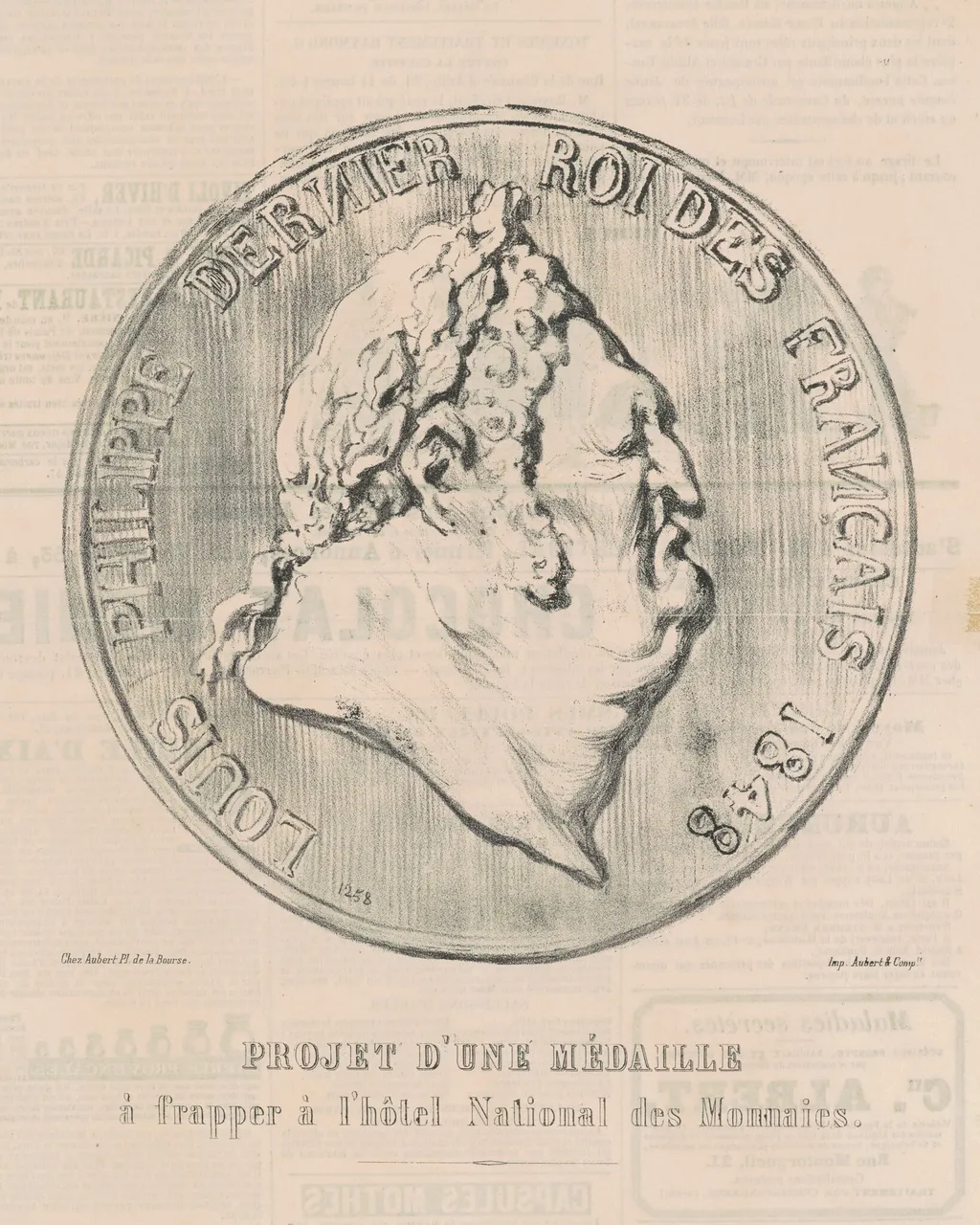
Louis-Philippe, dernier roi des français is an ink print by the Romanticist artist Honoré Daumier. It dates from 1848 and is held in the collection of the National Gallery of Art.
About this work
This lithograph shows a medal with a profile view of Louis-Philippe, the last king of France.
This lithograph shows a medal with a profile view of Louis-Philippe, the last king of France. He's wearing a laurel wreath and there's an inscription on the medal. The inscription says "LOUIS PHILIPPE DERNIER ROI DES FRANÇAIS" and the year 1848.
What's interesting is that the medal highlights Louis-Philippe's features in a simple way. The artist used a few lines to show his face and the laurel wreath. You can learn more about this type of printmaking by looking into the technique: lithography.
Overview
This lithograph by Honoré Daumier presents a stylized medal portrait of Louis-Philippe, the final monarch of France. Rendered in monochrome, the image mimics the form of a commemorative coin or medallion, bearing his profile and the inscription 'LOUIS PHILIPPE DERNIER ROI DES FRANÇAIS' with the year 1848. The work functions as a visual commentary rather than a ceremonial tribute, using the medal format to underscore the abrupt end of his rule.
Subject & Meaning
The portrait captures Louis-Philippe in profile, crowned with a laurel wreath, a classical symbol of victory, yet the inscription declares him the 'last' king, transforming the wreath into an ironic emblem of finality. The inclusion of 1848, the year of his abdication, frames the image as a historical marker. Daumier’s choice to depict the deposed monarch in this formal, numismatic style critiques the monarchy’s pretensions while acknowledging its collapse.
Technique & Style
Daumier employed lithography to achieve sharp, linear clarity with minimal tonal variation. The face is rendered with economical, precise strokes that define features without embellishment, emphasizing the king’s aging visage. The laurel wreath and lettering are cleanly outlined, reinforcing the illusion of a struck medal. The restrained aesthetic mirrors the starkness of the political moment, avoiding sentimentality in favor of sober observation.
History & Provenance
Created shortly after Louis-Philippe’s abdication in February 1848, the print emerged during the upheaval of the February Revolution. It was likely circulated among republican circles as a satirical artifact, capitalizing on public sentiment against the July Monarchy. As a work of political commentary, it was part of Daumier’s broader output for publications like La Caricature, where his prints challenged authority through visual wit.
Context
In 1848, France experienced a wave of revolutionary fervor that toppled monarchies across Europe. Daumier’s lithograph reflects the rapid shift in public perception: the king, once portrayed as the 'Citizen King,' was now framed as a relic. The medal format, traditionally used to honor enduring figures, was repurposed to signify obsolescence, aligning with broader cultural efforts to redefine legitimacy after centuries of dynastic rule.
Legacy
Daumier’s depiction of Louis-Philippe as a final, frozen image on a medal became emblematic of how political change is visually encoded. The work exemplifies lithography’s role in 19th-century political discourse, demonstrating how mass-produced prints could shape public memory. Its enduring power lies in its quiet precision, offering no overt caricature, yet leaving no doubt about the monarchy’s demise.
Own this work as a print
Artist & collection
Artist
Honoré-Victorin Daumier (French: ; 26 February 1808 – 10 or 11 February 1879) was a French painter, sculptor, and printmaker, whose many works offer commentary on the social and political life in France, from the…









 Déjà relevée!
 L'habitué de la boutique de Félix
 Une querelle d'allemand
 André Hercules, Cardinal de Fleury
 Louis XVI, Roi de France
 H Beard Print Collection
 Self-Portrait in the Role of M. Prud'homme
 Allegorical Portrait of Jean-Baptiste Hüet
 Are you not ordering anything?...
 Louis Hector, duc de Villars
 Que Diable Monsieur Ne Bougez donc pas...
- Projet ... Pour désarmer les ennemis de ... Voltaire