Artwork
Dancers Backstage
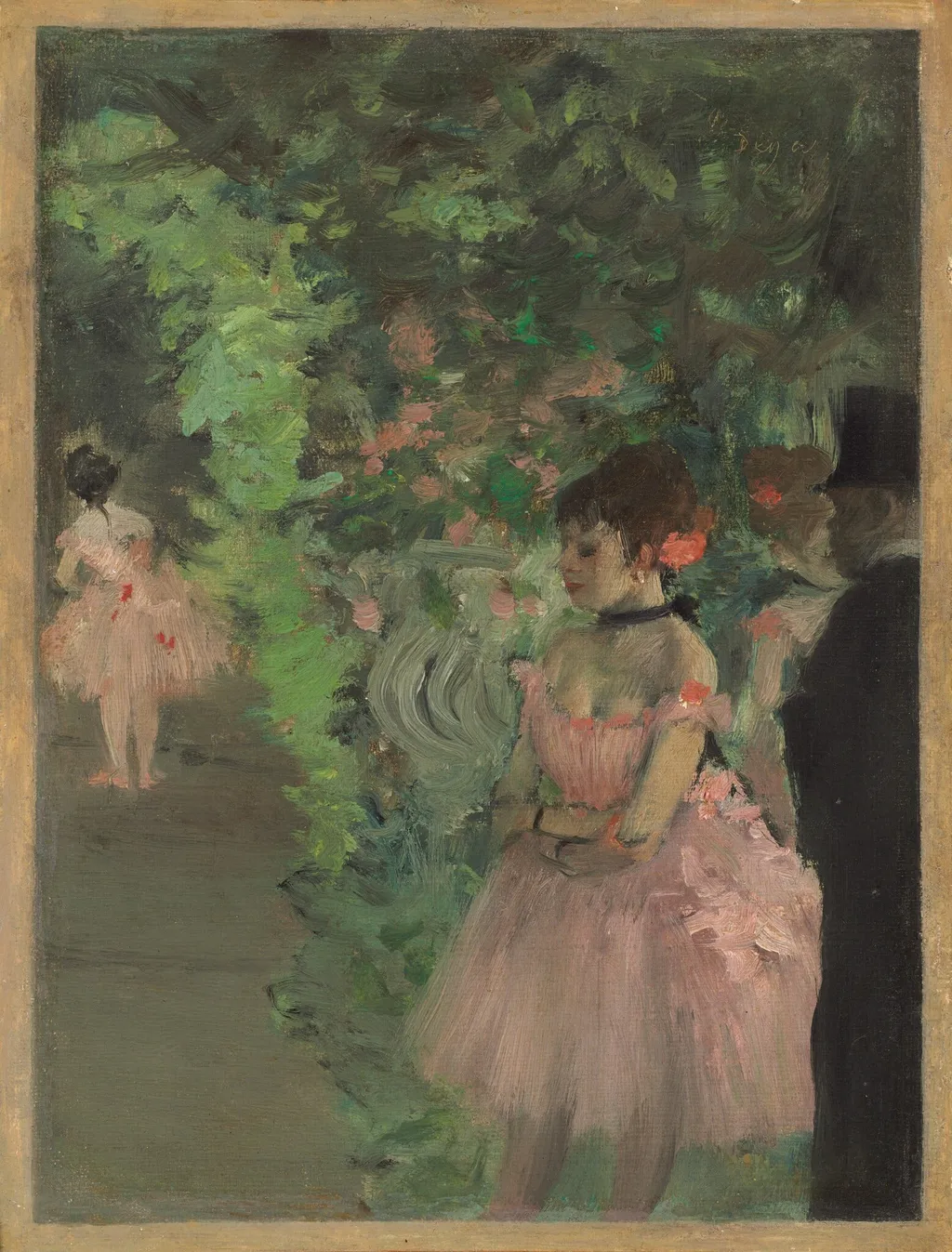
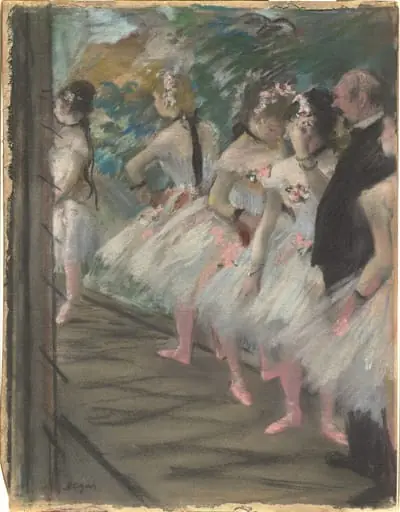
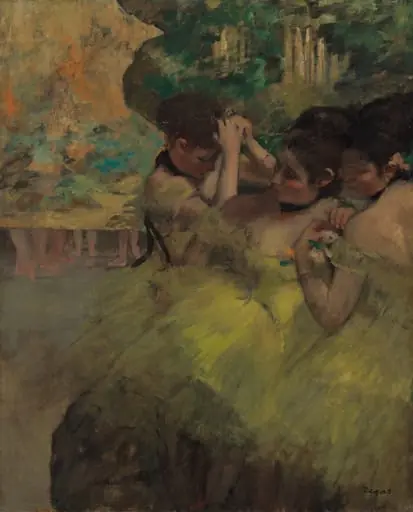
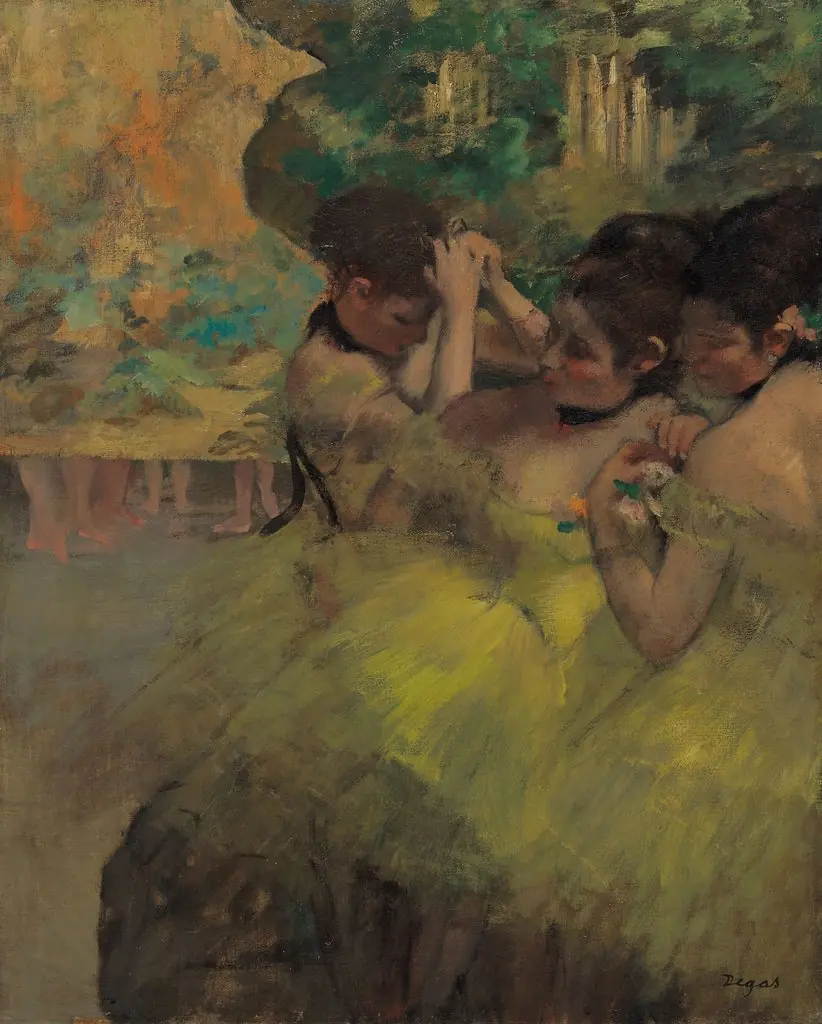
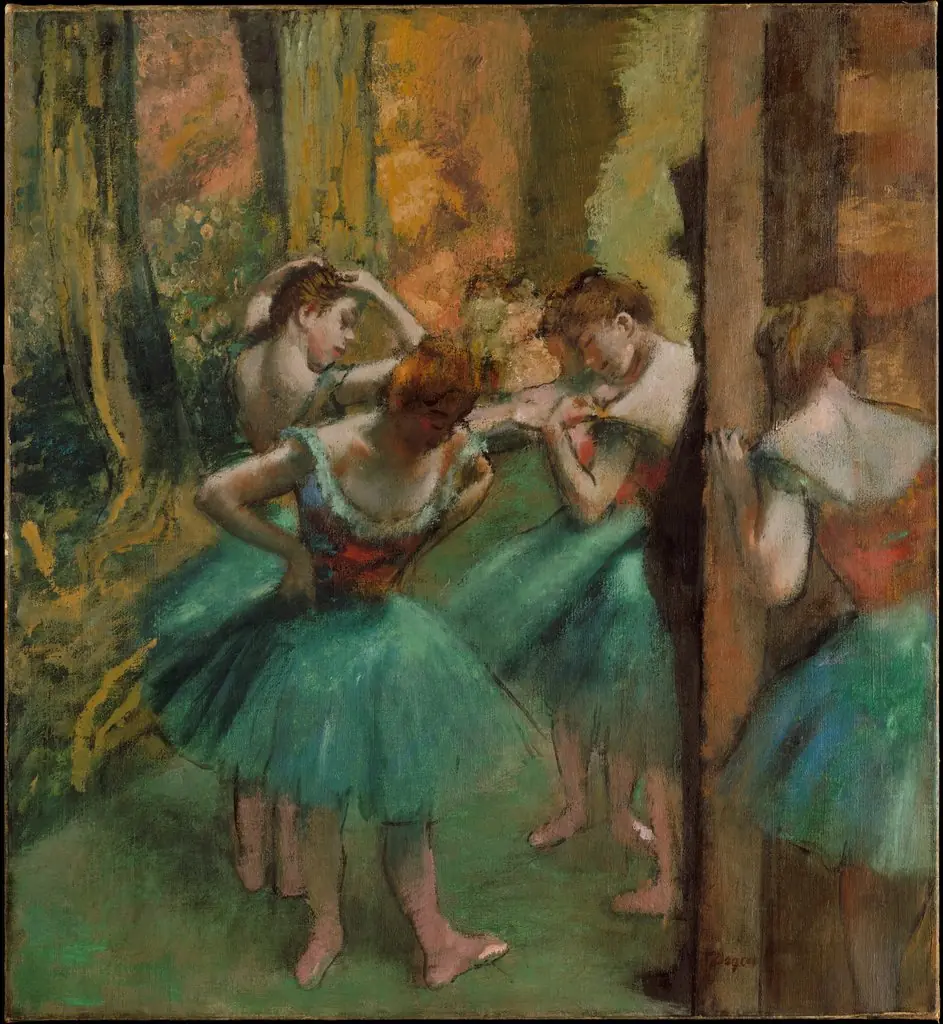
Dancers Backstage is an oil painting by the Impressionist artist Edgar Degas. It dates from 1880 and is held in the collection of the National Gallery of Art.
- Inscription
- Inscribed:upper right: Degas
About this work
Technique & Style
Dancers Backstage is an oil painting on canvas executed by Edgar Degas in 1879.
Dancers Backstage is an oil painting on canvas executed by Edgar Degas in 1879. The work is modest in scale, measuring 24.2 cm in height by 18.8 cm in width. Classified as a genre scene, it belongs to Degas's sustained engagement with dancers as a subject, rendered here in oil rather than his more familiar pastel medium.
A Reid & Lefèvre label on the reverse of the canvas carries a date of 1882, suggesting a later dating was once attached to the work, though the canonical date remains 1879.
History & Provenance
The painting was created in 1879 by Edgar Degas, as recorded in the work’s provenance chain. It first entered the market through Théodore Duret, who sold it at the Galerie George Petit in Paris on 19 March 1894. The buyer was Durand-Ruel, who transferred the work to its New York branch on 27 February 1895 and later sold it on 31 December 1928 to Alex Reid & Lefèvre.
By April 1929 the painting had passed to D.W.T. Cargill, though no record of his sale appears in his estate auction in 1947. It was subsequently handled by the Carroll Carstairs Gallery in New York and acquired by Ailsa Mellon Bruce on 3 June 1948. After her death in 1969, the painting was bequeathed to the National Gallery of Art, Washington, D.C., in 1970.
Edgar Degas's Dancers Backstage is held in the collection of the National Gallery of Art in Washington, D.C., where it was accessioned in 1970 following a bequest by Ailsa Mellon Bruce. Prior to this final transfer, the work was sold to Bruce by the Carroll Carstairs Gallery in New York on June 3, 1948. The painting's provenance traces back through several prominent dealers and collectors, including Alex Reid & Lefèvre, D.W.T. Cargill, and the Durand-Ruel galleries in Paris and New York, before originating with Théodore Duret in 1879. The provided sources detail this ownership history but do not list specific exhibition records for the work.
Context
Critical reception of Degas's Dancers Backstage has long emphasized its dynamic composition and intimate portrayal of rehearsal space, reflecting broader scholarly interest in the artist's exploration of movement and performance. The work, painted in 1879, exemplifies Degas's fascination with the theatrical world, situating it within his broader oeuvre of ballet and dance scenes that challenged academic conventions by focusing on behind-the-scenes moments rather than staged performances. Its inclusion in major institutional collections, including the National Gallery of Art, underscores its significance in the narrative of Impressionist innovation and the redefinition of modern subjectivity in late 19th-century art.
Scholarship frequently contextualizes Dancers Backstage alongside Degas's broader experiments with asymmetrical framing and cropped compositions, techniques that prefigured modernist approaches to visual perception. The painting's provenance, tracing from Théodore Duret through Durand-Ruel to Ailsa Mellon Bruce and finally to the National Gallery of Art, illustrates the transatlantic circulation of Impressionist works and the role of private collectors in shaping public museum holdings. This trajectory also reveals the painting's enduring relevance in both private and public spheres, influencing later interpretations of Degas's work through evolving curatorial and academic lenses.
Overview
Created in 1880, this oil on canvas by Edgar Degas captures a quiet moment behind the stage of a ballet rehearsal. The composition centers on two female figures illuminated against a shadowy backdrop that suggests foliage. Degas, who frequently returned to the world of dance, presents the scene as a candid glimpse rather than a formal performance, emphasizing the everyday reality of the performers.
Subject & Meaning
The work portrays a dancer in a pink skirt holding a fan in the foreground, while a second figure in a white tutu with red dots stands turned away in the background. The contrast between the active pose and the turned figure suggests a pause in preparation, inviting viewers to consider the labor and intimacy of rehearsal life beyond the public spectacle.
Own this work as a print
Artist & collection

Artist
Born Hilaire-Germain-Edgar De Gas on 19 July 1834 in Paris, Edgar Degas came from an affluent banking family with aristocratic roots and spent his childhood among the cultivated circles of the French capital.