Artwork
Two Studies of an Indian from Calcutta, Seated and Standing
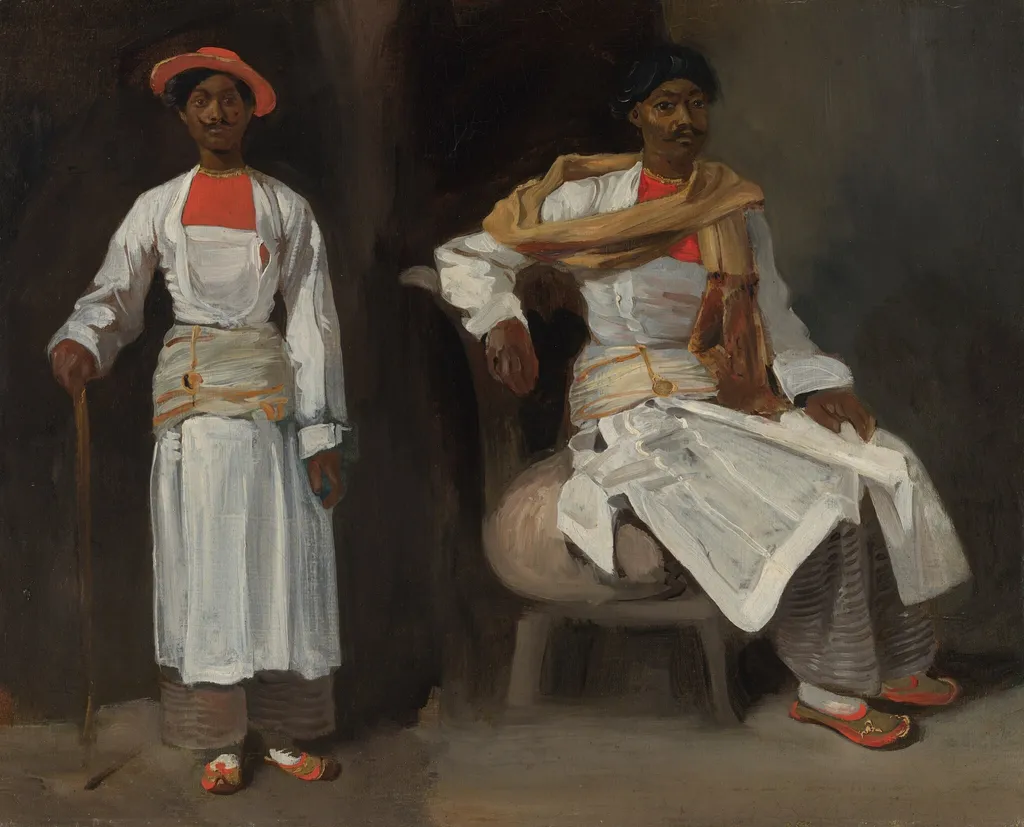
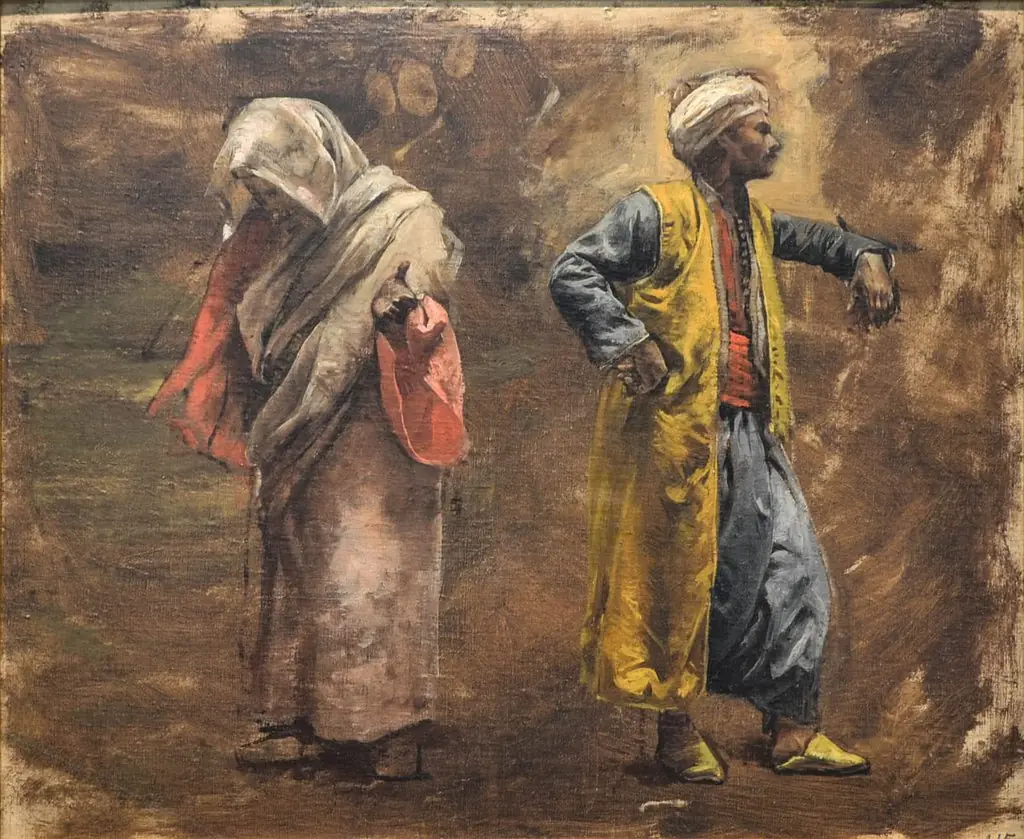
Two Studies of an Indian from Calcutta, Seated and Standing is an oil painting by the Orientalist artist Eugène Delacroix. It dates from 1824 and is held in the collection of the National Gallery of Art.
About this work
Technique & Style
The composition presents two distinct figure studies of a man from Calcutta, capturing both seated and standing poses within a single frame.
Executed in 1823, this work is an oil painting on canvas. The physical support bears specific marks of the artist's studio practice, including a red wax seal stamped with the initials "ED" located on the center of the middle stretcher bar. A torn label affixed to the stretcher further documents its history, partially preserving the name of a former owner.
The composition presents two distinct figure studies of a man from Calcutta, capturing both seated and standing poses within a single frame. The painting measures 37.5 cm in height and 45.7 cm in width.
History & Provenance
Two Studies of an Indian from Calcutta, Seated and Standing was painted by Eugène Delacroix in 1823, executed in oil on canvas.
The work remained with the artist until his estate was dispersed at the Hôtel Drouot in Paris from 17 to 19 February 1864 (lot 186), passing through Cadart & Luquet to Detrimont. Henri Rouart acquired it in February 1844, and it reappeared at the Galerie Manzi-Joyant sale in Paris on 9–11 December 1912 (first day, lot 190). Lucien Henraux then owned the painting, which descended through his family before being sold in 1937 through Paul Rosenberg in Paris.
By 1938, and continuing through at least 1957, it belonged to Erich Maria Remarque at Porto Ronco, Ticino, Switzerland, who lent it to exhibitions and museums during that period. Sam Salz in New York handled the work before Paul Mellon purchased it in October 1960. Mellon bequeathed it in 1999 to the National Gallery of Art, with a life interest retained by Mrs. Mellon that was released in 2006.
Since 1999 the painting has been held by the National Gallery of Art, Washington, D.C., accessioned as 1999.1.1.
It was first acquired by the artist’s estate and sold at Hôtel Drouot, Paris, in February 1864. By 1844 it had entered the collection of Henri Rouart, whose estate sale in December 1912 transferred it to Lucien Henraux. After remaining in his family, it was sold in 1937 to P. Rosenberg and by 1938 belonged to Erich Maria Remarque.
The work was purchased in October 1960 by Paul Mellon and bequeathed to the National Gallery of Art in 1999.
Overview
Eugène Delacroix created the oil painting Two Studies of an Indian from Calcutta, Seated and Standing circa 1824. The canvas presents a pair of dark‑skinned men in traditional Indian attire, one standing with a red hat and cane, the other seated with a tan scarf. A deep, muted background isolates the figures, emphasizing their clothing and posture.
Subject & Meaning
The work juxtaposes two poses of the same individual, offering a study of posture and costume rather than a narrative scene. By portraying both seated and standing stances, Delacroix highlights variations in bearing and the visual interest of Indian dress, reflecting a European curiosity about exotic peoples.
Context
During the 1820s, European art was increasingly fascinated by the cultures of Asia and the Middle East, a trend labeled Orientalism. Delacroix’s study aligns with this movement, offering a European artist’s visual investigation of Indian dress and demeanor, a subject rarely seen in French salons at the time.
Own this work as a print
Artist & collection
Artist
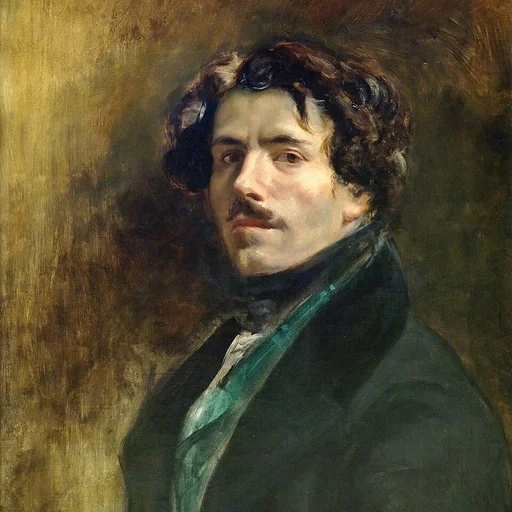
Ferdinand Victor Eugène Delacroix ( DEL-ə-krwah, -KRWAH; French:; 26 April 1798 – 13 August 1863) was a French Romantic artist who was regarded as the leader of the French Romantic school.