Artwork
Apollo in the Forge of Vulcan
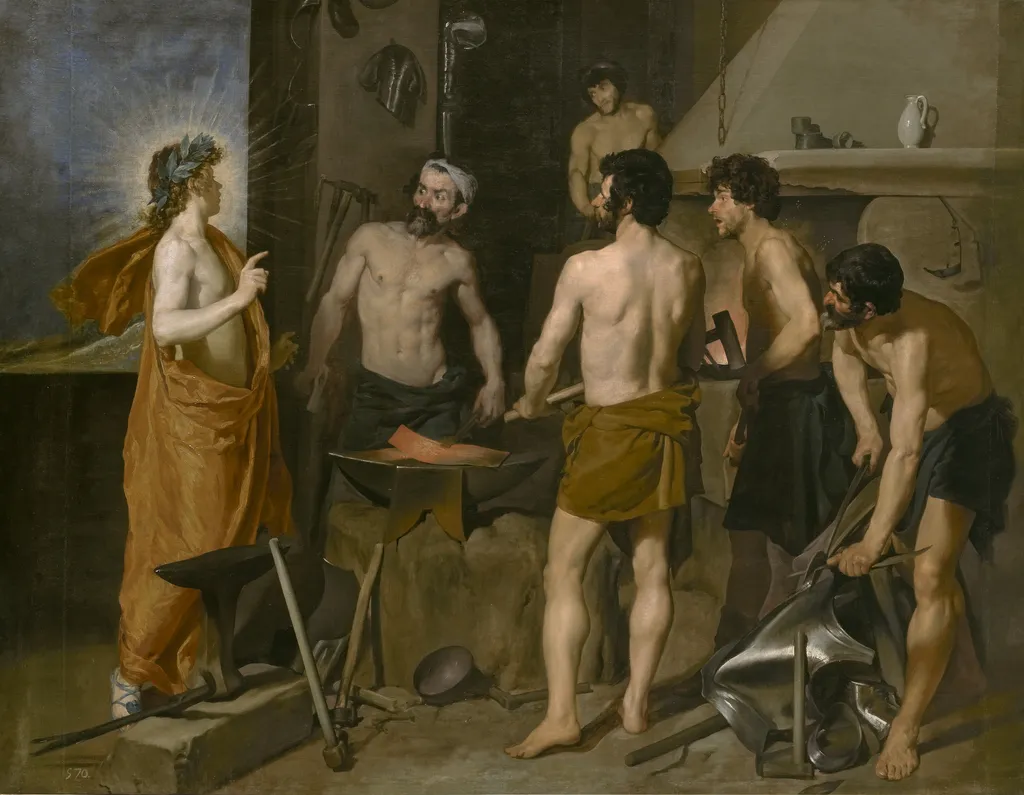
Apollo in the Forge of Vulcan is an oil painting by the Early Baroque Italian artist Diego Velázquez. It dates from 1630 and is held in the collection of the Museo del Prado.
About this work
Subject & Meaning
This humanization of mythological figures contrasts the delicate, marble-like physique of Apollo with the strained, muscular bodies of the smiths.
The painting illustrates a specific episode from Ovid's Metamorphoses where Apollo, identified by his laurel crown and radiant aura, visits Vulcan's forge to reveal that Vulcan's wife, Venus, is committing adultery with Mars. Unlike traditional depictions showing the entrapment of the lovers, Velázquez captures the precise moment of revelation, focusing on Vulcan's shock and the cessation of his labor as he forges armor for Mars. The god is portrayed not as an idealized deity but as a common blacksmith surrounded by cyclopean assistants who appear as ordinary laborers reacting with surprise.
This humanization of mythological figures contrasts the delicate, marble-like physique of Apollo with the strained, muscular bodies of the smiths. Interpretations of the work vary, ranging from a simple narrative of betrayal to an allegorical comparison between the major arts, represented by Apollo, and the mechanical arts, embodied by Vulcan. Some scholars suggest a thematic pairing with Velázquez's Joseph's Tunic, linking both works through themes of deception and the power of speech over material action.
Technique & Style
Executed in oil on canvas, this large-scale work measures 223 by 290 cm. Velázquez employed a palette characterized by subtle grays, greens, and cold mauves, alongside striking oranges and earth tones. His brushwork is noted for being lighter and freer than in previous periods, achieving a photographic realism in the depiction of metallic armor, anvils, and red-hot iron. The composition utilizes a frieze-like arrangement to create depth, often described as "space sandwiching," where figures are layered to enhance spatial perception.
Technical analysis reveals that some pigments have degraded over time; notably, Apollo's laurel wreath, originally green due to a mixture including yellow lake, has shifted to blue as the unstable lake pigment faded. Conversely, the flesh tones, composed of yellow ochre, vermilion, and azurite, have remained stable. The artist modeled the nude figures by applying diluted pigments over a base layer to create volume and a sense of fleshly softness through chiaroscuro, moving beyond strict tenebrism toward a more diffuse light.
History & Provenance
Diego Velázquez painted Apollo in the Forge of Vulcan in Rome during 1630, following his first trip to Italy. Executed without a royal commission, the work was created at the initiative of the artist, reportedly at the request of Peter Paul Rubens, within the residence of the Spanish ambassador to the Papal States. Velázquez retained ownership of the canvas until 1634, when he sold it to King Philip IV of Spain, alongside his companion piece Joseph's Tunic and other works, to decorate the new Buen Retiro Palace.
The painting entered the collection of the Museo del Prado in Madrid on August 5, 1819. Technical analysis suggests that lateral strips were added to the canvas during its creation or shortly thereafter, potentially altering its original dimensions before its transfer from the Buen Retiro to the Royal Palace.
The painting is held in the Museo del Prado, Madrid, with accession number P00418.
It entered the Prado’s collection on 5 August 1819.
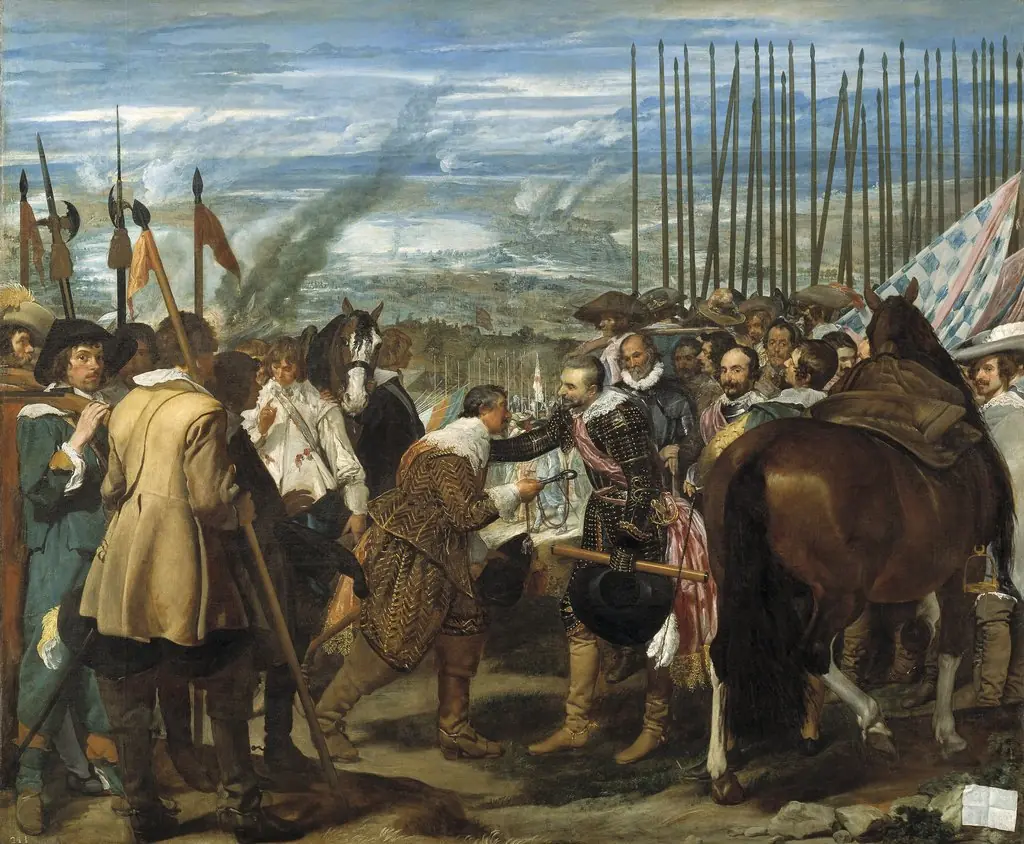
The work has been exhibited in major Velázquez presentations, including the 2011–2012 exhibition “Velázquez and The Surrender of Breda: The Making of a Masterpiece” at The Metropolitan Museum of Art, New York.
Context
Scholars consistently rank Apollo in the Forge of Vulcan among Velázquez’s signal achievements from his first Italian sojourn, noting how the painting crystallizes his assimilation of classical form and contemporary practice. Commentators praise the unified, natural interaction of the figures and the work’s photographic rendering of metals and tools, which aligns with Velázquez’s Sevillian bodegón realism rather than idealized mythological convention. Technical studies at the Museo del Prado confirm that the artist modulated flesh tones through layered, uneven glazes to model volume and tactility, while the orange toga of Apollo signals the influence of Venetian colorism absorbed in Italy.
Interpretations of the subject remain contested. Some read the scene as a humanized myth in which Apollo’s revelation disrupts Vulcan’s labor, emphasizing the primacy of speech over action; others propose a broader allegory linking the arts of light and fire. The painting’s early inclusion in the Buen Retiro’s decorative program, followed by its transfer to the Prado in 1819, secured its canonical place in Spanish royal collecting and later national museum display.
Legacy
Created without a royal commission during Velázquez's first Italian journey, Apollo in the Forge of Vulcan was painted at the request of Peter Paul Rubens and brought back to Spain in 1630. The work entered the Spanish royal collection in 1634 when the artist sold it to the crown for the decoration of the Buen Retiro Palace. It has been consistently cited as one of the most significant compositions from Velázquez's early career, particularly noted for its unified and natural interaction of figures.
Critics regard the painting as a masterpiece that successfully merges classical themes with a realistic, humanized depiction of mythological characters. The work remains a central piece in the Museo del Prado, where it has been housed since 1819, serving as a key example of the artist's transition toward a more sophisticated handling of the nude and light.
Overview
Diego de Velázquez’s oil painting titled Apollo in the Forge of Vulcan was executed around 1630, shortly after his first journey to Italy in 1629. The work, often linked with his contemporaneous piece Joseph’s Tunic, demonstrates a mature handling of narrative composition and entered the Spanish royal collection before being transferred to the Museo del Prado in 1819.

Own this work as a print
Artist & collection
Artist
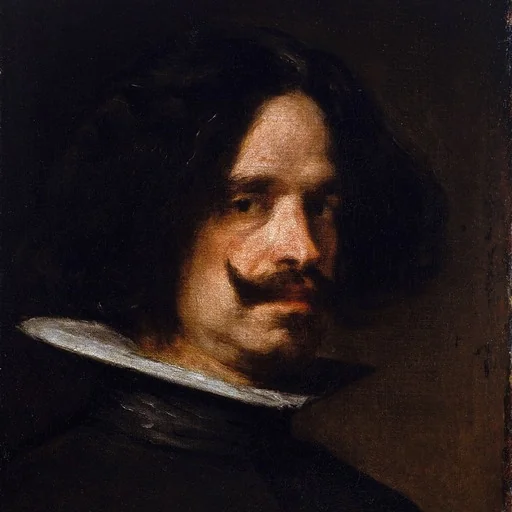
Diego Rodríguez de Silva y Velázquez was a Spanish Baroque painter, the leading artist in the court of King Philip IV of Spain and Portugal, and of the Spanish Golden Age.